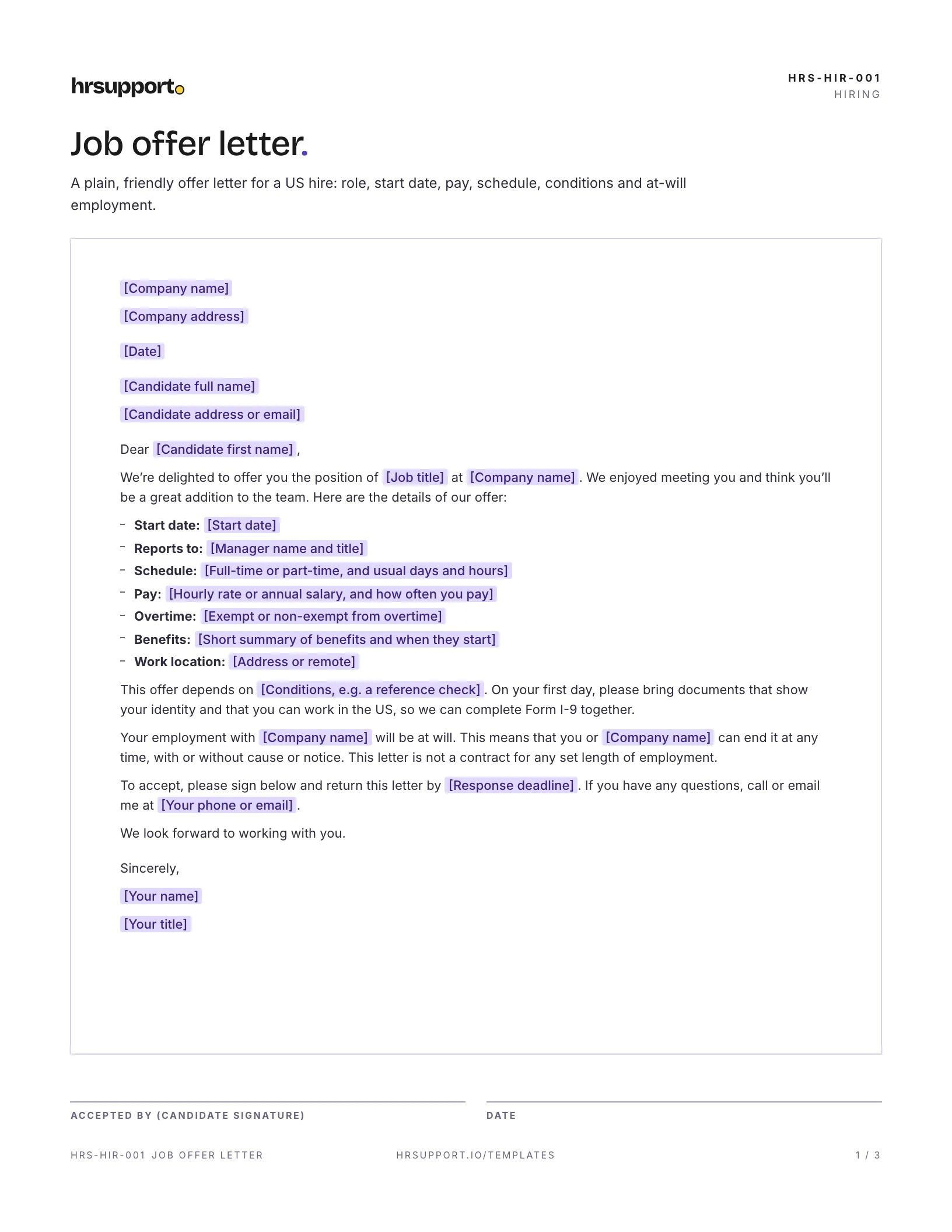
 Offer Letter TemplateRole, start date, pay, schedule and at-will wording, ready to edit in Word.Free
 Word
Word PDF
PDFWrite down what the job is, what it pays and what it takes, before you advertise. Then use the same description to hire, train and review.
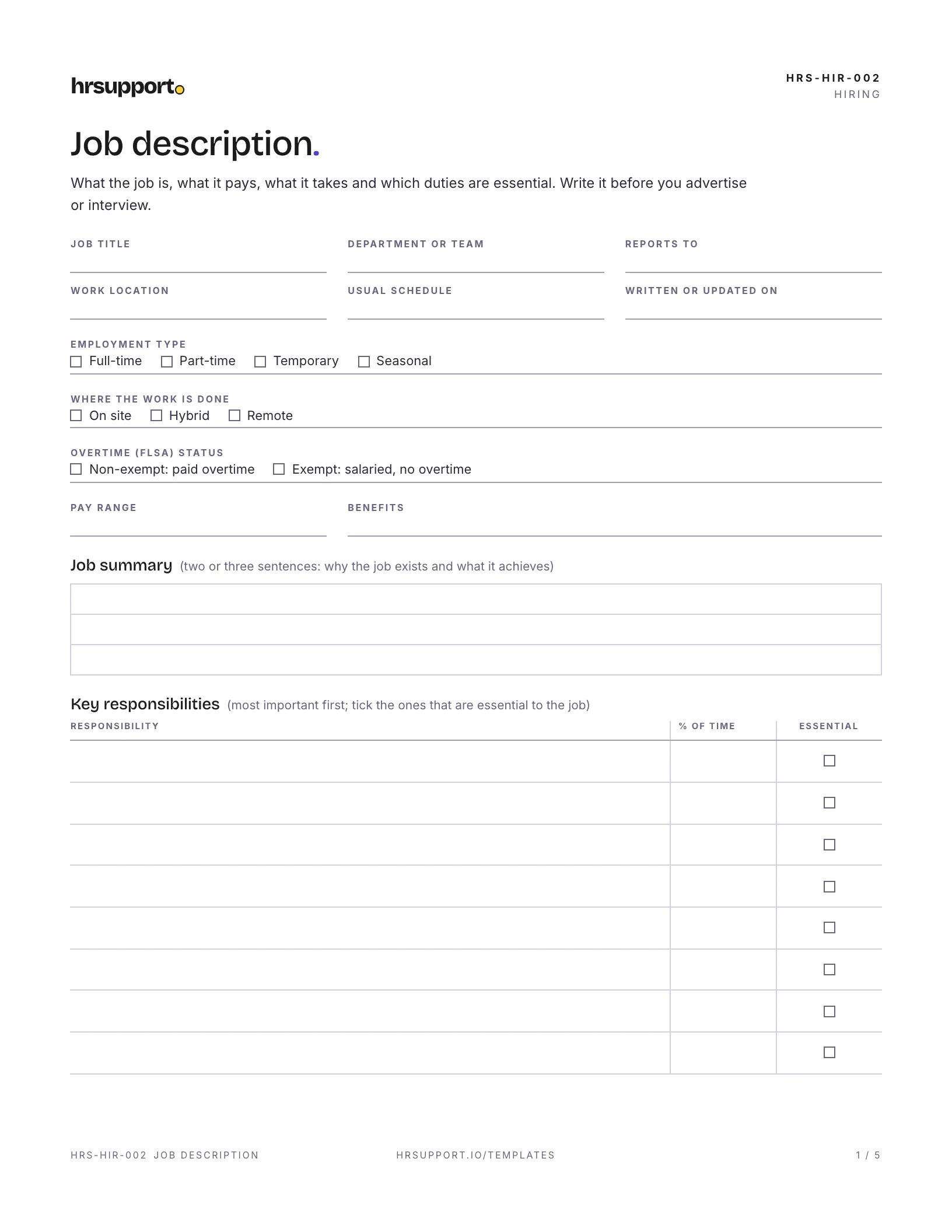
This free job description template helps US small businesses write down what a job is before they hire for it. It covers the job’s details, overtime status, pay range, a short summary, the key duties with the share of time each takes and which are essential, and qualifications. It also has the physical requirements, working conditions and an equal opportunity statement. Download it as a Word file to type into, or as a PDF to print.
A five-page PDF, sized for US Letter paper, and an editable Word file:
Page one has the job title, department, who the job reports to, location, schedule and the date it was written. It also has tick boxes for employment type, where the work is done and overtime status, plus the pay range and benefits. Then come a ruled box for the job summary and a key responsibilities table with “% of time” and “Essential” columns. Page two covers qualifications (required or preferred), physical requirements with how often each applies, and working conditions. It ends with an equal opportunity statement you fill in and sign-off lines.
The example in the download is for a landscape crew lead at a fictional landscaping company in Washington State. It’s a full-time, on-site, non-exempt job with an hourly pay range and a short list of benefits. Six duties add up to 100% of the time, and five of them are ticked as essential. The physical requirements give real weights and frequencies, such as lifting up to 50 lb often. Working conditions cover weather, noise and early starts. It was written and approved before the job was posted, so the employee line is still blank.
The Word version has the same sections as the PDF. Type into the blank fields and table cells, tick the boxes, and replace the highlighted [placeholders] in the equal opportunity statement with your business name and contact. Add or delete rows in the responsibilities table to fit the job, and save a copy for each role. Keep the master blank, so every new job description starts from the same structure and your job descriptions stay consistent across the business.
Some states require a pay range in job postings. For example, California Labor Code section 432.3 requires employers with 15 or more employees to include the pay scale in any job posting. Washington’s RCW 49.58.110 requires the wage scale or salary range and a general description of benefits from employers with 15 or more employees. Colorado has similar job posting rules. Check your state and city before you post.
Under the ADA, the EEOC considers your judgment and a written job description prepared before advertising or interviewing as evidence of a job’s essential functions. It also looks at how much time is spent on each one (29 CFR 1630.2(n)). Mark the essential duties honestly, and describe physical requirements as what the job needs done. Job ads must not show a preference for, or discourage, applicants because of a protected trait, such as asking for “recent college graduates” (EEOC).
Get advice before you call a job exempt from overtime if you’re unsure the duties and salary qualify (Department of Labor). Do the same before you list a requirement that could screen out people with disabilities or older workers.
Not sure what your state requires in a job posting? That’s what hrsupport.io is for: HR answers for your state, with the law behind every answer.
Ready to use it? It’s free, and comes with a filled-in example.
Template questions
The job title, department, who the job reports to, location and schedule, and whether it is full-time or part-time. Add the overtime status (exempt or non-exempt), the pay range and benefits, and a short summary. Then list the key duties with the share of time each takes and which are essential. Finish with qualifications, physical requirements, working conditions and an equal opportunity statement.
In some states, yes, in the job posting. California and Washington require employers with 15 or more employees to include a pay scale or wage range in job postings, and Washington also requires a general description of benefits. Colorado has similar job posting rules. Even where it isn't required, putting the range in the job description keeps your ad and your offer consistent.
The basic duties a person in the job must be able to perform, with or without reasonable accommodation. Under the ADA, which covers employers with 15 or more employees, a written job description prepared before you advertise or interview is evidence of which functions are essential. So is the amount of time spent on each duty, which is why this template has a % of time column.
It helps, because it forces the decision before you make an offer. But the label doesn't make it so. The Department of Labor says job titles don't determine exempt status; the employee's actual duties and salary must meet all the requirements of its rules. If you're unsure, get advice before you treat a job as exempt from overtime.
A job description is your internal record of the job, its duties, requirements and pay. A job posting is the ad you publish to attract candidates. Write the description first, then build the posting from it. That way the duties, requirements and pay range in your ad match the job you're actually hiring for.
Start with the work, not the title. List what the person will spend their time on, most important first, and estimate the share of time for each. Mark which duties are essential. Then add only the qualifications the job really needs, describe the physical demands honestly, and add the pay range. Keep the language plain and avoid wording that discourages any group from applying.
Free HR templates
Offer Letter TemplateRole, start date, pay, schedule and at-will wording, ready to edit in Word.FreeWordPDF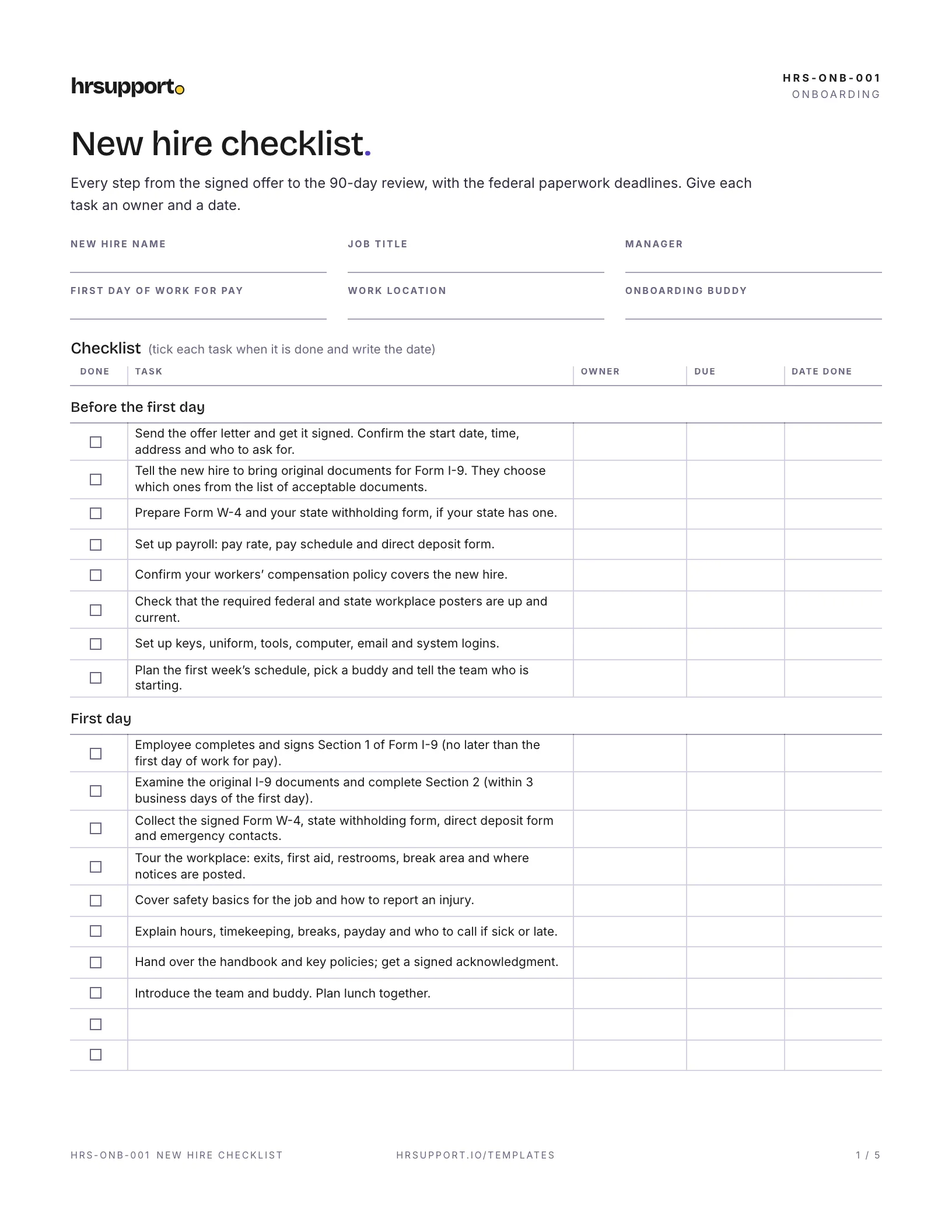 New Hire ChecklistBefore day one to the 90-day review, with the I-9, W-4 and state reporting deadlines.FreeWordPDF
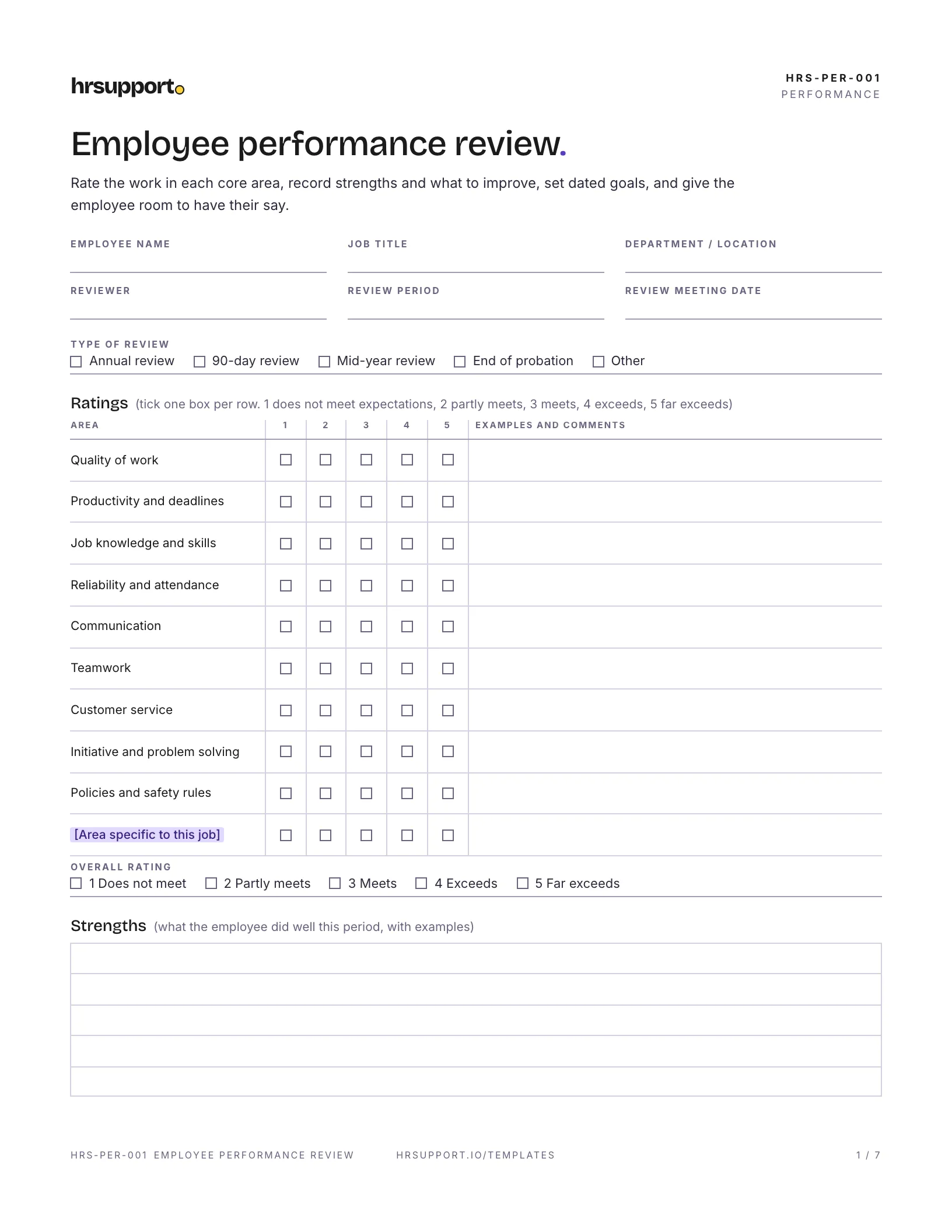 Performance Review TemplateAnnual or 90-day review with 1–5 ratings, goals, self-assessment and signatures.FreeWordPDF
Join the waitlist for early access and early-access pricing. It takes ten seconds.