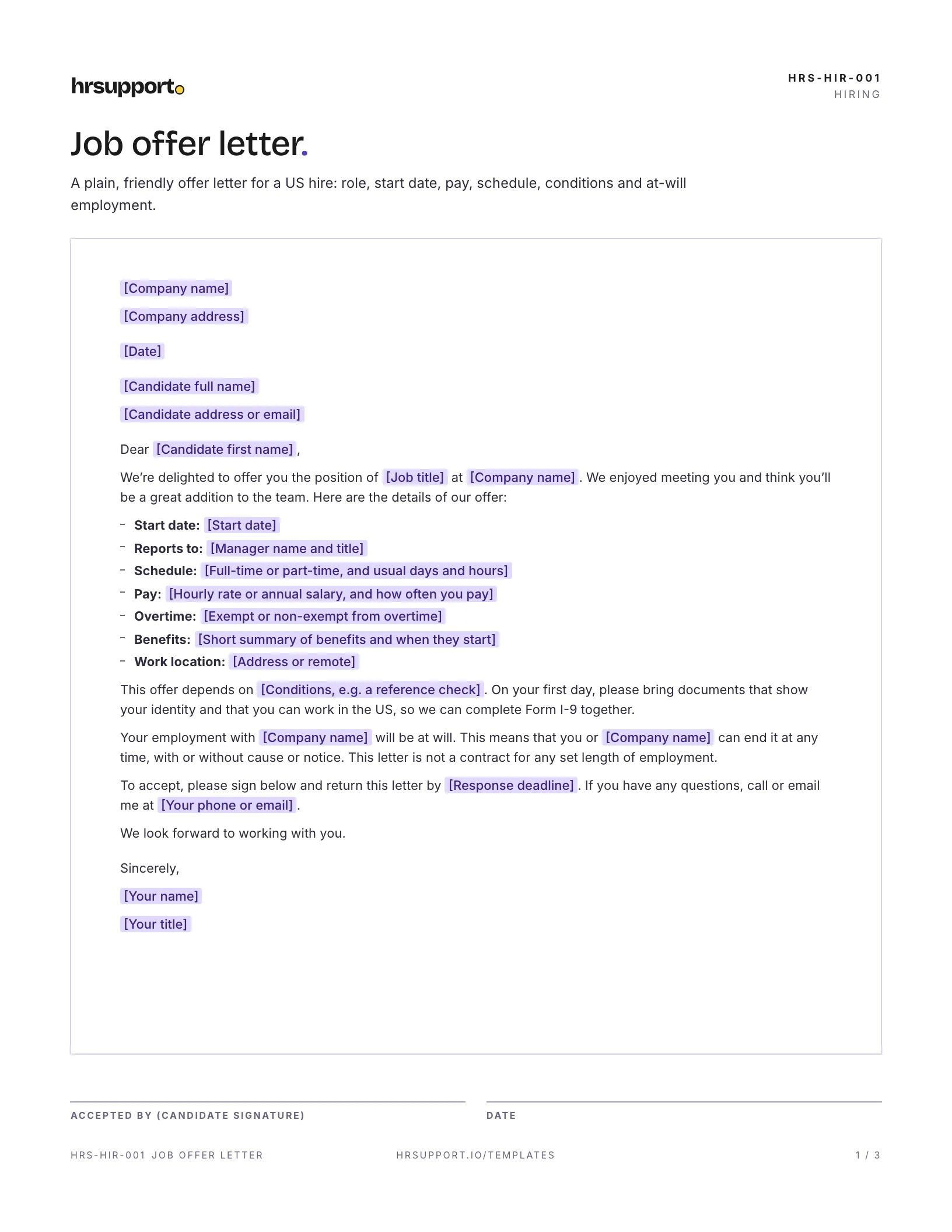
 Offer Letter TemplateRole, start date, pay, schedule and at-will wording, ready to edit in Word.Free
 Word
Word PDF
PDFGet a new employee from signed offer to fully up to speed, without missing a form or a deadline. Every task has an owner and a date.
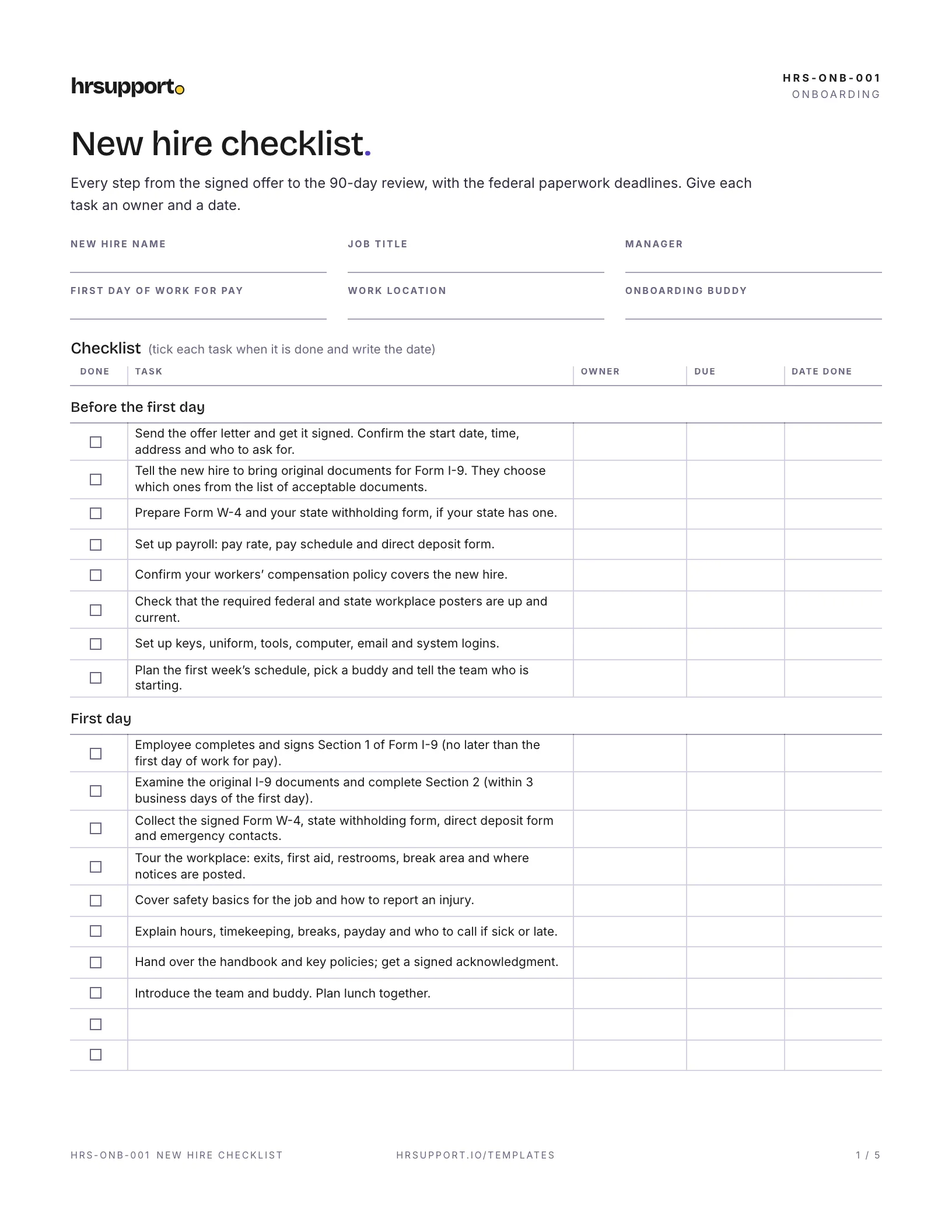
This free new hire checklist is an onboarding checklist for US small businesses. It takes a new employee from signed offer letter to their 90-day review, with every task in order, an owner and a due date for each, and the federal paperwork deadlines printed next to the tasks they apply to. Print it, or edit the Word version to add the tasks your jobs need.
A five-page PDF, sized for US Letter paper, and an editable Word file:
Page one has fields for the new hire, job title, manager, first day of work for pay, location and onboarding buddy. Then come the tasks for before the first day and for the first day. Page two covers the first week and the first 30, 60 and 90 days. It also has blank rows for job-specific tasks, a notes box, and lines for the manager and employee to sign off.
The example in the download is for a front desk coordinator starting on a Monday at a fictional dental office in Vermont. The owner and office manager split the tasks before the first day. Section 2 of the I-9 is done on the first day, ahead of the Thursday deadline. The new hire report goes in well within Vermont’s 10 days. E-Verify is marked “not used”, because the practice isn’t required to use it. Two job-specific tasks are added in the blank rows, and the notes record a schedule change agreed at the 30-day check-in.
These are the federal rules every US employer needs on their onboarding checklist:
People search for this under different names: employee onboarding template, new employee onboarding checklist, new employee orientation checklist. They overlap. An orientation checklist usually covers only the first day, while an onboarding template runs from the offer to the end of the first few months. This template does both. Use the first-day section on its own for orientation, and the rest for onboarding.
Get advice before onboarding if you’re hiring in a new state for the first time or bringing on a remote employee in another state. The same goes if the new hire needs visa sponsorship, or you’re unsure whether the role is exempt from overtime. Each changes which forms, posters and deadlines apply.
Not sure what your state requires for a new hire? That’s what hrsupport.io is for: HR answers for your state, with the law behind every answer.
Ready to use it? It’s free, and comes with a filled-in example.
Template questions
The paperwork (Form I-9, Form W-4, any state withholding form, direct deposit and emergency contacts), payroll and equipment set-up, the state new hire report, and the first-day basics like a tour, safety and key policies. A good checklist also plans the first week of training and check-ins at 30, 60 and 90 days, and gives every task an owner and a due date.
At the federal level, the employee completes Section 1 of Form I-9 and a Form W-4. Many states also have their own withholding certificate, for example California's DE 4. Most employers also collect a direct deposit form, emergency contacts and a signed handbook acknowledgment. As the employer, you complete Section 2 of the I-9 and report the hire to your state.
The employee must complete Section 1 no later than their first day of work for pay, and can do it any time after accepting the offer. You must examine their documents and complete Section 2 within 3 business days of that first day. USCIS gives the example of an employee who starts on Monday; Section 2 is due by Thursday.
Federal law requires employers to report new and rehired employees to the state where they work within 20 days of hire. Some states set a shorter deadline, for example 10 days in Vermont and 14 days in Massachusetts. Check your state's new hire reporting website for how to report.
For most employers it is voluntary. It is required for federal contractors whose contracts include the E-Verify clause, and some states require it, for example as a condition of a business license. If you use E-Verify, you must create the case no later than the third business day after the employee starts work for pay. Everyone still completes Form I-9.
Orientation is usually the first day or two, covering paperwork, a tour, safety and policies. Onboarding is the whole process of getting someone settled and productive, which often runs for the first 90 days. This checklist covers both, so the first-day section works as a new employee orientation checklist on its own.
Free HR templates
Offer Letter TemplateRole, start date, pay, schedule and at-will wording, ready to edit in Word.FreeWordPDF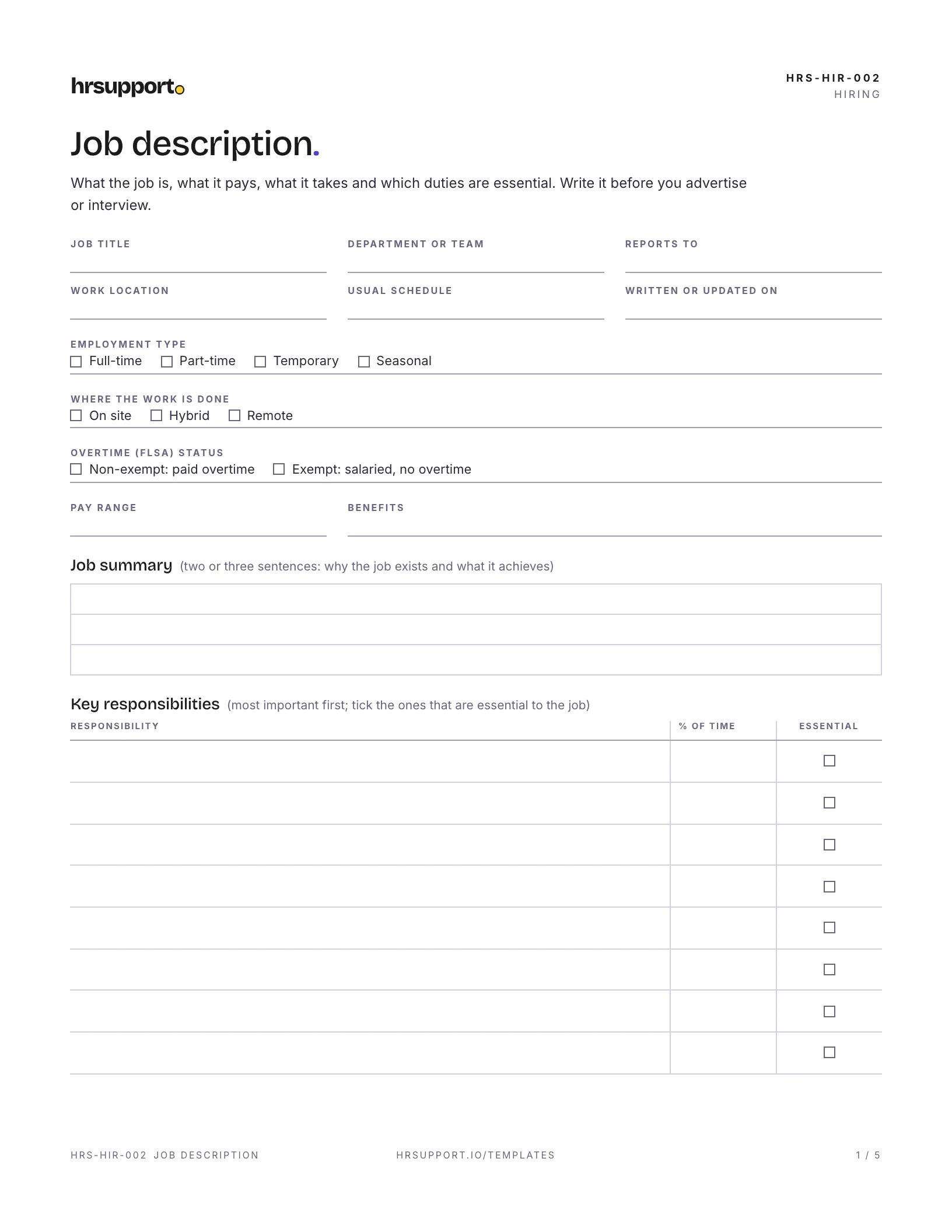 Job Description TemplateDuties, essential functions, FLSA status, pay range, qualifications and an EEO statement.FreeWordPDF
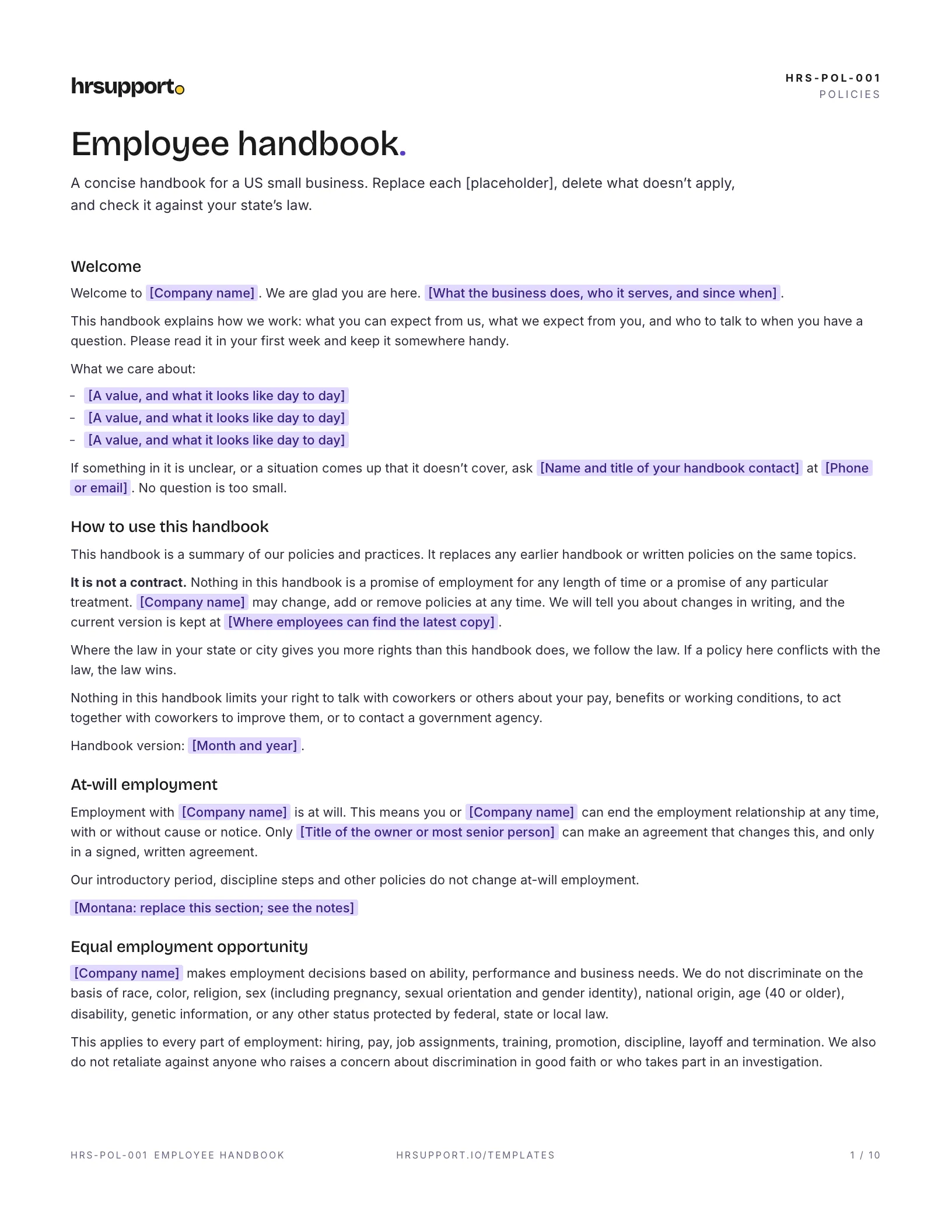 Employee Handbook TemplateTwenty-nine short policies and an acknowledgment page, ready to fill in.FreeWordPDF
Join the waitlist for early access and early-access pricing. It takes ten seconds.