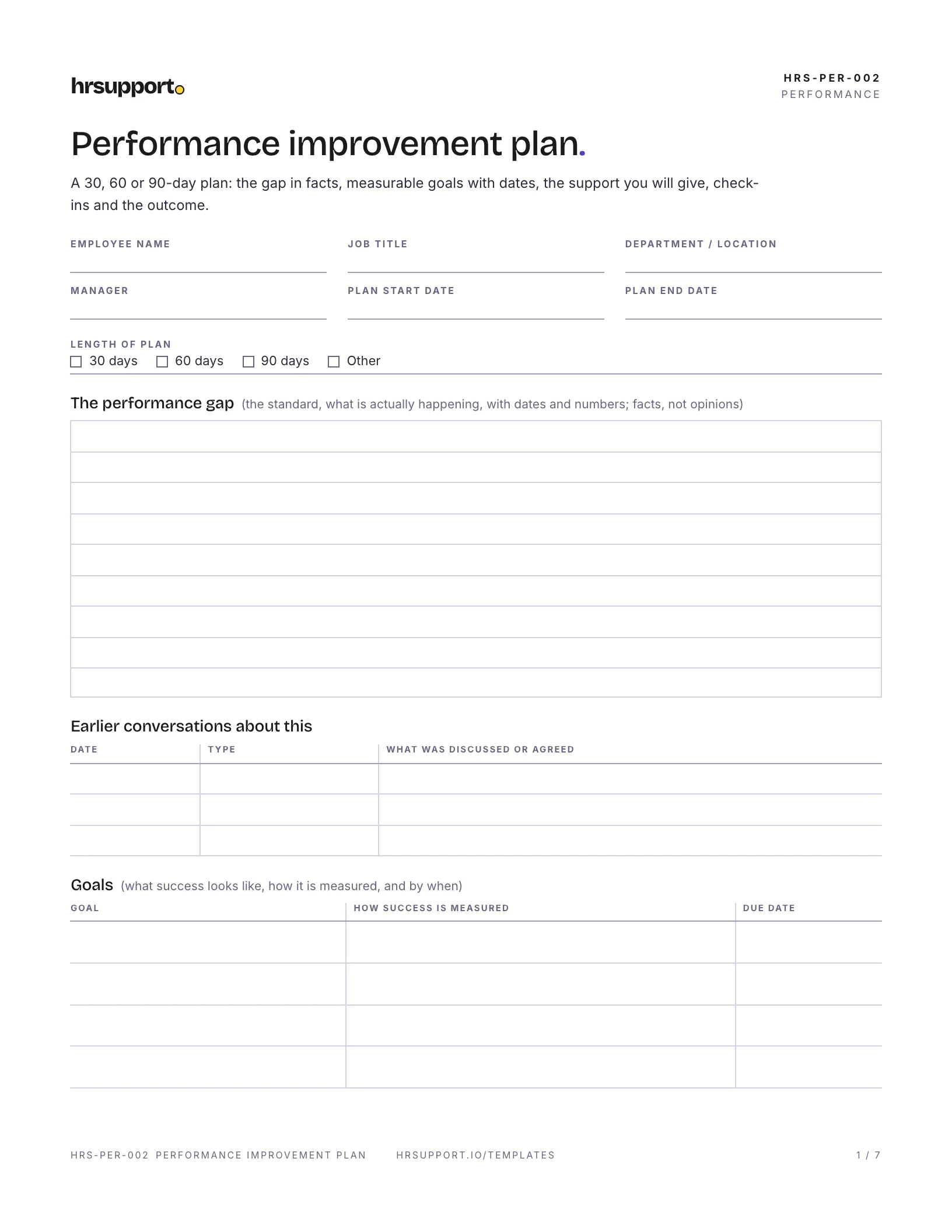
 Performance Improvement Plan Template30/60/90-day PIP with measurable goals, support, check-ins and an outcome page.Free
 Word
Word PDF
PDFA practical annual or 90-day review. Rate the work on a simple scale, write down strengths and goals, and let the employee have their say.
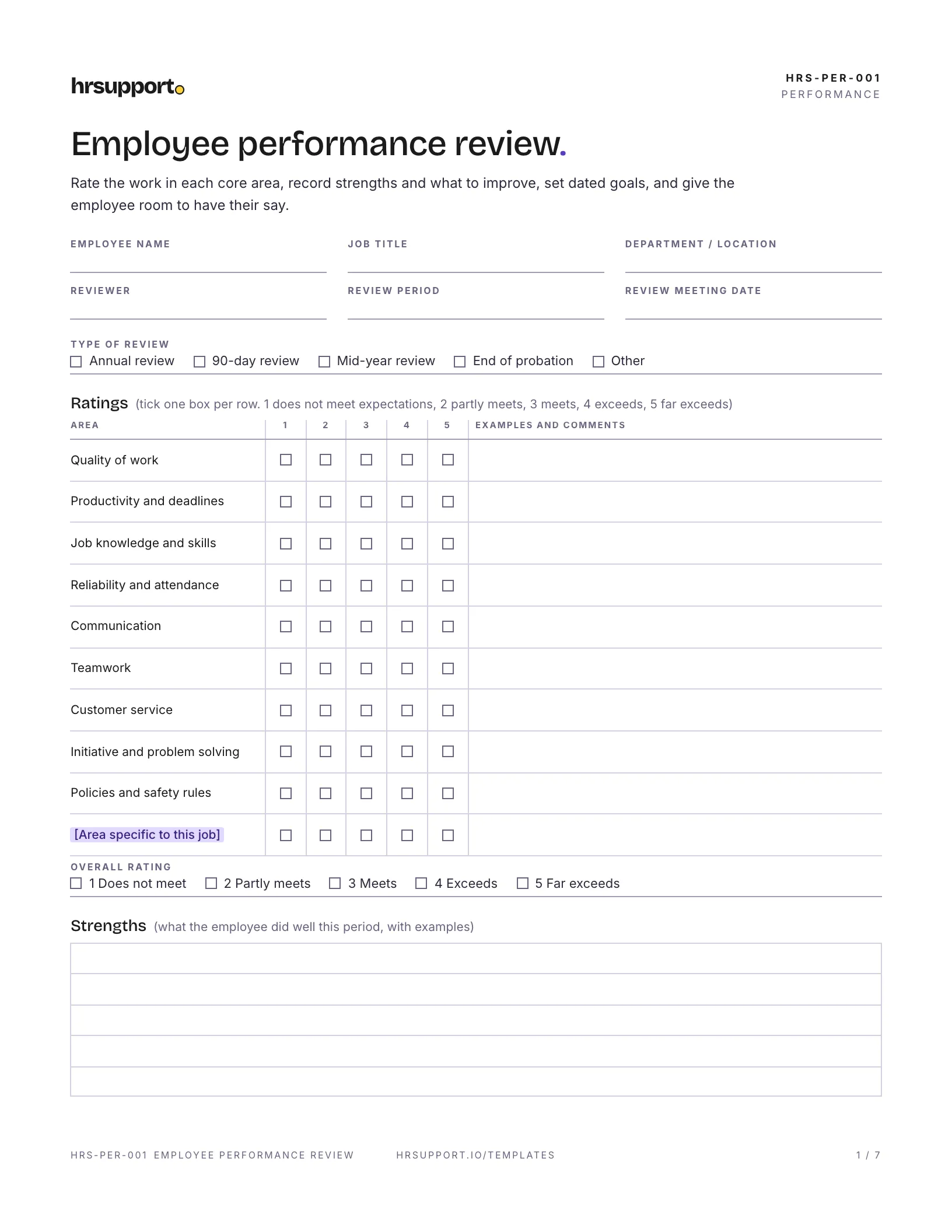
A free performance review template for US small businesses. Use it for an annual review, a 90-day review for a new hire, or a mid-year check-in. It rates the work in ten core areas on a simple 1–5 scale, records strengths and what to improve, and sets goals with dates. It also gives the employee room for their own self-assessment and comments.
A seven-page PDF and an editable Word file, sized for US Letter paper:
Page one records the employee, reviewer and review period, and the type of review. It also holds the ratings table, where you tick a box from 1 to 5 for each area and write an example beside it. It ends with the overall rating and the strengths. Page two covers areas to improve, a goals table (goal, measure, support and target date), training and development, and the reviewer’s summary. Page three is the employee’s page: a self-assessment to fill in before the meeting, comments on the review, the next review date and signatures.
The Word version is the blank form with editable placeholders, so you can rename the rating areas to fit the job.
The example is an annual review of an office and dispatch coordinator at a fictional plumbing company. She’s rated “far exceeds” for reliability, teamwork and customer service. She gets “meets” for job knowledge, initiative and following policies, with a short example on every row. The strengths section notes she cut the time from finished job to invoice from five days to two. The areas to improve are specific: job notes that miss parts, and leaning on the owner for estimates. Her three goals each have a measure, the support the owner will give, and a date, with a 90-day check-in booked. Her self-assessment and comments are filled in too.
The comments are what make a review useful. Short, factual examples work best:
Avoid labels like “great attitude” or “not a team player”. They tell the employee nothing they can act on, and they’re hard to back up later.
Page 3 works as a stand-alone employee self-evaluation form. Hand it out before the meeting and ask the employee to answer three questions in their own words: what went well, what was hard and what would help, and what they want to learn or work toward next. Read it before you finish your ratings. Gaps between how you and the employee see the year are the most important things to talk about.
An annual review looks back over the whole year and sets goals for the next one. A 90-day review is shorter and looks forward: is the new hire settling in, and what do they need? Many small businesses do both, a 90-day review for new hires and an annual review for everyone. For an employee who is struggling, a review is not the place to start a formal process; use a performance improvement plan instead.
Rate the work, not the person, and leave out anything about age, health, pregnancy, religion or other protected traits. Pause and get advice before a low rating if the employee has recently complained about discrimination or harassment, asked for an accommodation, or taken protected leave. The EEOC lists a performance evaluation that is “lower than it should be” as one example of possible retaliation. If an employee links a performance problem to a medical condition, you don’t have to raise an accurate rating. But you should talk about a reasonable accommodation, according to EEOC guidance under the ADA.
Not sure how to handle a tricky review, or what your state requires? That’s what hrsupport.io is for: HR answers for your state, with the law behind every answer.
Ready to use it? It’s free, and comes with a filled-in example.
Template questions
The employee's name, job and review period, ratings for the main parts of the job with an example for each, an overall rating, strengths, areas to improve, and goals for the next period with a measure and a date. Add the support you will give, space for the employee's own view and comments, and signatures. This template has each of these, on three pages.
Describe a behavior or result, give an example, and say what good looks like. "Job notes sometimes miss the parts used, so 6 invoices had to be redone; record parts on every job" is useful. "Needs to be more careful" isn't. Pick two or three areas, not ten, and turn each one into a goal with a date.
A short review at the end of a new hire's first three months, often at the end of a probationary period. It checks that the person understands the job, flags problems early, and sets goals for the rest of the year. Use the same form, tick "90-day review", and focus on the areas that matter most in the first months.
It helps. A self-evaluation tells you how the employee sees their own year before you meet, so there are fewer surprises, and it often raises problems you didn't know about. Give it out about two weeks ahead. This template's self-assessment asks three questions: what went well, what was hard and what would help, and what they want to work toward next.
It depends on the state. In California, for example, current and former employees can inspect and get a copy of personnel records about their performance; the employer must provide them within 30 days of a written request (Labor Code section 1198.5). Wherever you are, giving the employee a signed copy at the meeting is good practice.
If you have 15 or more employees, EEOC rules (29 CFR 1602.14) require you to keep personnel records for at least one year from when they were made, and for a year after an involuntary termination. If a discrimination charge is filed, keep them until it is resolved. Many employers keep reviews for the length of employment plus several years.
Free HR templates
Performance Improvement Plan Template30/60/90-day PIP with measurable goals, support, check-ins and an outcome page.FreeWordPDF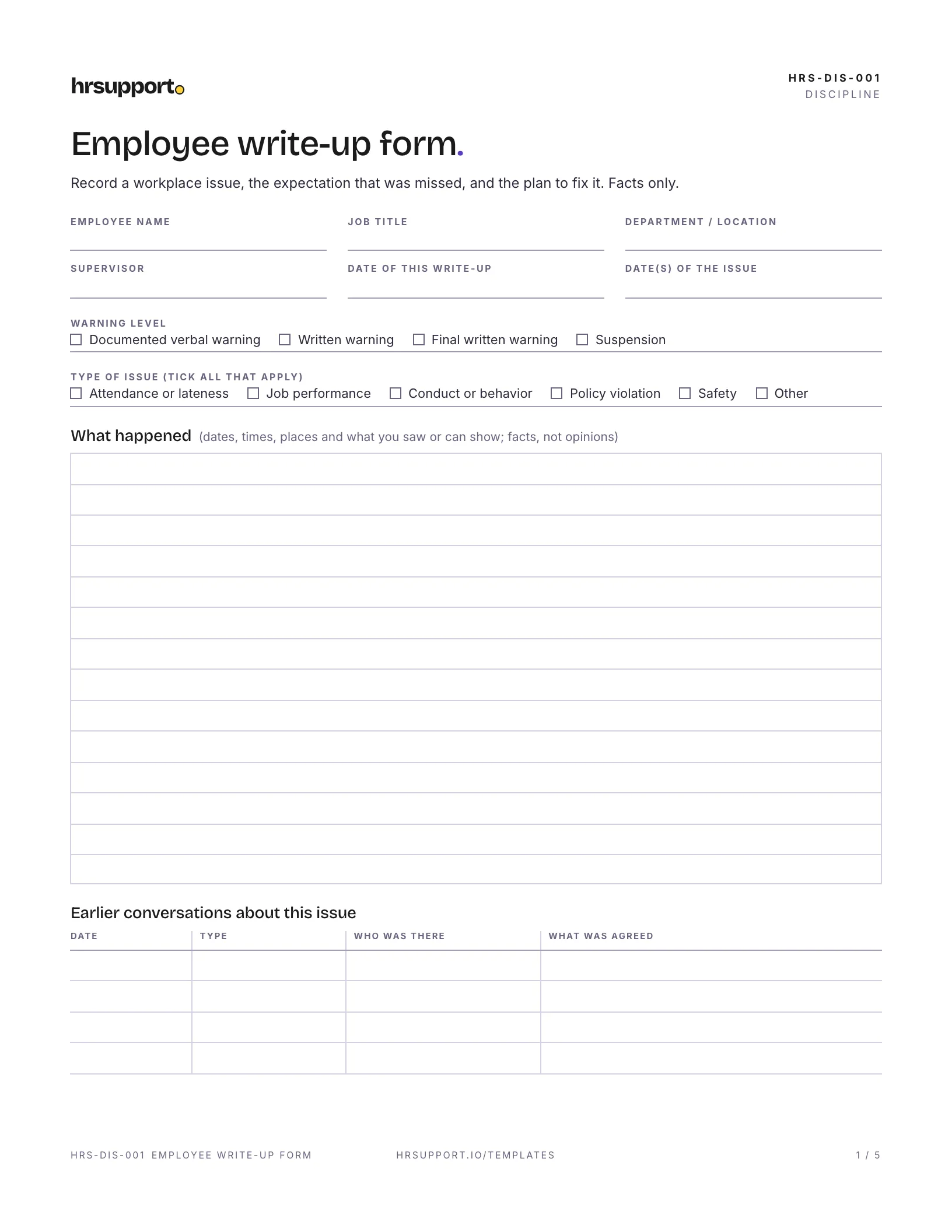 Employee Write-Up FormVerbal, written and final warnings, with an improvement plan and signatures.FreeWordPDF
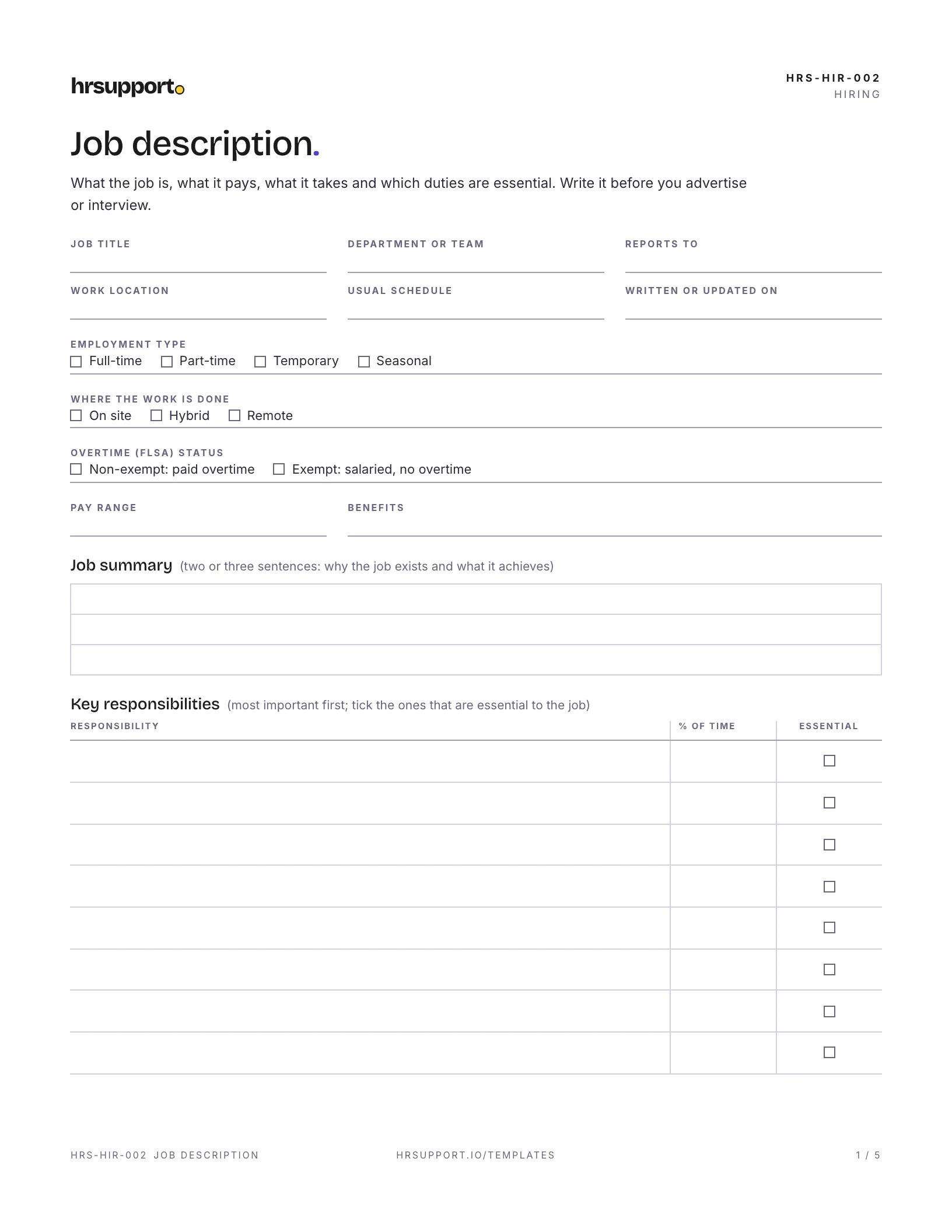 Job Description TemplateDuties, essential functions, FLSA status, pay range, qualifications and an EEO statement.FreeWordPDF
Join the waitlist for early access and early-access pricing. It takes ten seconds.