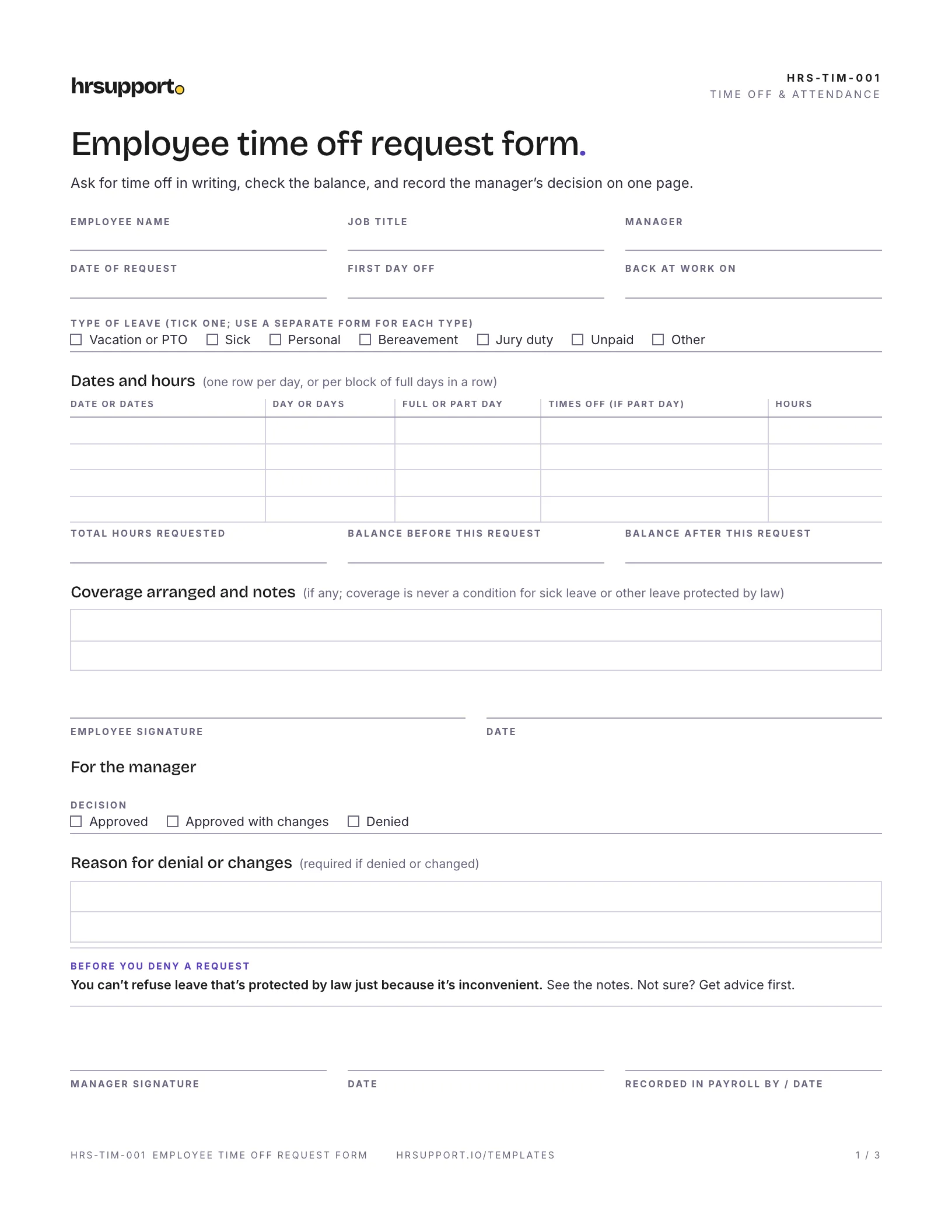
 Employee Time Off Request FormLeave type, dates and hours, balance, coverage and approval on one page.Free
 Word
Word PDF
PDFA clear, fair employee attendance policy you can adapt in an hour. Set the call-in rules and the numbers, and track absences on the printable tracker.
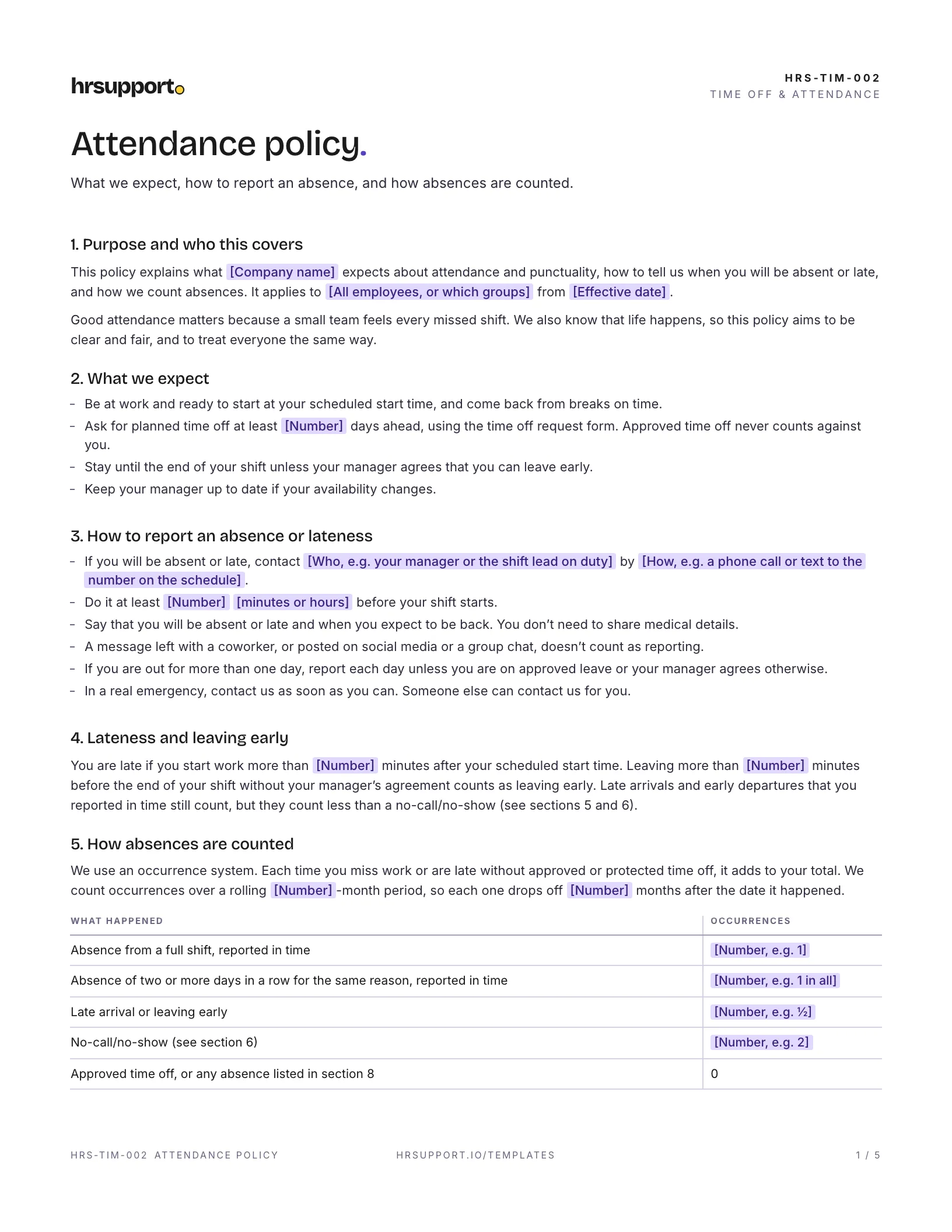
An attendance policy template gives your team clear rules for showing up, calling in and being on time, and gives you a fair way to act when someone doesn’t. This free attendance policy is written for US small businesses, especially those that run on shifts. It covers expectations, call-in rules, tardiness, no-call/no-shows, an occurrence system, discipline steps and the absences that never count. It ends with a printable employee attendance tracker.
A five-page PDF and a Word file you can edit, sized for US Letter paper:
The policy is written in plain English, so you can drop it into your employee handbook or hand it out on its own.
An occurrence system, sometimes called an attendance point system, counts unplanned absences instead of judging each excuse. A reported full-day absence might be one occurrence, a late arrival half of one, and a no-call/no-show two. Several days out in a row for the same reason count as one. Occurrences drop off after a rolling period, such as 12 months, so one bad patch doesn’t follow someone forever. The template leaves each number as a fill-in, so you can set values that fit your business.
Lateness is easy to handle unevenly, especially when the manager likes one employee more than another. The policy fixes a grace period, such as five minutes, and counts anything beyond it as a late arrival, worth less than a full absence. Leaving early without agreement counts the same way. Write the grace period down and apply it to everyone. Talk to someone the first time they’re late, before it adds up, because a quick conversation often fixes a bus timetable or a childcare clash.
Missing a shift without any word is the hardest absence for a small team, so the policy treats it more seriously than a reported absence. A first no-call/no-show counts extra and leads to at least a written warning. You choose how many missed shifts in a row you’ll treat as a resignation. Before you do, call and write to the employee and keep a note of each attempt. A hospital stay or a family emergency can explain a silence, and that leave may be protected.
The last page is a printable attendance tracker. Use one sheet per employee. Record the date, a code, the scheduled and actual times, how the absence was reported, and the occurrences, with a running total. Codes V, P and C never count. Use P for any protected leave, and keep medical details off the tracker. Fill it in the same day, while the details are fresh, and ask the employee to initial entries that add occurrences, so there’s no dispute later about what happened or when.
Several laws limit what an attendance policy can count. Under the FMLA, employers with 50 or more employees can’t count FMLA leave under a no-fault attendance policy (29 CFR 825.220). Employers with 15 or more employees may have to give leave as a reasonable accommodation, and can’t penalize employees for using it (EEOC). The PWFA covers pregnancy-related limitations (EEOC). Some states bar penalizing paid sick leave, for example Washington (RCW 49.46.210). Call-in rules still matter: under the FMLA, employees must follow your usual call-in procedure unless there are unusual circumstances, such as a medical emergency (29 CFR 825.303). Federal law also protects federal jurors (28 U.S.C. 1875) and service members (38 U.S.C. 4311).
Get advice before you discipline or dismiss someone whose absences may be linked to their health, a disability, pregnancy, a family member’s illness, jury duty or military service. Do the same if they’ve recently complained or asked for leave.
Want a second opinion before you act on an attendance problem? hrsupport.io gives HR answers for your state, with the law behind every answer.
Ready to use it? It’s free, and comes with a filled-in example.
Template questions
Federal law doesn't set a number, so it's up to your policy. This template treats a first no-call/no-show as serious, with at least a written warning, and lets you set how many missed shifts in a row count as a resignation. Before you treat it that way, try to reach the employee by phone and in writing, and check whether an emergency or protected leave was behind it.
It's a way of counting absences so that everyone is treated the same. Each unplanned absence, late arrival or early departure adds a set number of occurrences, or points. Several days out in a row for the same reason count as one. Occurrences drop off after a rolling period, such as 12 months, and set totals trigger each step of discipline.
Often not. You can't count FMLA leave under a no-fault attendance policy, and you can't penalize leave given as an accommodation under the ADA or the PWFA. Some state and local sick leave laws also bar it. Washington, for example, bars counting paid sick leave as an absence that can lead to discipline. Check your state and city before you count any sick day.
For hourly employees, federal law doesn't require pay for time not worked, so you pay for the time they actually work. Check how your time clock rounds. For salaried exempt employees, don't dock pay for lateness or a partial-day absence. Federal rules allow deductions only in limited cases, such as full days off for personal reasons.
It's good practice. A signed acknowledgment shows that the employee received the policy and knew the rules, which matters if you later discipline someone under it. If an employee won't sign, note the date you gave them a copy and have a second manager sign as a witness. Ask everyone to sign again when you change the policy.
The date, a code for what happened, the scheduled time and the actual time in or out, how and when the employee reported it, and the occurrences it adds, with a running total. Keep medical details off the tracker. Use a code for protected leave instead, and keep any medical notes in a separate confidential file.
Free HR templates
Employee Time Off Request FormLeave type, dates and hours, balance, coverage and approval on one page.FreeWordPDF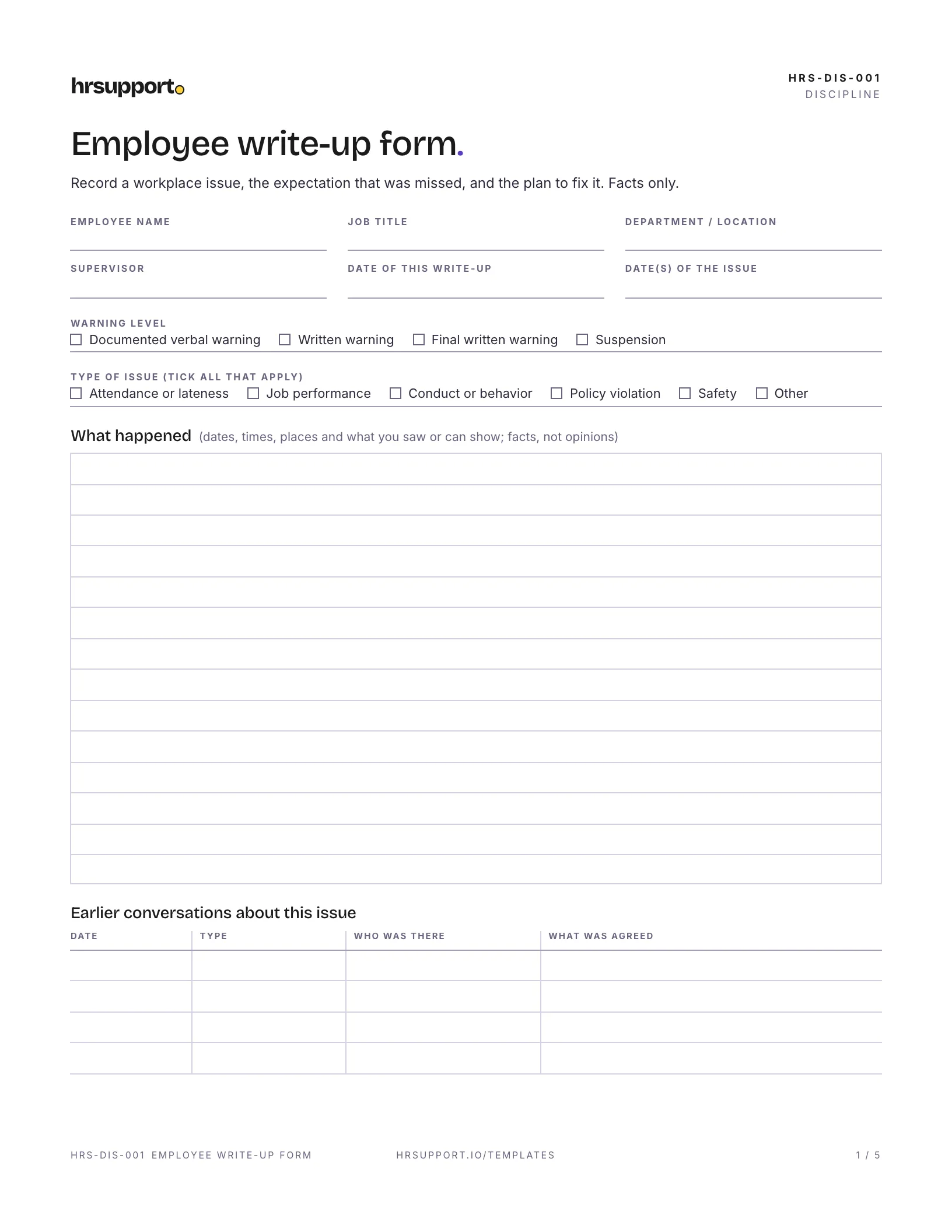 Employee Write-Up FormVerbal, written and final warnings, with an improvement plan and signatures.FreeWordPDF
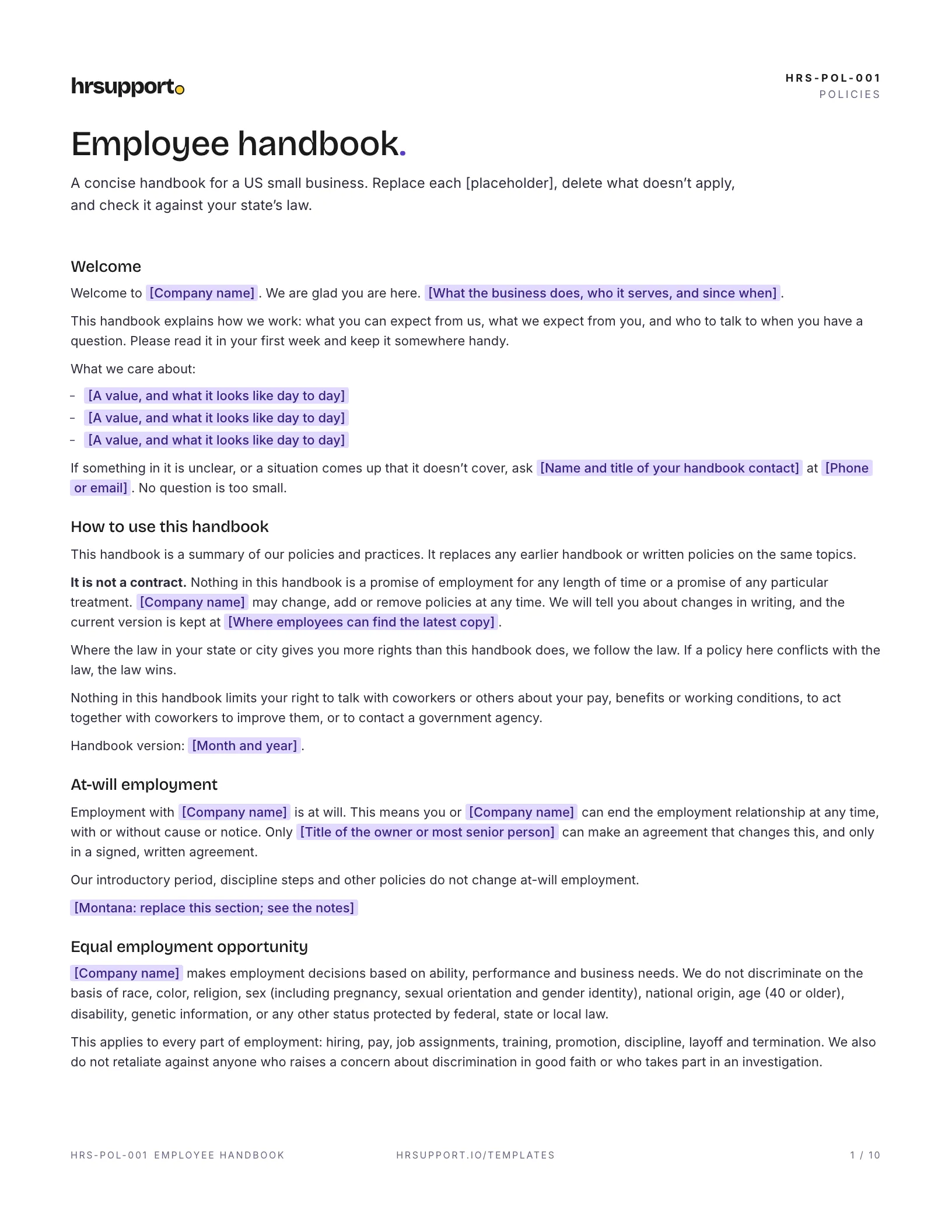 Employee Handbook TemplateTwenty-nine short policies and an acknowledgment page, ready to fill in.FreeWordPDF
Join the waitlist for early access and early-access pricing. It takes ten seconds.