 Attendance Policy TemplateCall-in rules, occurrences, no-call/no-show, discipline steps and a tracker.Free
 Word
Word PDF
PDFA simple one-page form for vacation, PTO, sick and other leave. The employee asks in writing, you check the balance and record your decision.
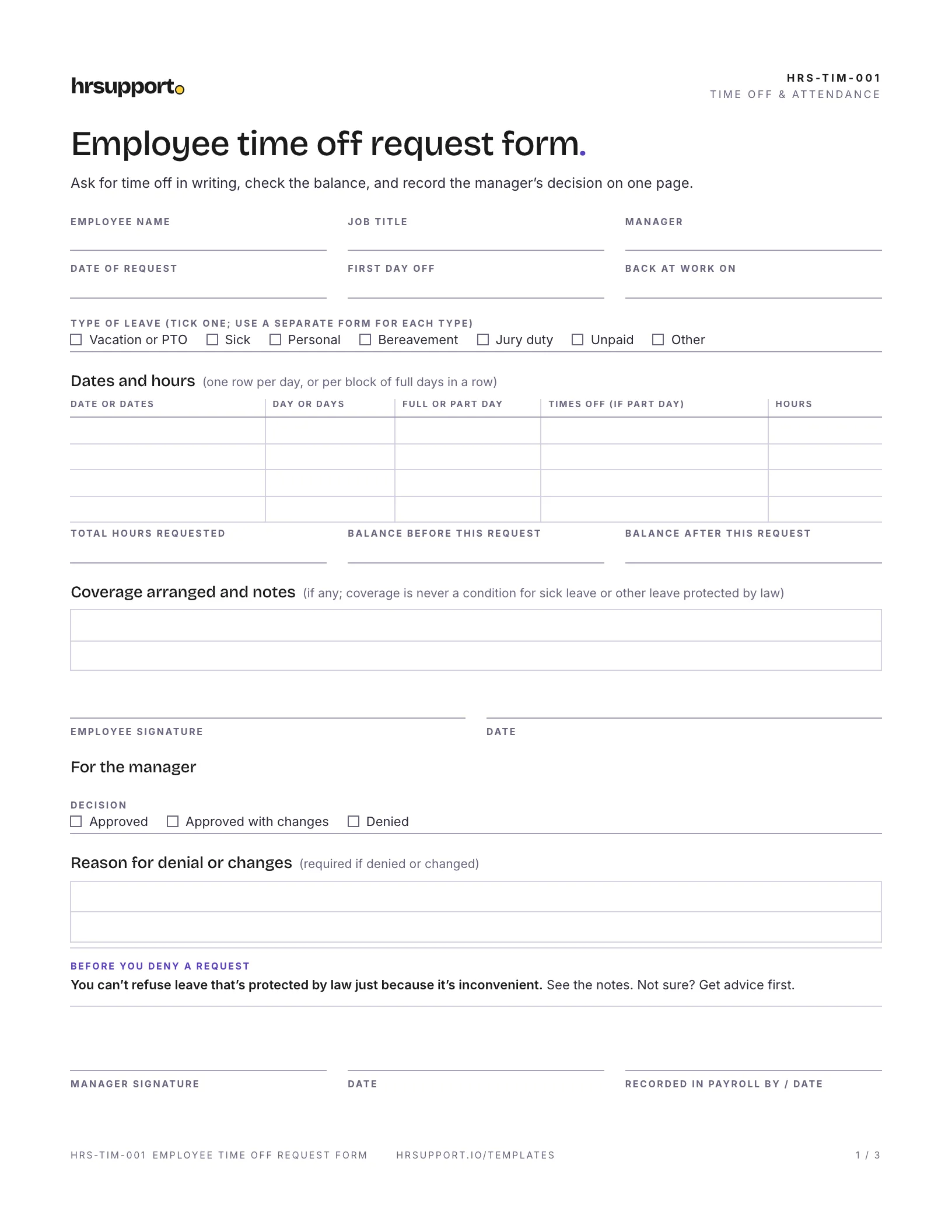
An employee time off request form puts a request for vacation, PTO or other leave in writing, with the dates, the hours and the manager’s decision. This free time off request form fits on one page. The employee fills in the top half. You check their balance, record your decision and sign, and payroll gets an accurate record.
A three-page PDF and a Word file you can edit, sized for US Letter paper:
The Word file has the form and the notes, so you can add your company name or change the leave types to match your policy.
The example is a vacation request from a crew lead at a fictional landscaping company. He asks for three full days and a half day before a holiday, 28 hours in all. His balance is 52 hours of PTO before the request and 24 hours after. He notes who will lead his crew, and the operations manager approves the request two days later and records it in payroll.
PTO request forms, vacation request forms and leave request forms are the same thing under different names. If you give one pool of paid time off, tick “Vacation or PTO” for planned time and “Sick” for illness, so you can see the pattern. If you keep separate vacation and sick balances, use one form per type, so each balance stays right.
Not every absence can be requested ahead of time. When someone calls in sick or has a family emergency, let them tell you by phone or text, then fill in the form together when they’re back, ticking the right type of leave. Don’t treat a late form as a reason to refuse sick leave that the law protects.
When two people want the same days, decide on a rule before it happens and write it in your policy. First come, first served is simple. Some businesses rotate popular holidays from year to year instead. Whichever you choose, apply it the same way to everyone and note the reason on the form.
The form works best with a short written policy. Your PTO policy should say:
Some leave isn’t yours to refuse. The FMLA covers employers with 50 or more employees in 20 or more workweeks this year or last. Eligible employees can take up to 12 workweeks of job-protected leave in a 12-month period (29 CFR 825.200). You can ask for notice and ask employees to schedule planned treatment to avoid unduly disrupting work (29 CFR 825.302). You can’t interfere with leave they’re entitled to.
State and local paid sick leave laws can bar you from denying sick days or requiring the employee to find cover. California is one example (Labor Code 246.5). Federal law protects employees serving on a federal jury (28 U.S.C. 1875). USERRA protects employees who serve in the military, at employers of every size (20 CFR 1002.34).
Get advice before you deny or count against someone any leave for their own or a family member’s health, a disability, jury service or military duty. Do the same if an employee has recently complained or asked for an accommodation.
Not sure what your state requires for sick leave or PTO payout? hrsupport.io gives HR answers for your state, with the law behind every answer.
Ready to use it? It’s free, and comes with a filled-in example.
Template questions
That's up to your policy for ordinary vacation and PTO. Pick a rule that fits your business, such as two weeks for planned time off, and apply it to everyone. Sick leave is different, because illness can't be planned. For foreseeable FMLA leave, you can ask for 30 days' notice, or notice as soon as practicable if that isn't possible. State sick leave laws may set their own notice rules.
Yes, for ordinary vacation or PTO, if your policy allows it and you treat everyone the same way. Write down the reason. You can't refuse leave that's protected by law just because it's inconvenient, such as FMLA leave, state paid sick leave, jury duty or military service. If you're unsure whether a request is protected, get advice before you say no.
Federal wage law doesn't require pay for time not worked, such as vacation, sick days or holidays. That's set by your policy, unless a state or local paid sick leave law applies. Check your state's rules on unused vacation when someone leaves. In California, for example, vested vacation must be paid out at termination and can't be forfeited.
For vacation, you can ask, as long as you apply the rule fairly. For sick leave, be careful. California, for example, bars employers from requiring an employee to find a replacement as a condition of using paid sick days. That's why the form treats coverage as optional and says it's never a condition for protected leave.
Not really. A PTO request form, a vacation request form and a leave request form all do the same job. The employee asks for specific days in writing and the manager approves or denies them. This template covers all of them, with a box for each type of leave. If you keep separate balances for vacation and sick leave, use one form per type.
It's good practice. A written request shows exactly which days and hours were asked for, what was approved and when. It also keeps payroll accurate. If an employee calls in sick or has an emergency, let them tell you by phone, then fill in the form together when they're back.
Free HR templates
Attendance Policy TemplateCall-in rules, occurrences, no-call/no-show, discipline steps and a tracker.FreeWordPDF Employee Handbook TemplateTwenty-nine short policies and an acknowledgment page, ready to fill in.FreeWordPDF
 Employee Write-Up FormVerbal, written and final warnings, with an improvement plan and signatures.FreeWordPDF
Join the waitlist for early access and early-access pricing. It takes ten seconds.