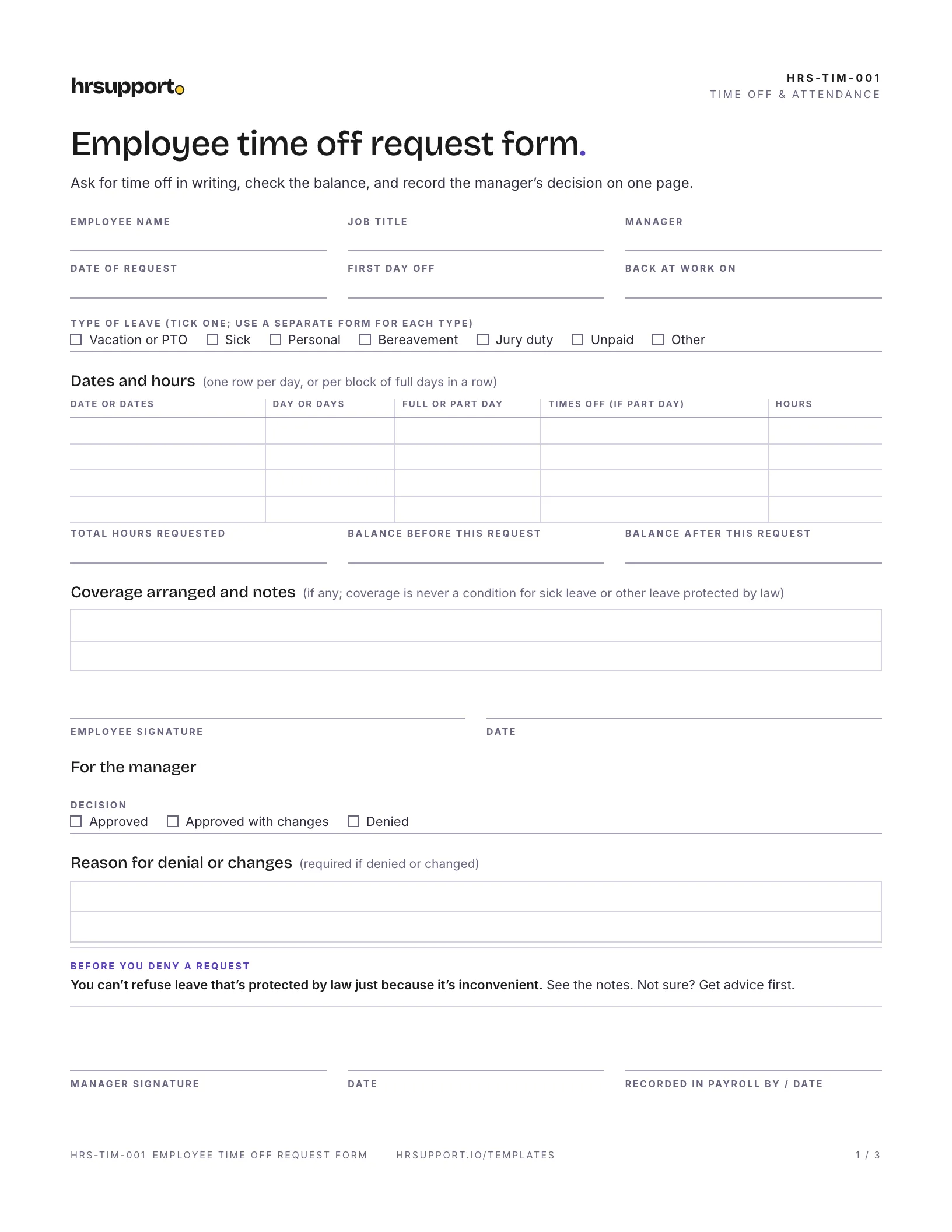
 Employee Time Off Request FormLeave type, dates and hours, balance, coverage and approval on one page.Free
 Word
 PDF
A two-page bereavement policy you can fill in and hand out. Set how many paid and unpaid days you give, who counts as family, when the days can be taken and what support you offer.
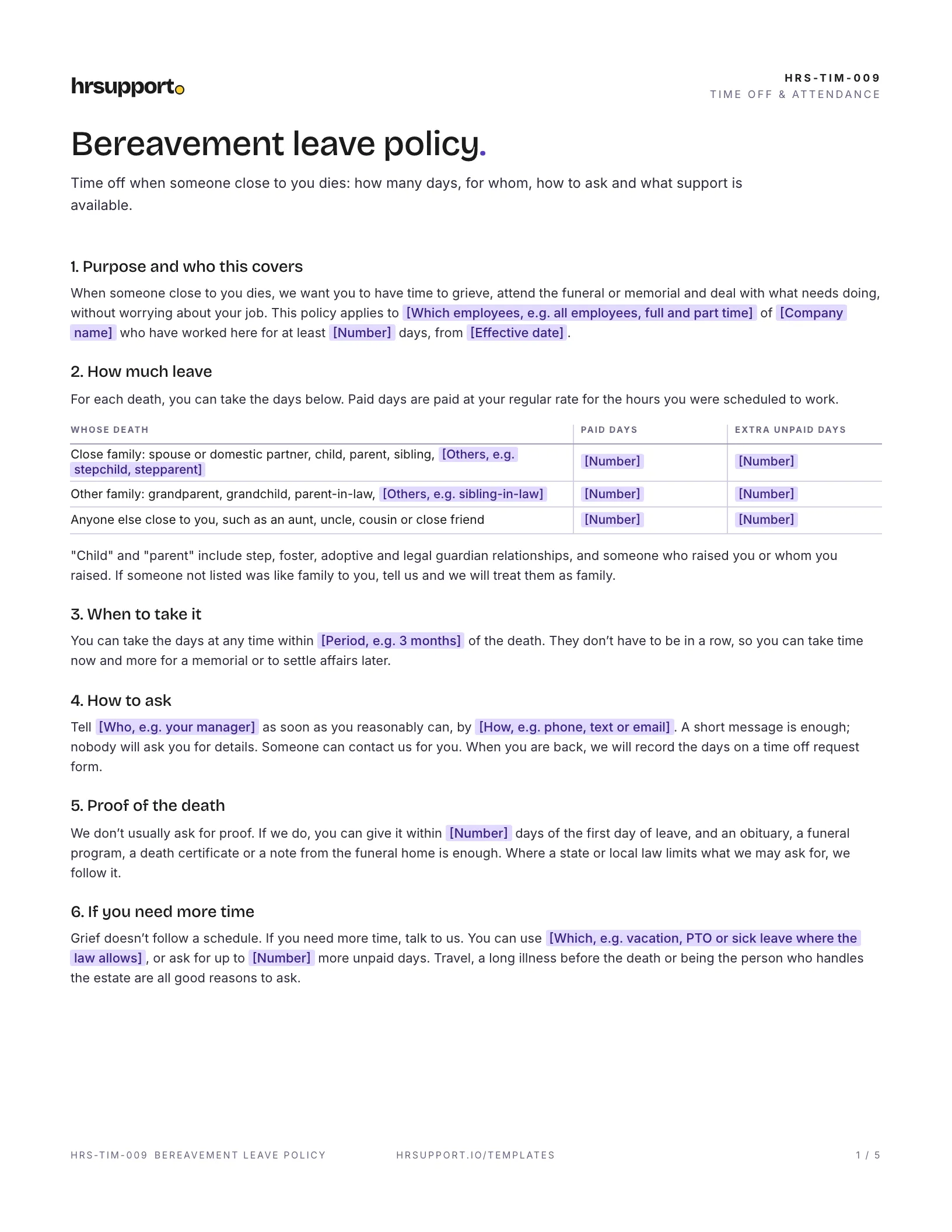
A bereavement leave policy tells your team what happens when someone close to them dies: how many days they can take, whether they are paid, and who to tell. This free bereavement leave policy template is written for US small businesses with no HR department. It covers eligibility, paid and unpaid days for each group of relatives, who counts as family, when the days can be taken, how to ask, proof, extra time, an optional line on pregnancy loss, other leave and support. Having it written down means the conversation, when it comes, can be short and kind.
A five-page PDF and a Word file you can edit, sized for US Letter paper:
You can use it on its own or as the bereavement section of your employee handbook.
There is no single answer, and practices vary. The Bureau of Labor Statistics describes funeral leave as time off because of a death in the family, usually limited to a few days. One simple approach is more days for a spouse, child or parent than for a grandparent or in-law, and a day for anyone else close. The template sets this out as a table with three rows, and the example uses 3 paid days plus 2 unpaid for family and 1 plus 1 for others. If your state sets a minimum, your numbers must meet it.
Whoever your policy says, unless a state law sets a wider list. Start with spouses, domestic partners, children, parents and siblings. Then decide on grandparents, grandchildren and parents-in-law; California’s law lists all of them. Write the list down, include step, foster and adoptive relationships, and leave room for “someone who was like family”. It costs little and saves an awkward conversation at the worst time.
Not under federal law for private employers. The Department of Labor says the Fair Labor Standards Act doesn’t require payment for time not worked, including attending a funeral, and that this is generally a matter of agreement between employer and employee. Some states require leave, paid or not. For example:
Section 7 is optional: a few days after a miscarriage, a stillbirth, a failed adoption or surrogacy, or an unsuccessful fertility treatment, without asking which. Some states require it. For example, since January 1, 2024, California has required employers with 5 or more employees to allow up to five days of reproductive loss leave after these events, for employees who have worked there at least 30 days (Government Code 12945.6).
Say you’re sorry, and tell them not to worry about work. Ask what they would like the team to be told, and keep the details to that. Don’t ask for proof in the first conversation. Have someone cover their work, and when they come back, check in privately and offer a lighter week or flexible hours. Grief can take months, so if they need longer time off, a leave of absence letter sets out the terms. Record the days afterwards on a time off request form.
The example is a fictional bookkeeping firm. Employees are eligible after 30 days. Close family and other family each get 3 paid days plus 2 unpaid days, and anyone else close gets 1 of each, all to be used within 3 months. The firm includes the pregnancy loss section with 5 paid days and lists its employee assistance program. A payroll specialist asks whether his partner’s father counts, and the answer is recorded before he signs.
Get advice if your state or city has its own bereavement or family leave law, if an employee also needs time off for their own health, or before you discipline anyone for an absence linked to a death in the family.
Not sure what your state requires? hrsupport.io gives HR answers for your state, with the law behind every answer.
Ready to use it? It’s free, and comes with a filled-in example.
Template questions
Not under federal law for private employers. The Department of Labor says the FLSA does not require payment for time not worked, including attending a funeral, and that it is generally a matter of agreement between employer and employee. Some states do require it. For example, California requires employers with 5 or more employees to allow up to five days, and Illinois requires FMLA-covered employers to allow up to 10 unpaid workdays.
Only if your policy, a contract or a state or local law says so. Federal law doesn't require it. If you can, pay at least some days. It's hard to grieve while worrying about a short paycheck. This template lets you set paid days and extra unpaid days for each group of relatives, and lets employees use PTO for more time.
There is no standard. The Bureau of Labor Statistics describes funeral leave as time off because of a death in the family that is usually limited to a few days. One simple approach is more days for a spouse, child or parent than for other relatives. Some states set a minimum. Pick a number you can give everyone, every time, and allow extra time unpaid or from PTO.
Under your own policy, it covers whoever you list. California's law includes grandparents, grandchildren and parents-in-law, plus domestic partners. This template lists them under "other family" and also covers step, foster and adoptive relationships. It ends with a line that lets someone ask to treat a person who was like family as family.
Often yes, but keep it light, and check your state first. California lets employers ask for documentation within 30 days of the first day of leave, such as a death certificate, a published obituary or written verification from a funeral home, and requires it to be kept confidential. Illinois allows reasonable documentation such as a death certificate or published obituary. You can also choose not to ask at all.
Employers with 5 or more employees must allow up to five days of bereavement leave for a spouse, child, parent, sibling, grandparent, grandchild, domestic partner or parent-in-law, for employees who have worked there at least 30 days. The days need not be consecutive and must be taken within three months of the death. They can be unpaid without a paid policy, but employees may use vacation, personal leave, sick leave or comp time.
Free HR templates
Employee Time Off Request FormLeave type, dates and hours, balance, coverage and approval on one page.FreeWordPDF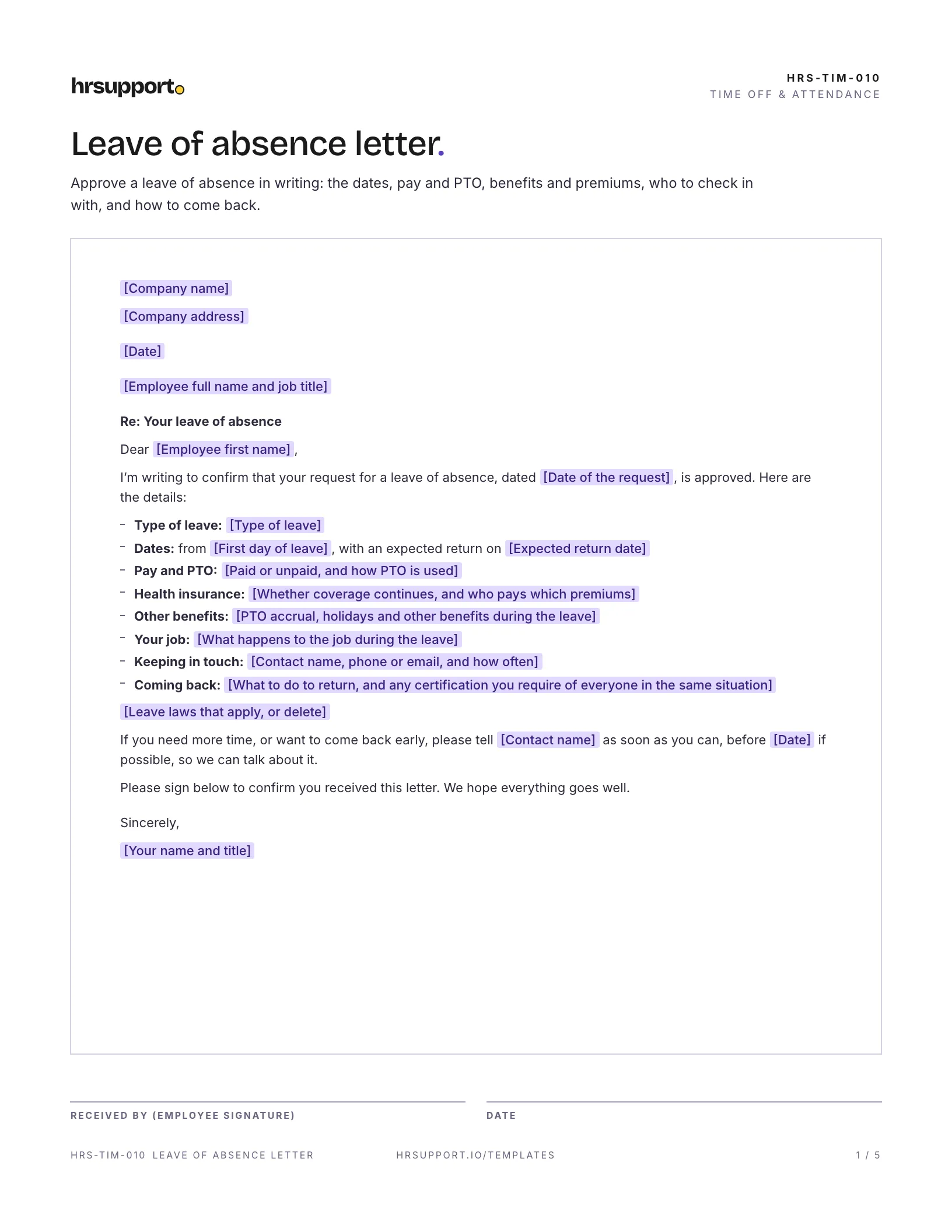 Leave of Absence Letter TemplateAn employer's leave approval letter, plus a one-page leave request form.FreeWordPDF
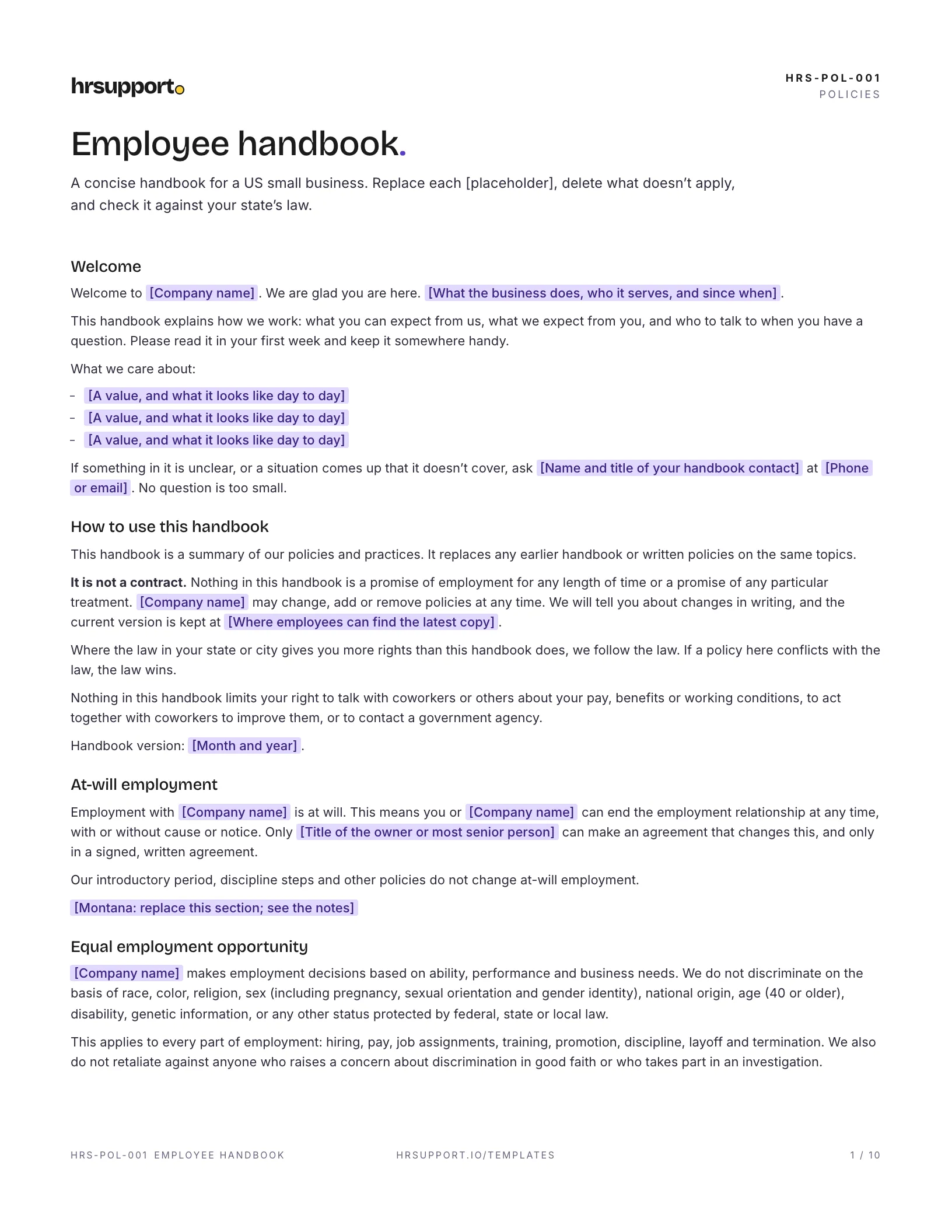 Employee Handbook TemplateTwenty-nine short policies and an acknowledgment page, ready to fill in.FreeWordPDF
Join the waitlist for early access and early-access pricing. It takes ten seconds.