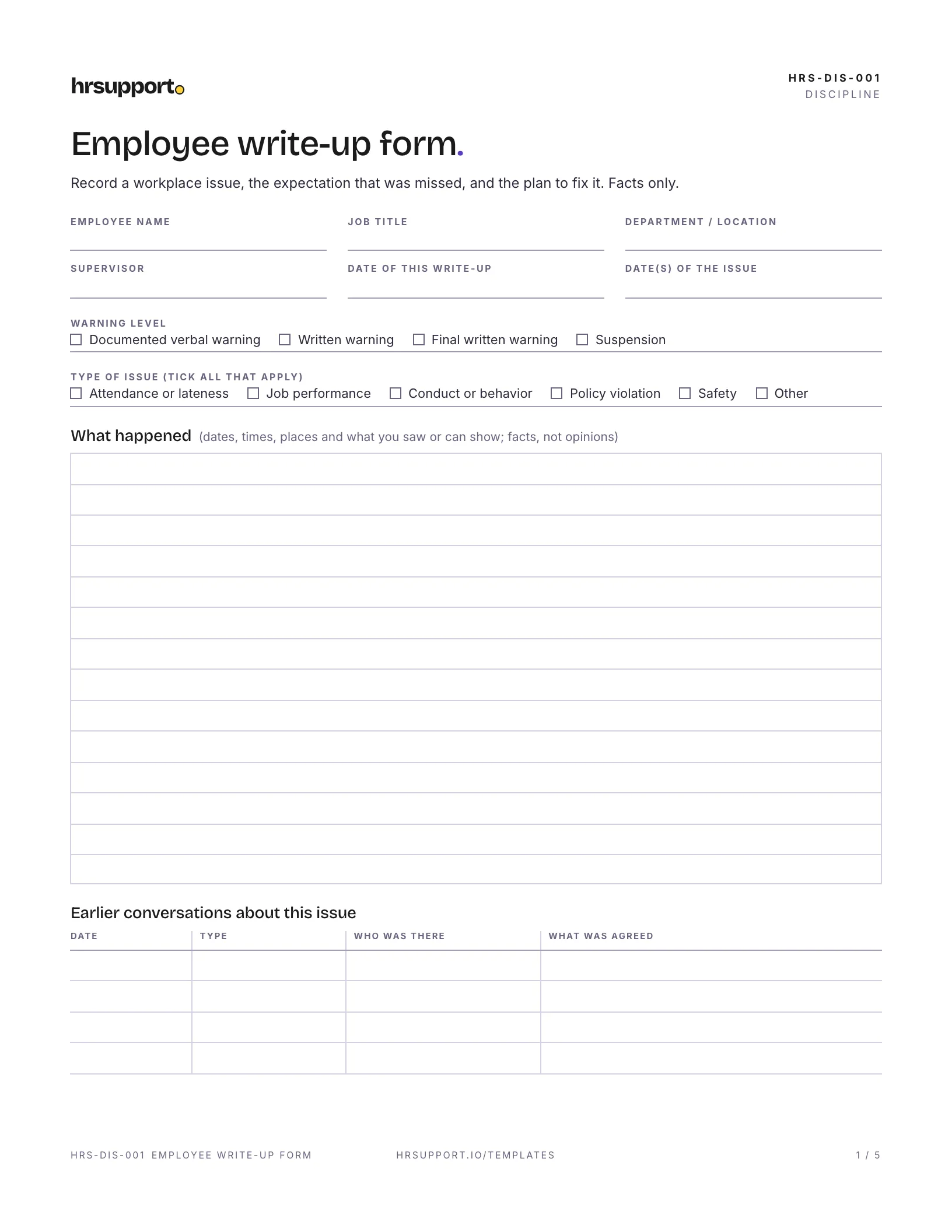
 Employee Write-Up FormVerbal, written and final warnings, with an improvement plan and signatures.Free
 Word
Word PDF
PDFMake it easy for employees to raise a concern, and handle it properly when they do. A two-page complaint form plus a handling record for your files.
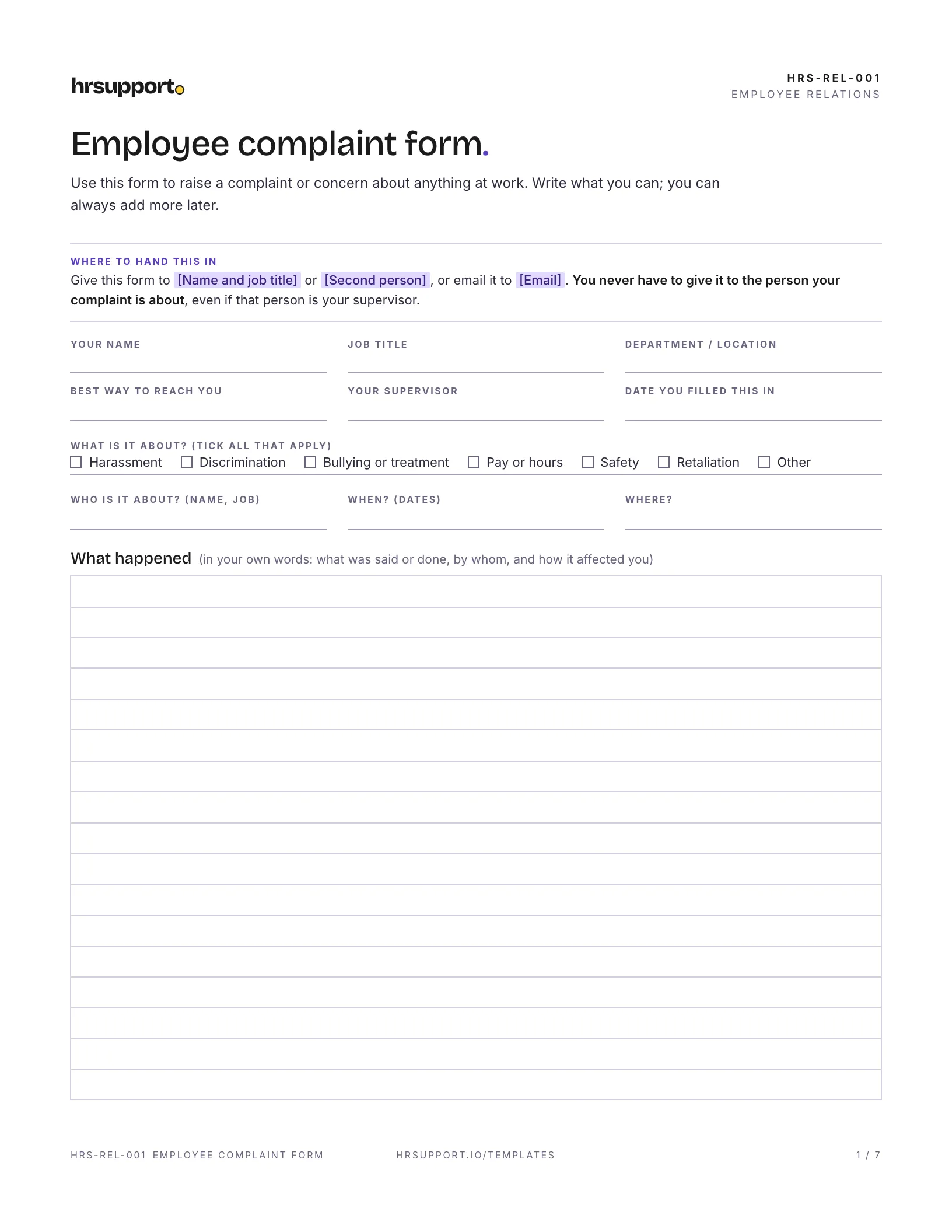
This free employee complaint form gives your staff a simple, private way to raise a workplace complaint or concern, and gives you a record of how you dealt with it. It’s written for US small businesses. The employee section covers harassment, discrimination, treatment, pay, safety and anything else. A separate handling record lets the owner or manager log the investigation, the findings and the outcome.
A seven-page PDF, sized for US Letter paper, and an editable Word file:
Page one names two people the form can be handed to and has fields for the employee, what the complaint is about, who it involves, when and where. A large box follows for what happened. Page two covers witnesses, evidence, whether it was raised before and what the employee would like to happen. It also explains what happens next. The handling record has interim steps, an investigation log, findings, the outcome, the action taken and a date to check for retaliation.
The example is a fictional print shop in Colorado. A press operator complains that her shift lead mocked her accent in front of the crew, made a remark in the break room and twice moved her off the press she’s trained on. She hands the form to the office manager, not to the shift lead. While the owner looks into it, she reports to him instead. He interviews two witnesses and the shift lead, and checks the training log. He finds the complaint substantiated, gives the shift lead a final written warning and training, and sets a date a month later to check for retaliation.
Many employers search for a separate harassment complaint form. This form covers harassment, with a tick box for it, so you don’t need two. What matters most for harassment is how you respond. The EEOC says employers should have an effective complaint process and act quickly when an employee complains. It also encourages employees to report harassment early, before it escalates (EEOC). Make it easy to report, take every complaint seriously, and act on what you find.
In a non-union workplace, an employee grievance form and a complaint form do the same job. If you have a union contract, it probably sets out its own grievance procedure, and you should follow that instead.
Keep the complaint form and the handling record together in a confidential file. Don’t put them in the personnel file of the employee who complained or of the person complained about. Any warning that results goes in the personnel file of the person disciplined, as usual. If you have 15 or more employees, EEOC rules require you to keep personnel records for at least one year, and longer if a discrimination charge is filed (29 CFR 1602.14). Many employers keep complaint files for several years.
It’s illegal to punish an employee for complaining about discrimination or harassment, or for taking part in an investigation (EEOC). Employees who act together to raise problems about pay or working conditions are generally protected under the National Labor Relations Act. The same goes for one employee bringing a group complaint (NLRB). OSHA says employers must keep the workplace free from retaliation for raising concerns about hazards (OSHA). Treat every complaint as protected until you’ve had advice.
Get advice if a complaint involves you or a senior manager, alleges assault or a crime, or names several people. Do the same if you’re thinking of taking action against the person who complained, for any reason.
Not sure how to handle a complaint in your state? That’s what hrsupport.io is for: HR answers for your state, with the law behind every answer.
Ready to use it? It’s free, and comes with a filled-in example.
Template questions
Who to hand it to, with at least two options, and the employee's name and contact details. Then what the complaint is about, who it involves, when and where it happened, and a full account in their own words. Add witnesses, any evidence and what they would like to happen. It should also say how you'll handle it, how far you'll keep it confidential, and that retaliation won't be tolerated.
No, and you shouldn't insist on it. A complaint made by email, by text or in a conversation is still a complaint, and you still need to deal with it. The form helps people who want to write it down, and it helps you capture the details. If someone tells you in person, offer to fill in the form with them.
Only as far as possible. To look into a complaint fairly you usually have to tell the person complained about what's alleged, and ask witnesses what they saw. So promise discretion, not secrecy. Share details only with the people who need them to investigate and act, and keep the records in a confidential file.
No. The EEOC says it's illegal to punish employees for complaining to a supervisor about discrimination or harassment, or for answering questions in an investigation. Employees who act together about pay or working conditions are generally protected by the National Labor Relations Act, and OSHA protects people who raise safety concerns. Get advice before taking any action against someone who has complained.
In a unionized workplace, a grievance usually means a formal complaint under the union contract, with its own steps. In most small businesses the words mean the same thing, an employee raising a problem about their work. This form works as an employee grievance form for a non-union workplace. If you have a union contract, follow its grievance procedure.
If you have 15 or more employees, EEOC rules require you to keep personnel records for at least one year, and longer if a discrimination charge is filed. Many employers keep complaint files for several years. Store them in a confidential file, not in the personnel file of the employee who complained or the person complained about.
Free HR templates
Employee Write-Up FormVerbal, written and final warnings, with an improvement plan and signatures.FreeWordPDF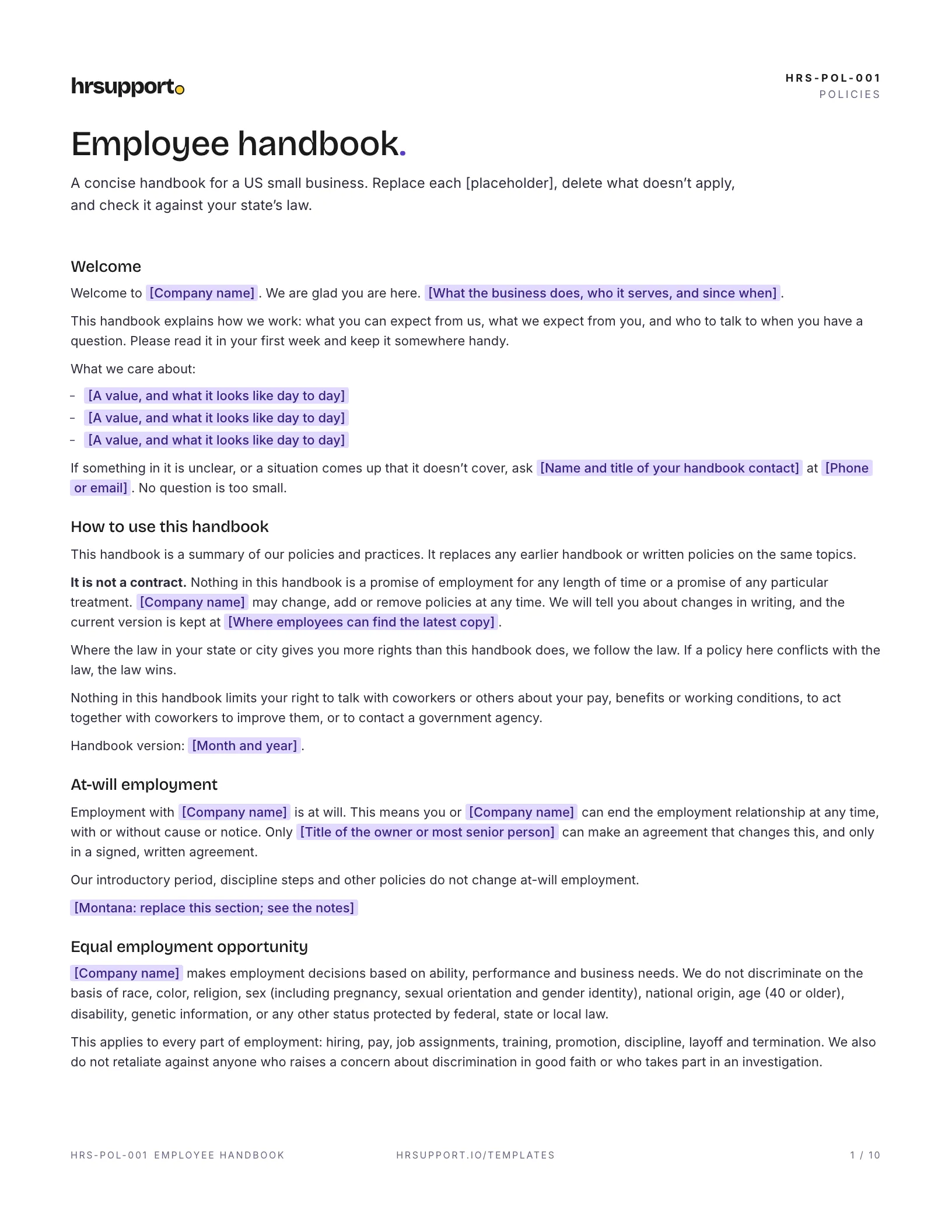 Employee Handbook TemplateTwenty-nine short policies and an acknowledgment page, ready to fill in.FreeWordPDF
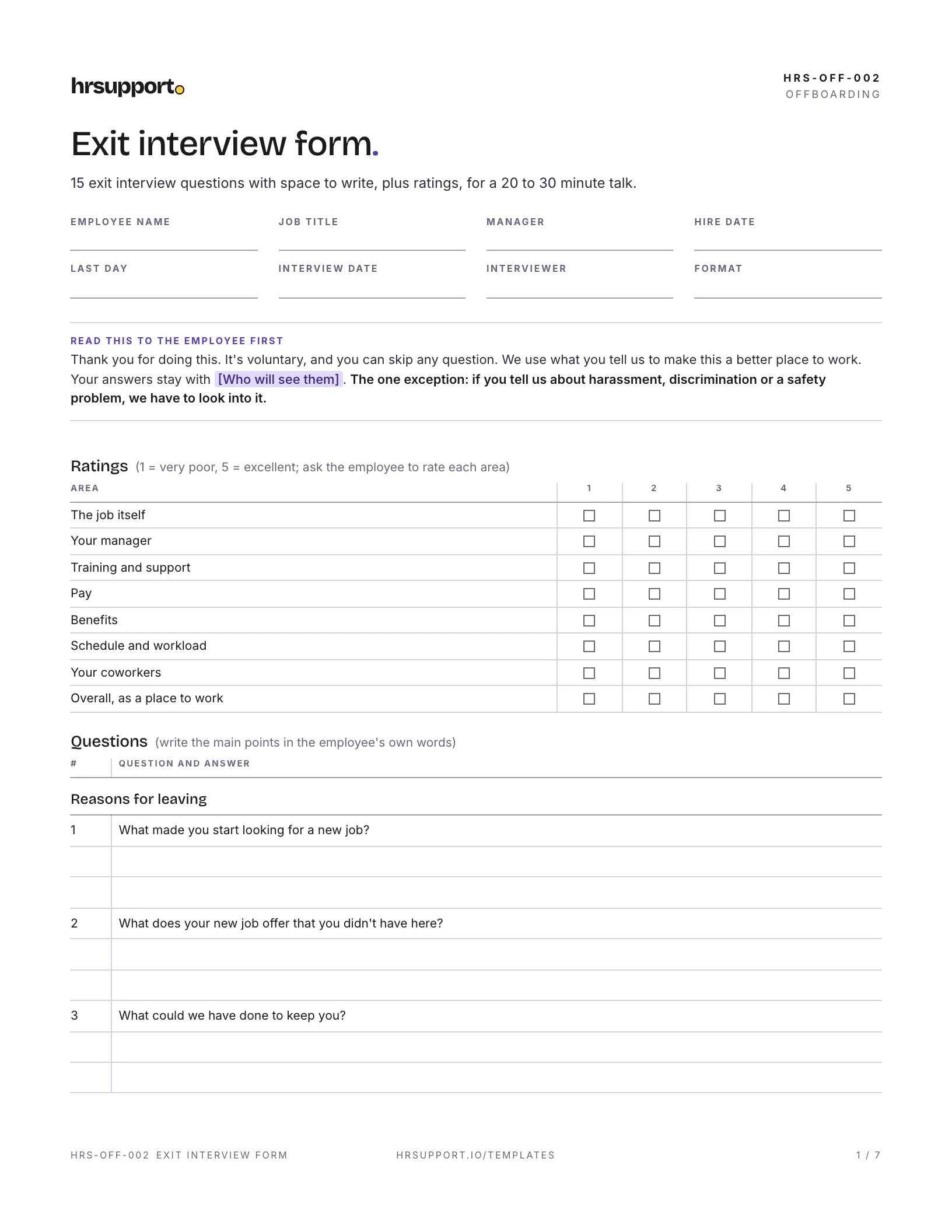 Exit Interview Questions and Form15 questions in five groups, 1–5 ratings and a follow-up box.FreeWordPDF
Join the waitlist for early access and early-access pricing. It takes ten seconds.