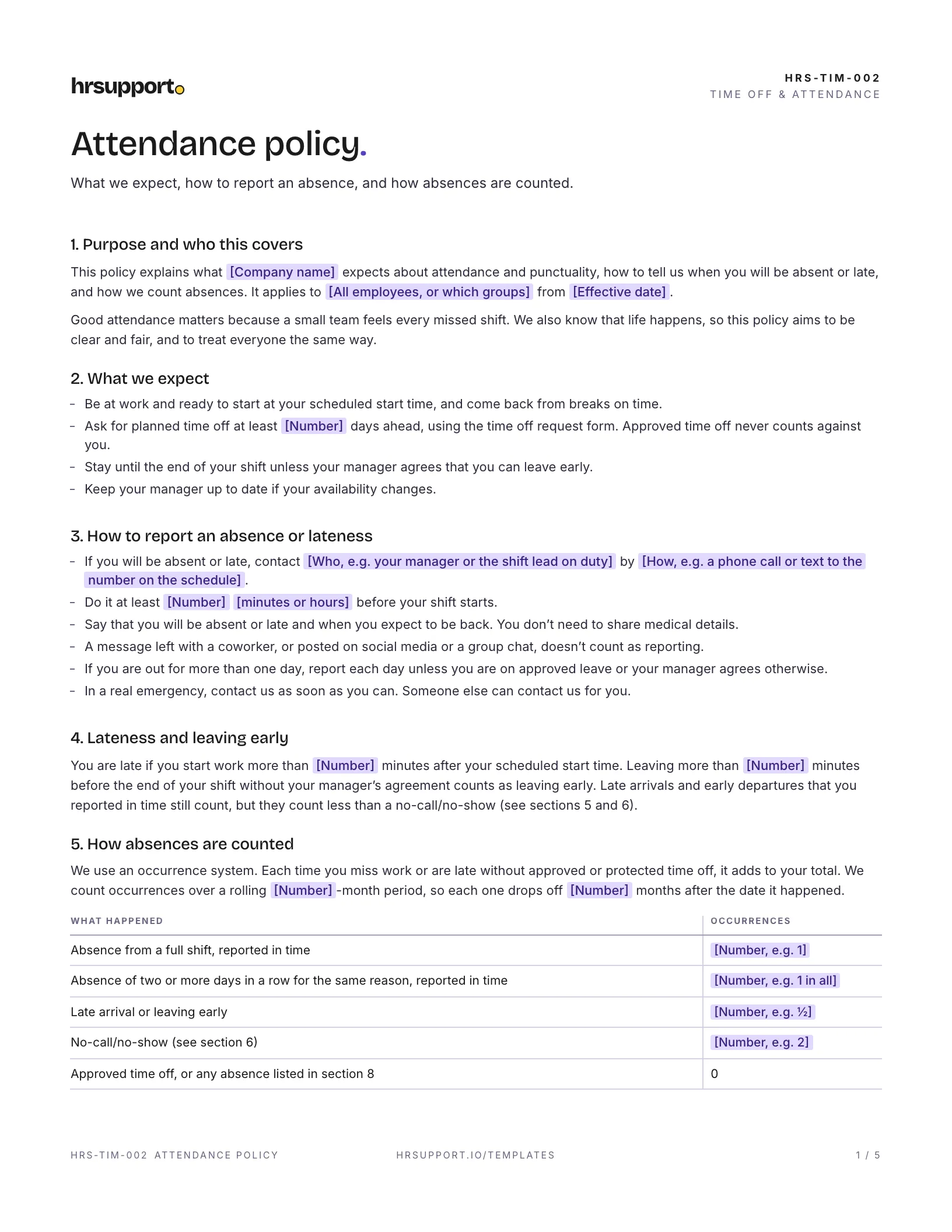
 Attendance Policy TemplateCall-in rules, occurrences, no-call/no-show, discipline steps and a tracker.Free
 Word
Word PDF
PDFA short, fair policy for missed shifts with no word, plus a warning letter to use after one. Set your call-in rule and your steps, and check for protected leave first.
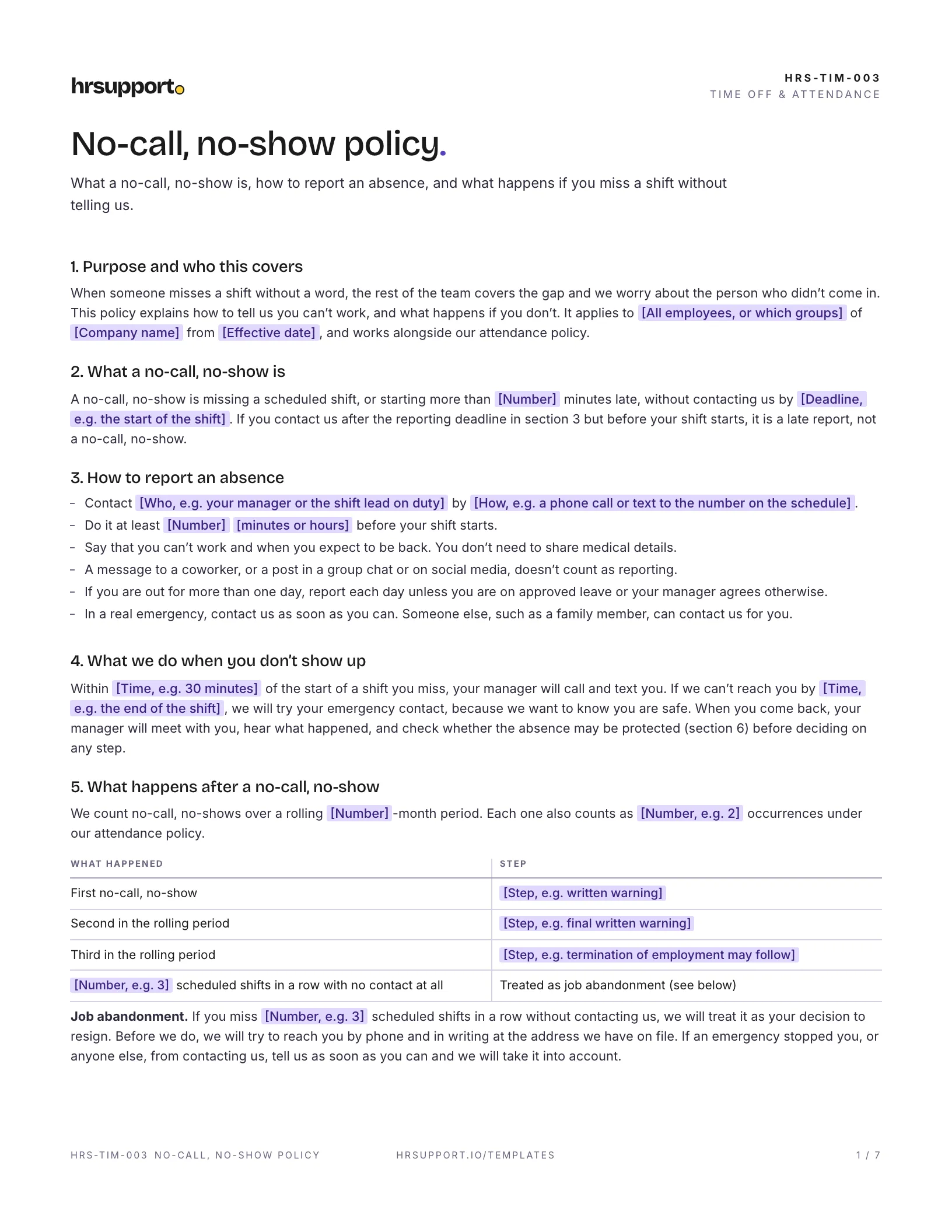
A no call no show policy tells employees exactly how to report an absence, and what happens if they miss a shift without a word. This free no-call, no-show policy template is written for US small businesses that run on shifts. It defines a no-call, no-show, sets the call-in rule, and gives steps for a first, second and third missed shift, plus a job abandonment clause. It also lists the absences you must check before acting. A warning letter for a missed shift completes the set.
A seven-page PDF and a Word file you can edit, sized for US Letter paper:
The policy works on its own or alongside our attendance policy, which uses the same definition and the same job abandonment choice.
The example is a fictional bakery in Spokane, Washington. The owner sets a two-hour call-in rule, a 12-month rolling period and three missed shifts in a row as job abandonment. A baker’s assistant misses a 5:00 a.m. Saturday shift because his phone died overnight. The owner called twice and texted, and he called back that afternoon. At the Monday meeting nothing suggests a protected reason, so he gets a written warning. The letter still gives him a week to raise one. He adds a short comment, and both sign.
People search for a “no call no show termination policy” because they want to know when they can let someone go. In most cases the answer is in your own policy, so it needs to be clear. The template gives you two separate tools. The first is steps for repeat no-call, no-shows within a rolling period, ending with possible termination after the third. The second is a job abandonment clause for an employee who stops coming in altogether. Fill in numbers you’ll actually use, and keep them the same as in any attendance policy you have.
Ending employment this way still ends employment. State final-pay deadlines apply, and a short termination letter confirms the date and the practical details.
A no-call, no-show can turn out to be protected leave. Under the FMLA, which covers private employers with 50 or more employees (DOL), an employee who needs unforeseeable leave must give notice as soon as practicable and generally follow your usual call-in rules. The exception is unusual circumstances: someone who needs emergency medical treatment doesn’t have to call in until they are stable and able to (29 CFR 825.303). You also can’t count FMLA leave under a no-fault attendance policy (29 CFR 825.220).
Employers with 15 or more employees may have to give leave as a reasonable accommodation for a disability, and can’t penalize an employee for using it (EEOC). The same goes for pregnancy-related limitations under the PWFA (EEOC). Some states protect paid sick leave too. For example, Washington bars counting paid sick leave as an absence that can lead to discipline (RCW 49.46.210). Federal law also protects federal jurors (28 U.S.C. 1875) and service members (38 U.S.C. 4311).
Get advice before you discipline or dismiss someone if the absence may be linked to their health, a disability, pregnancy, a family member’s illness, jury duty or military service. Do the same if they’ve recently complained, asked for leave or asked for an accommodation.
Not sure whether a missed shift is protected in your state? hrsupport.io gives HR answers for your state, with the law behind every answer.
Ready to use it? It’s free, and comes with a filled-in example.
Template questions
It's when an employee misses a scheduled shift without contacting their employer beforehand. Most policies set a deadline, such as the start of the shift, and a way to report, such as a call or text to the manager. Calling in late is usually treated differently from not calling at all. This template lets you set both the deadline and how late counts as missing the shift.
It's usually your own policy that decides, so write the number down. Many small businesses give a written warning for the first, a final warning for the second and consider termination after the third within a year. Separately, they treat several missed shifts in a row as job abandonment. Whatever you pick, write it down and apply it the same way to everyone.
One missed shift usually isn't. Job abandonment normally means an employee has stopped coming to work altogether, such as missing three shifts in a row with no contact. It's a policy choice, not a legal rule, so set the number in your policy. Before you treat it as a resignation, call, text and write to the employee and keep a note of each attempt.
Often yes, if your policy says so and you apply it consistently, but check first. The absence may be protected, for example FMLA leave, leave as a disability accommodation, paid sick leave under your state's law, jury duty or military service. A medical emergency can also explain why the employee couldn't call. Hear their side before you decide anything.
Generally yes. Under the federal FMLA rules, an employee who needs unforeseeable leave must give notice as soon as practicable and follow your usual call-in procedure, unless there are unusual circumstances. Someone who needs emergency medical treatment doesn't have to call until they are stable and able to, and a family member can call for them. FMLA leave still can't count against them under a no-fault attendance policy.
The date and shift that was missed, that the employee didn't contact you by the deadline, and who tried to reach them and when. Then add their explanation, the warning level and what happens next time. Invite them to tell you if the absence was for a protected reason, and leave room for their comments. The letter in this template follows that order.
Free HR templates
Attendance Policy TemplateCall-in rules, occurrences, no-call/no-show, discipline steps and a tracker.FreeWordPDF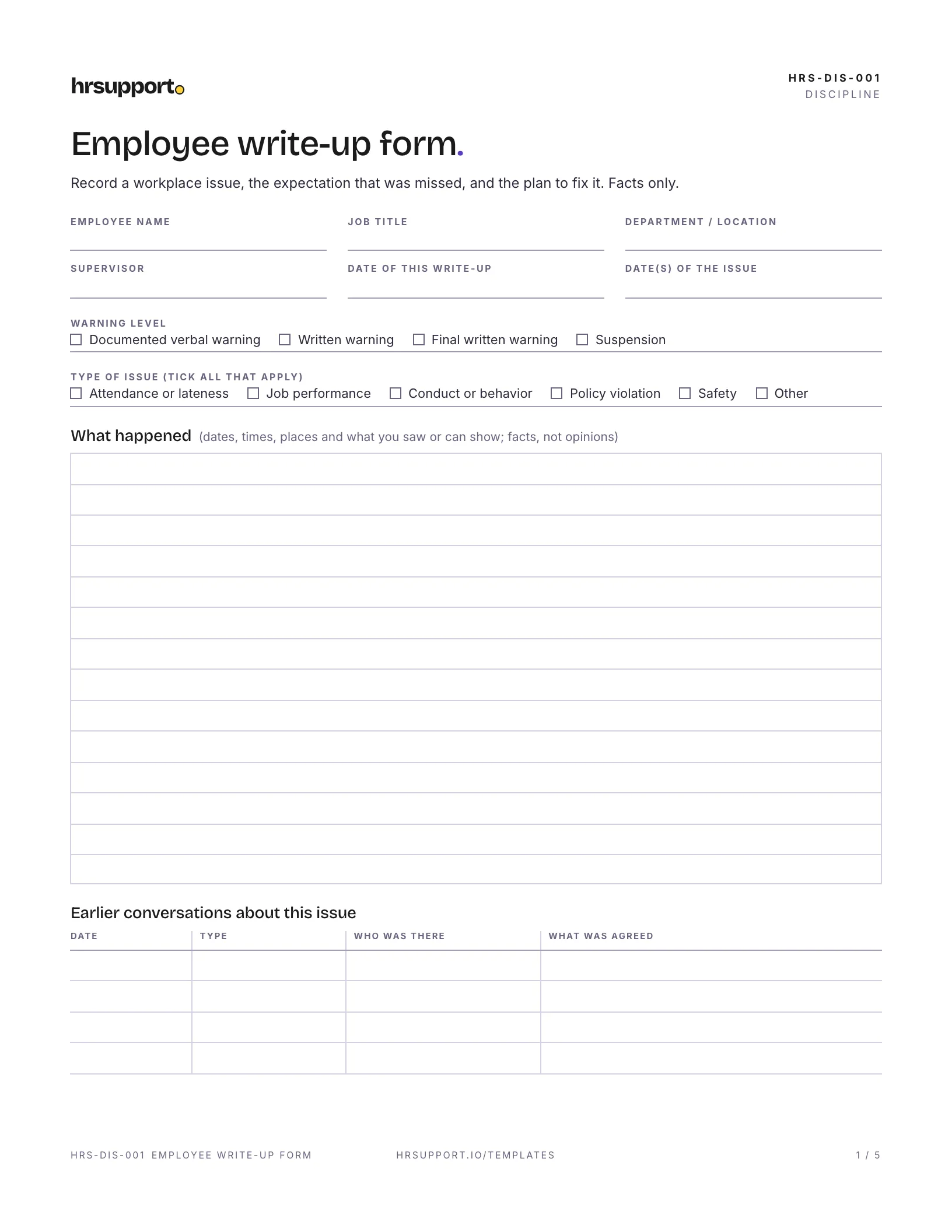 Employee Write-Up FormVerbal, written and final warnings, with an improvement plan and signatures.FreeWordPDF
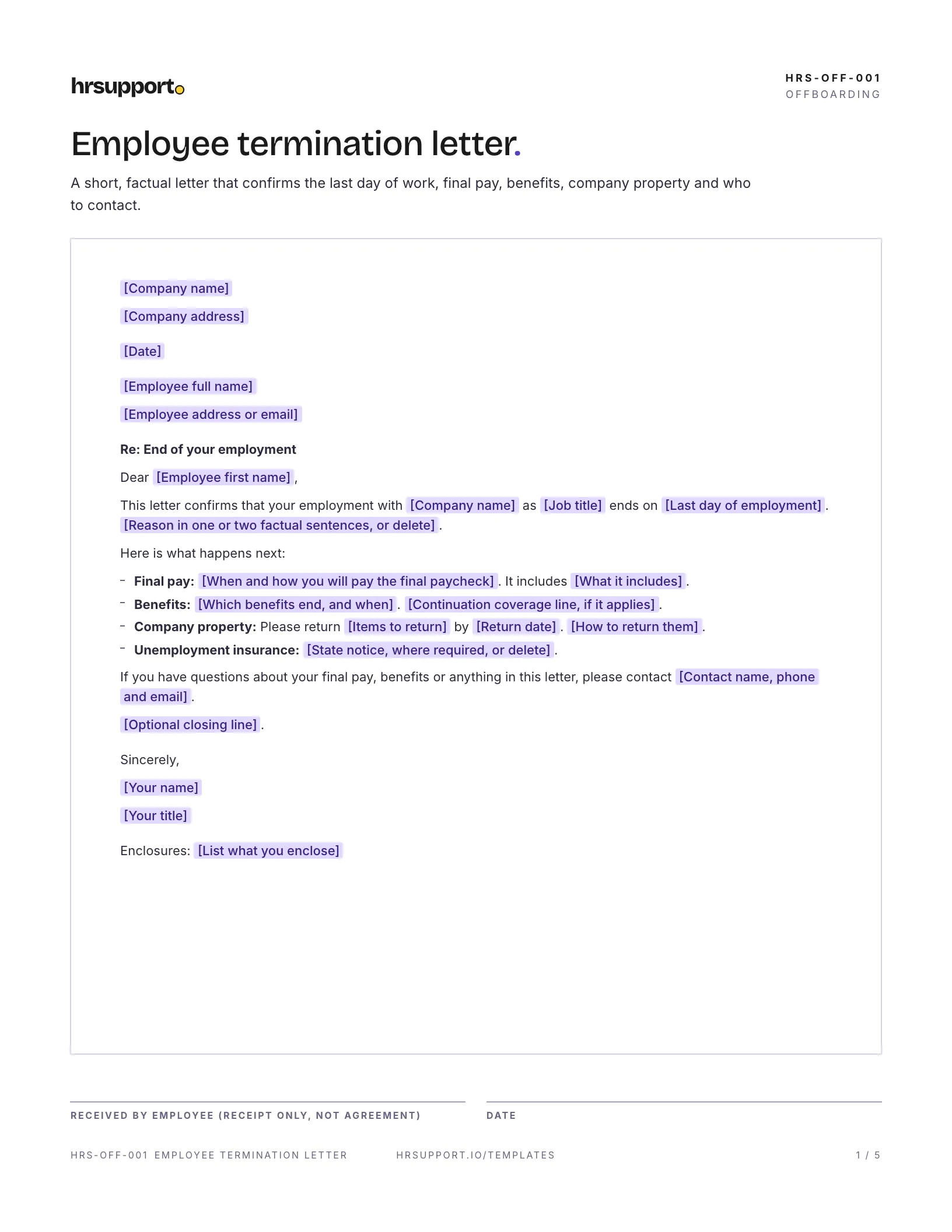 Termination Letter TemplateLast day, final pay, benefits, property and notices, with a termination record.FreeWordPDF
Join the waitlist for early access and early-access pricing. It takes ten seconds.