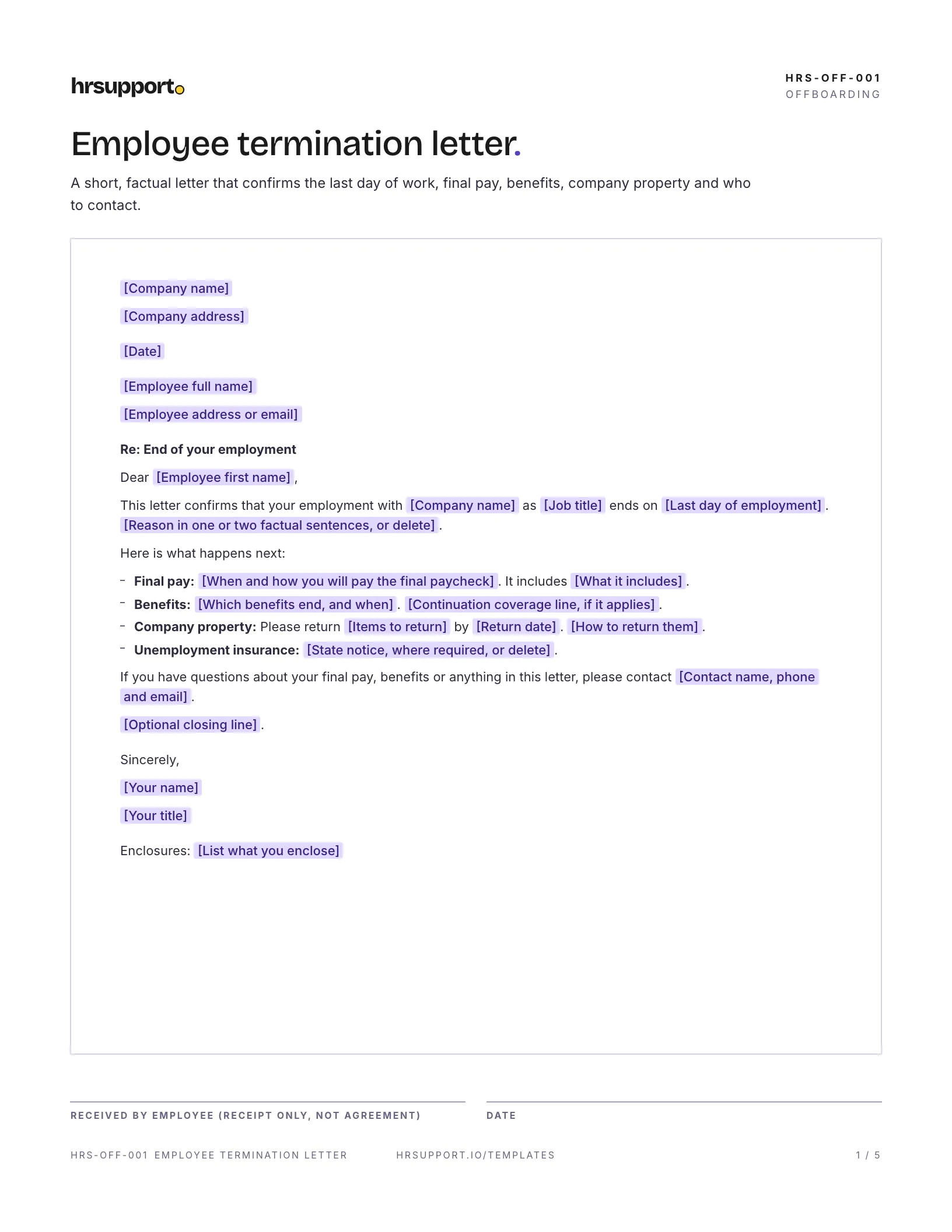
 Termination Letter TemplateLast day, final pay, benefits, property and notices, with a termination record.Free
 Word
Word PDF
PDFEverything to do when an employee leaves, in order, with an owner and a date for each task. Final pay, benefits, property, access and records, so nothing is missed.
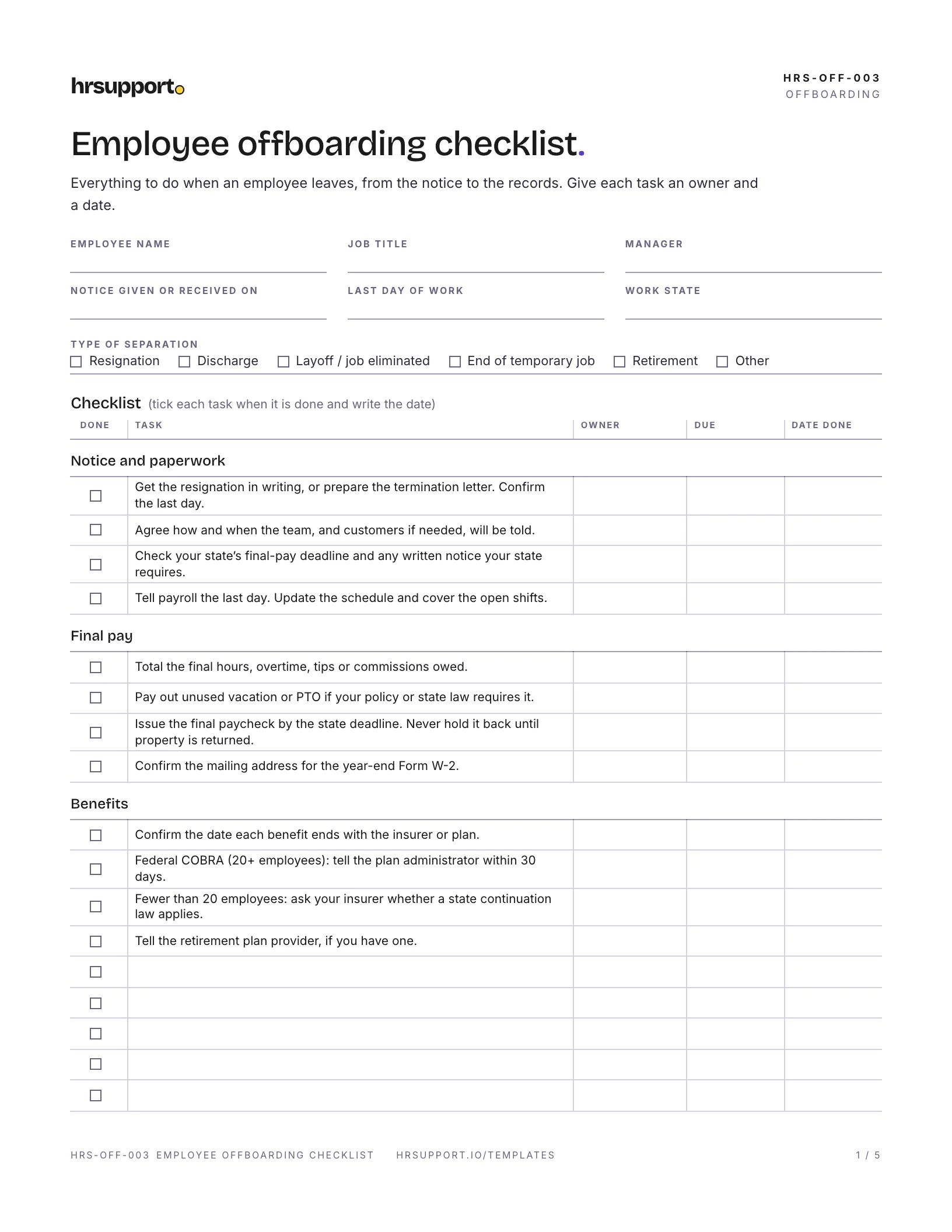
This free offboarding checklist covers everything a US small business needs to do when an employee leaves. That runs from the resignation letter or termination meeting to the records you keep afterwards. It works as an employee offboarding checklist for resignations and as an employee termination checklist when you end the job. Every task has an owner, a due date and a tick box, and the deadlines that matter are printed next to the tasks they apply to.
A five-page PDF, sized for US Letter paper, and an editable Word file:
Page one records the employee, manager, notice date, last day, work state and type of separation. It then lists the notice, final pay and benefits tasks. Page two covers property and access, the knowledge handover, the exit interview and records. It ends with blank rows for job-specific tasks, a notes box and sign-off lines.
The example is a fictional veterinary clinic in San Diego with nine employees. A veterinary technician gives two weeks’ written notice. Because she gave more than 72 hours’ notice, California law makes her final pay due on her last day. The office manager hands over a check with all hours worked and 22 hours of unused vacation. Federal COBRA is marked “not used” because the clinic has fewer than 20 employees, and the insurer confirms it will send a continuation notice. Two job-specific tasks are added in the blank rows. The notes record how long to keep her Form I-9.
Under federal law, you don’t have to pay a former employee immediately, but many states set a deadline. For example:
Check your own state’s rule when you get the notice, not on the last day.
COBRA generally applies to group health plans of employers with 20 or more employees. When an employee’s job ends or their hours are cut, you must tell the plan administrator within 30 days. The administrator then has 14 days to send the employee an election notice (DOL employer’s guide). If you have fewer than 20 employees, ask your insurer whether a state continuation law applies.
Keep a former employee’s Form I-9 for 3 years after the date of hire, or 1 year after employment ends, whichever is later (USCIS). If you have 15 or more employees, EEOC rules require you to keep personnel records for at least one year. Records of an involuntary termination must be kept for one year from the termination date, and longer if a discrimination charge is filed (29 CFR 1602.14).
Offboarding mirrors onboarding. The same paperwork, equipment and access you set up on the first day has to be closed down on the last. If you use our new hire checklist, the two together cover an employee’s whole time with you.
Get advice before you end someone’s employment if they’ve recently complained about discrimination, harassment, pay or safety, asked for an accommodation or taken protected leave. Do the same if they have a contract or belong to a union.
Not sure what your state requires when someone leaves? That’s what hrsupport.io is for: HR answers for your state, with the law behind every answer.
Ready to use it? It’s free, and comes with a filled-in example.
Template questions
The resignation or termination letter and the last day, the state final-pay deadline, final pay including any vacation you must pay out, and benefit end dates and the COBRA notice. Add return of company property, removal of email, software, banking and building access, a handover of open work, an exit interview and the records you must keep. Give each task an owner and a date.
Federal law doesn't require immediate payment, but many states set a deadline. California, for example, requires wages immediately on discharge, and within 72 hours when an employee quits without notice, or on the last day if they gave 72 hours' notice. Washington requires payment at the end of the established pay period. Check your state's rule before the last day.
Federal COBRA generally applies to group health plans of employers with 20 or more employees. When employment ends or hours are cut, you must tell the plan administrator within 30 days. The administrator then has 14 days to send the election notice to the employee. If you have fewer than 20 employees, ask your insurer whether a state continuation law applies.
Keep it for 3 years after the date of hire, or 1 year after employment ends, whichever is later. USCIS explains it this way. If someone worked for you for less than two years, keep the form for three years from their first day. If they worked for more than two years, keep it for one year after they leave.
Don't. The state final-pay deadline still applies whether or not keys, uniforms or equipment have come back. List what needs returning on the checklist and in the resignation acknowledgment or termination letter, give a return date, and follow up. If something isn't returned, get advice before deducting anything from pay, because state rules on deductions vary.
Nothing, really. "Employee termination checklist" is often used when the employer ends the job, and "offboarding checklist" covers every departure, including resignations and retirements. The tasks are the same either way: notice, final pay, benefits, property, access, handover and records. This template has a tick box for the type of separation.
Free HR templates
Termination Letter TemplateLast day, final pay, benefits, property and notices, with a termination record.FreeWordPDF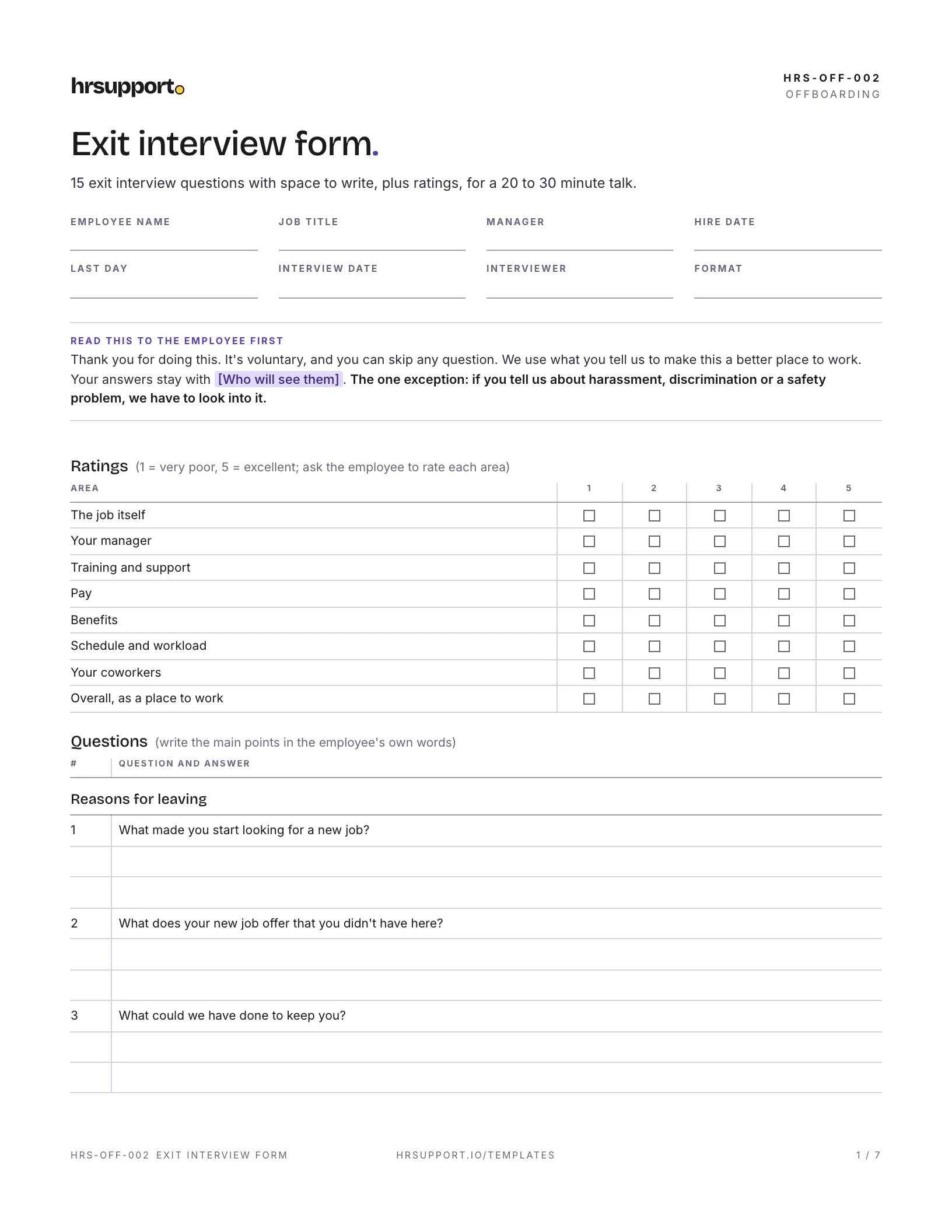 Exit Interview Questions and Form15 questions in five groups, 1–5 ratings and a follow-up box.FreeWordPDF
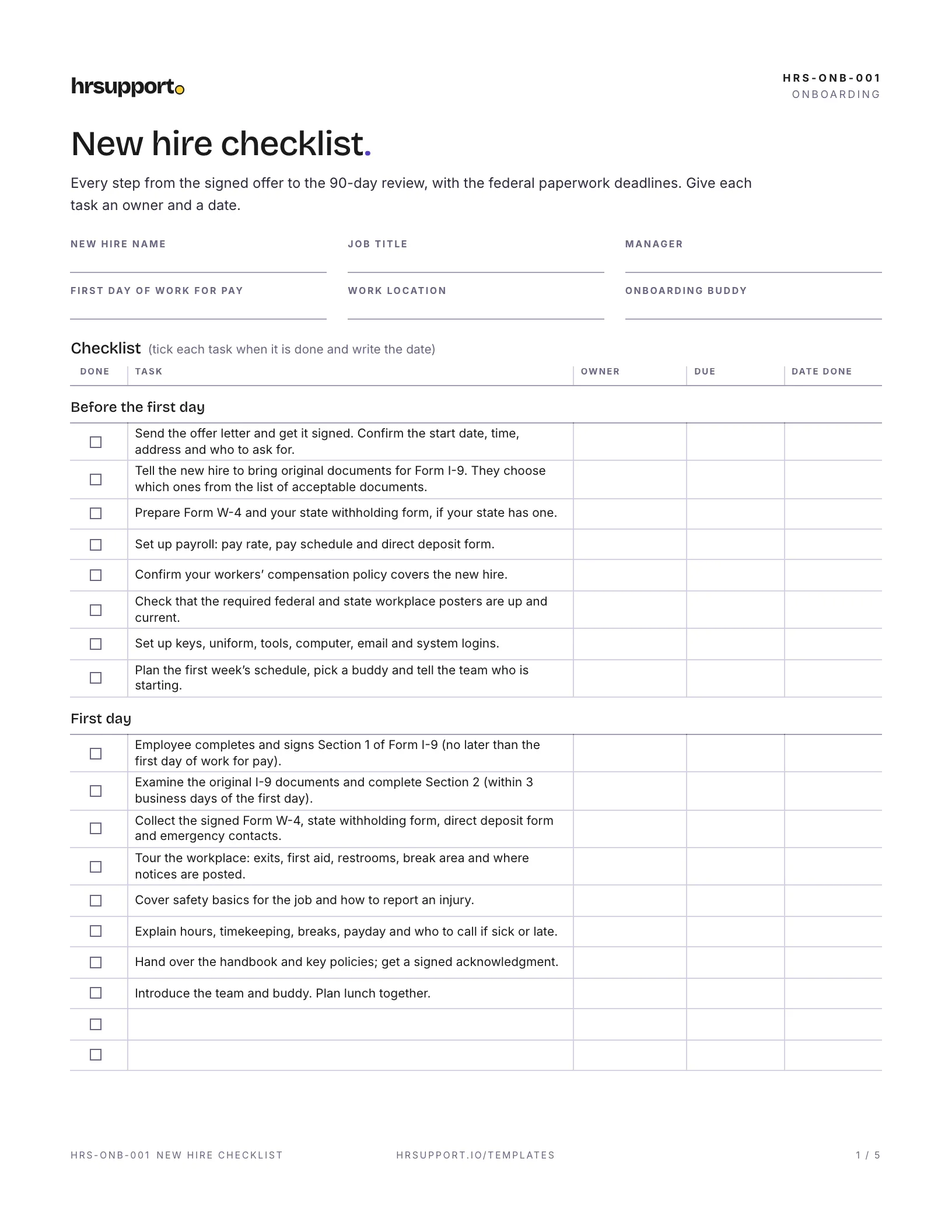 New Hire ChecklistBefore day one to the 90-day review, with the I-9, W-4 and state reporting deadlines.FreeWordPDF
Join the waitlist for early access and early-access pricing. It takes ten seconds.