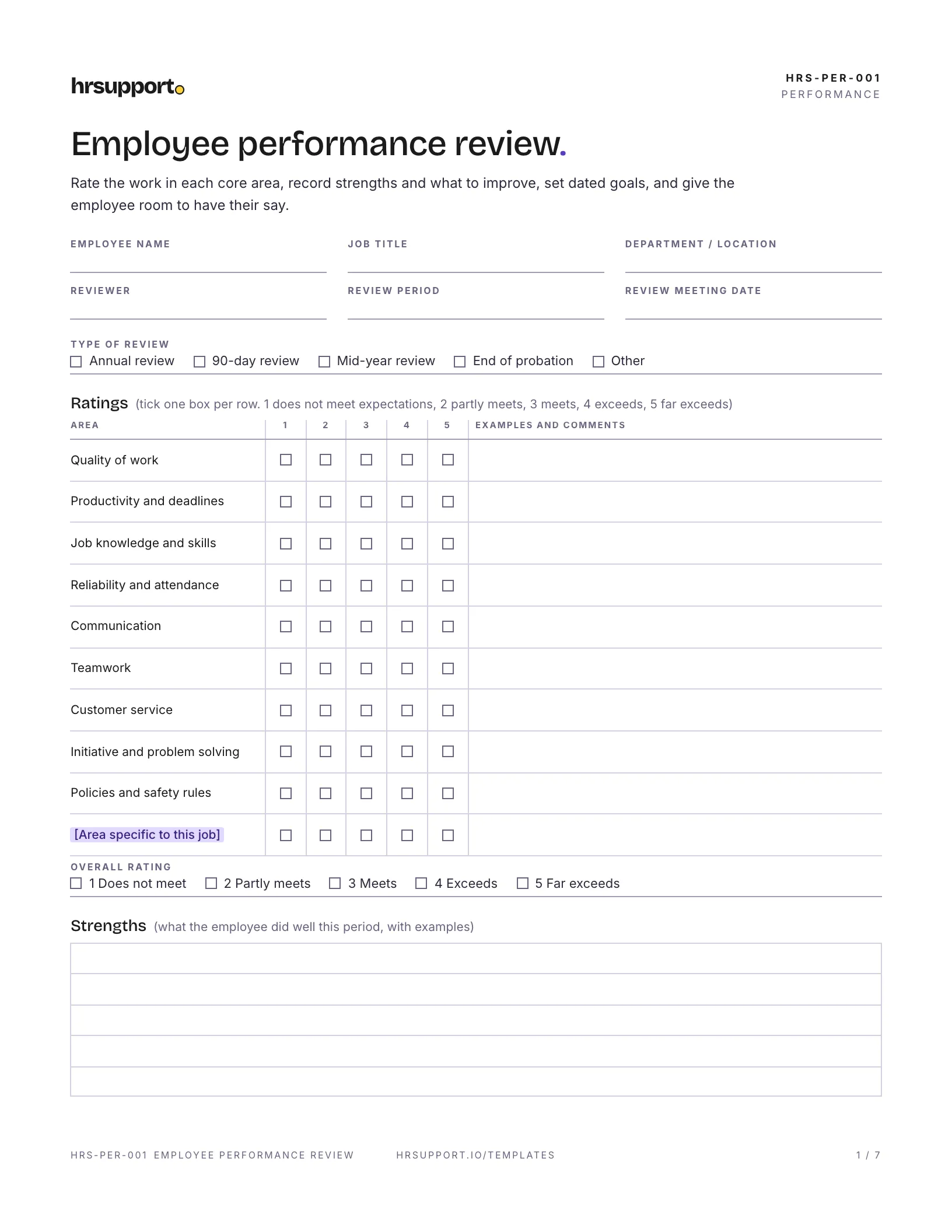
 Performance Review TemplateAnnual or 90-day review with 1–5 ratings, goals, self-assessment and signatures.Free
 Word
Word PDF
PDFA phrase bank for managers writing reviews. Pick a phrase for the right area and rating, add one real example, and you have a comment the employee can act on.
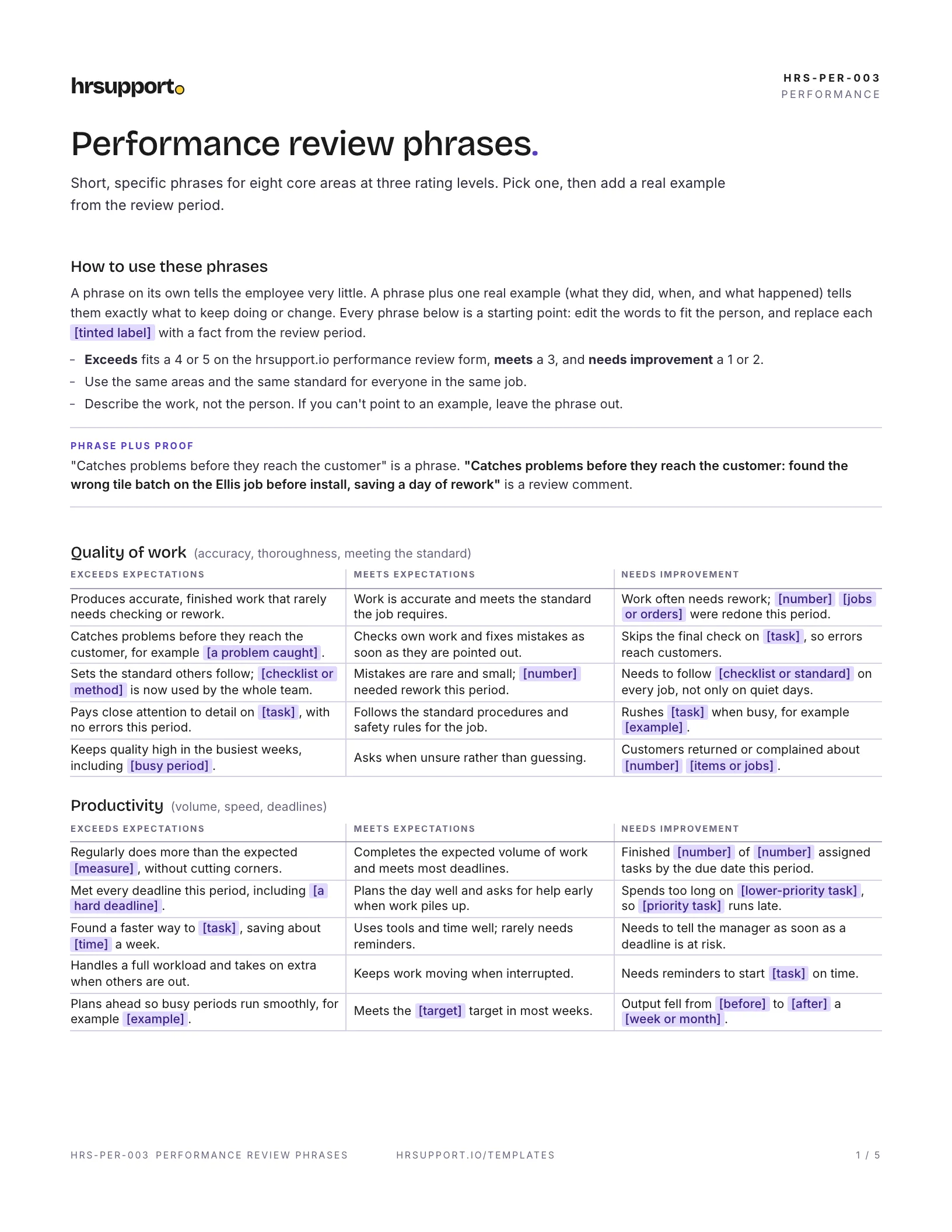
These free performance review phrases give managers a starting point for every comment on a review. There are 120 short phrases, grouped by skill and by rating level, each with room for a real example. Use them with any review form, including our free performance review template, to write comments that are specific, fair and easy for the employee to act on.
A five-page PDF and an editable Word file, sized for US Letter paper:
Each phrase has a highlighted [placeholder] where you add a fact: a number, a date, a task or an example. The Word version lets you copy phrases straight into your own review form.
A sample from each area of the PDF:
For job knowledge, describe what the person can do without help: “Handles every routine estimate alone; still learning commercial jobs.”
Two kinds of comment cause trouble. The first is anything about a protected trait. Federal law protects race, color, religion, sex (including pregnancy, sexual orientation and transgender status), national origin, age (40 or older), disability and genetic information, according to the EEOC. So “lots of energy for someone her age”, “less focused since the pregnancy” and “hard to understand” all invite a claim. Family medical history counts as genetic information. Stereotypes about caregivers can be sex or disability discrimination, according to EEOC guidance.
Leave also needs care. If you are covered by the FMLA, FMLA leave can’t be used as a negative factor or counted under a no-fault attendance policy (29 CFR 825.220). Count only absences that aren’t protected.
The second kind is the vague label: “bad attitude”, “not a team player”, “too emotional”, “always late”. These feel personal, and they don’t tell the employee what to change. Replace each with what happened and when.
End the review with two or three sentences that match the ratings: the main achievement, the one or two things to work on, and what happens next. For example: “A solid year in a demanding job. The next step is building estimates alone, and we will support that with two training sessions.” The summary should never surprise someone whose ratings say otherwise.
If an employee links a problem to a medical condition, you don’t have to raise an accurate rating. But you should talk about whether an accommodation would help, according to EEOC guidance under the ADA. Pause and get advice if the employee has recently complained about discrimination, asked for an accommodation or taken protected leave. The EEOC lists a performance evaluation that is “lower than it should be” as one example of possible retaliation. For an employee who is struggling, a performance improvement plan is the better next step.
Want a second opinion on a tricky review, or on what your state adds? That’s what hrsupport.io is for: HR answers for your state, with the law behind every answer.
Ready to use it? It’s free, and comes with a filled-in example.
Template questions
Good phrases describe a behavior or a result, not a personality, and leave room for a real example. "Catches problems before they reach the customer" is a good start. Add what happened, such as "found the wrong tile batch before install, saving a day of rework", and the employee knows exactly what to keep doing. This phrase bank has 120 of them across eight areas.
Name what the person did, give one example with a date or a number, and say why it mattered. "Trained two new hires in June and wrote the opening checklist the team now uses" is far more useful than "great team player". Specific praise shows you noticed, and it tells the employee which habits to keep.
Stick to facts and the standard. Say what happened, how often, and what good looks like, for example "Late 5 times since June 1; the schedule starts at 8:00." Then agree a goal with a date and the help you will give. Avoid labels like "lazy" or "bad attitude". They feel personal, and the employee can't act on them.
Leave out anything about age, pregnancy, health, family or caregiving, national origin or accent, religion, race, sex, sexual orientation or transgender status. Federal law protects these traits. Don't count protected leave against attendance, and avoid vague labels like "not a culture fit". The phrases to avoid page lists common examples, why each is a problem, and what to write instead.
For strong work: "Produces accurate, finished work that rarely needs checking or rework." For solid work: "Work is accurate and meets the standard the job requires." For work that needs to improve: "Work often needs rework; 6 orders were redone this period." Each one works best with a real example from the review period.
Use the same areas and the same standard for everyone in the same job, but not the same wording. Reviews that all read alike suggest the manager didn't look closely. Pick the phrase that fits, rewrite it in your own words, and add an example that only applies to that person. The example is what makes a comment believable.
Free HR templates
Performance Review TemplateAnnual or 90-day review with 1–5 ratings, goals, self-assessment and signatures.FreeWordPDF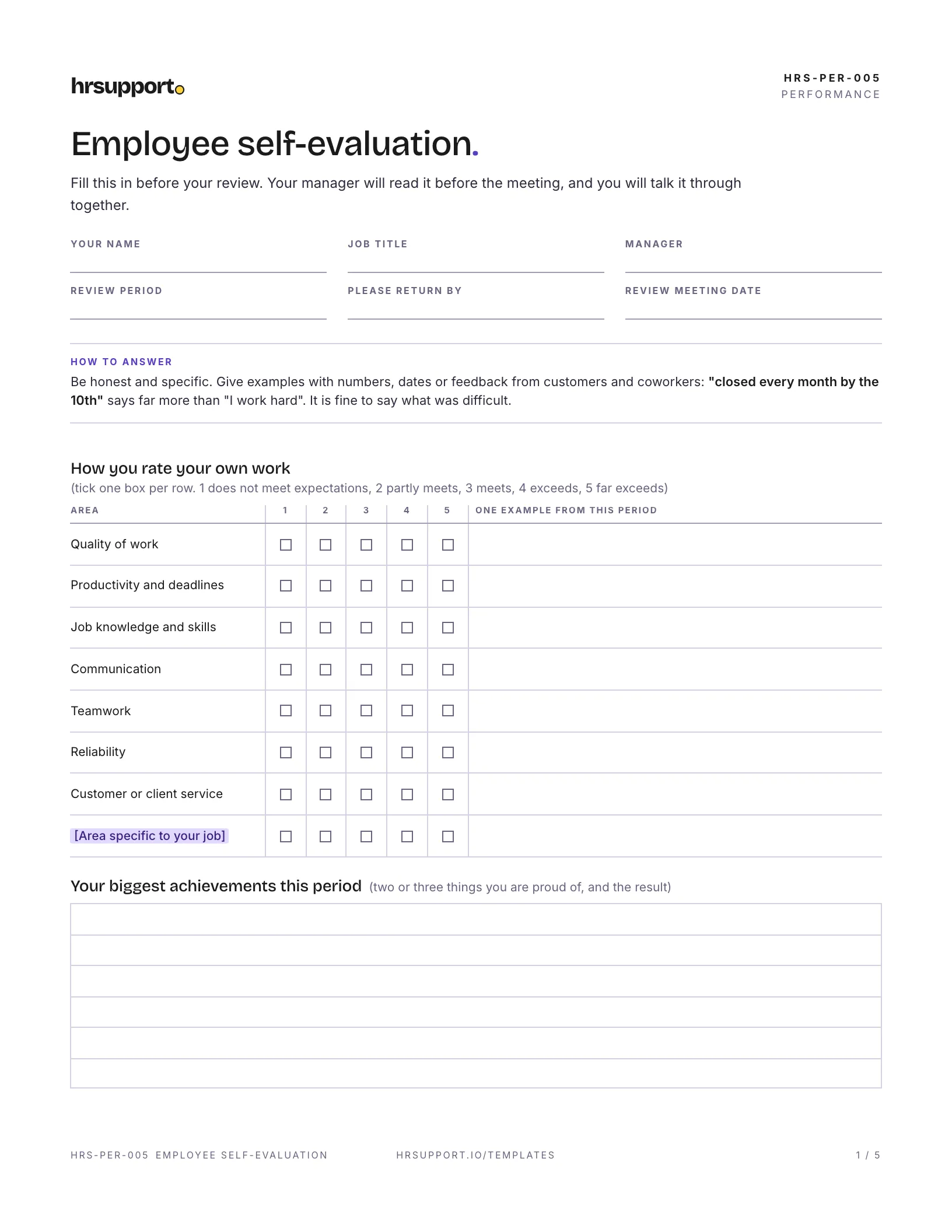 Employee Self-Evaluation FormTwo-page self-evaluation to hand out before a review, with example answers.FreeWordPDF
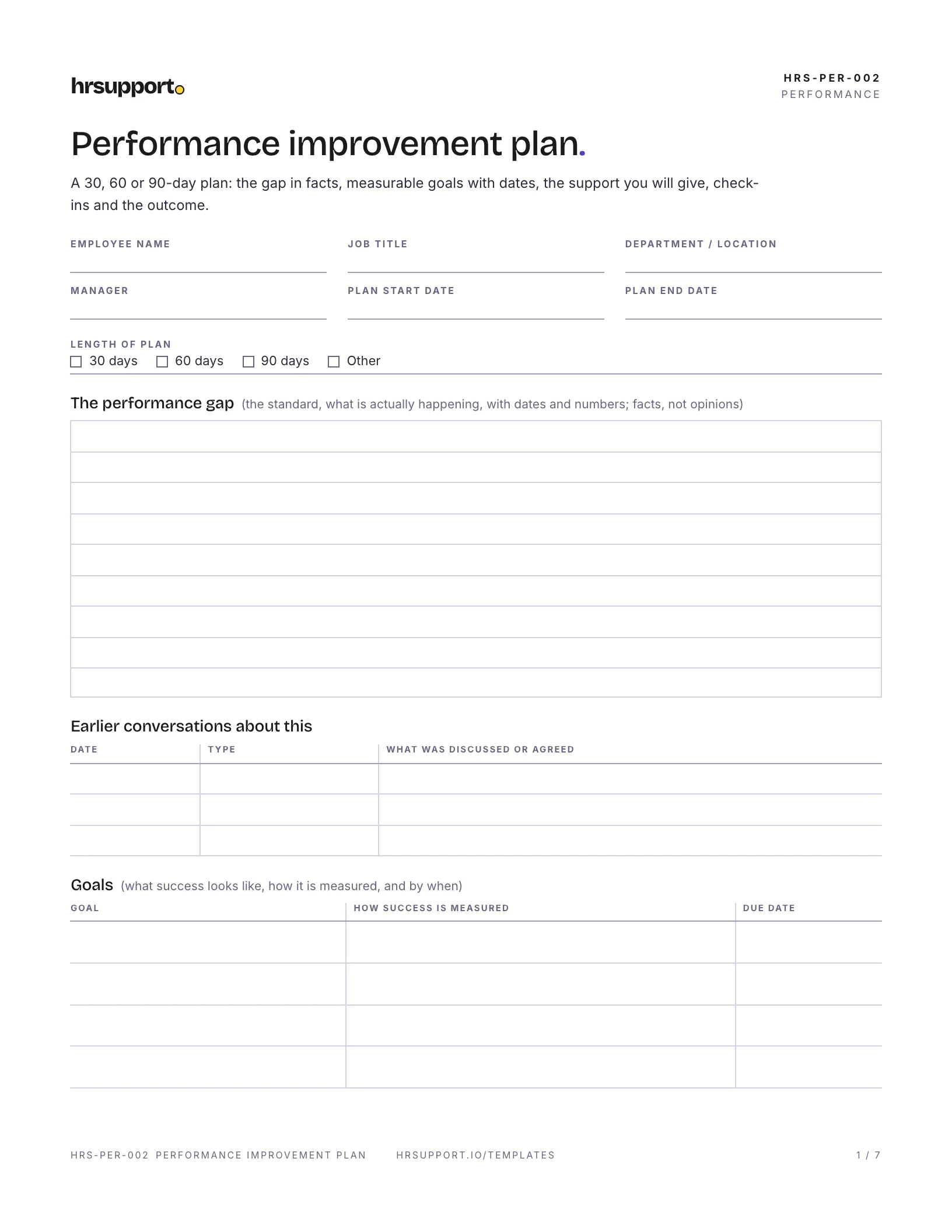 Performance Improvement Plan Template30/60/90-day PIP with measurable goals, support, check-ins and an outcome page.FreeWordPDF
Join the waitlist for early access and early-access pricing. It takes ten seconds.