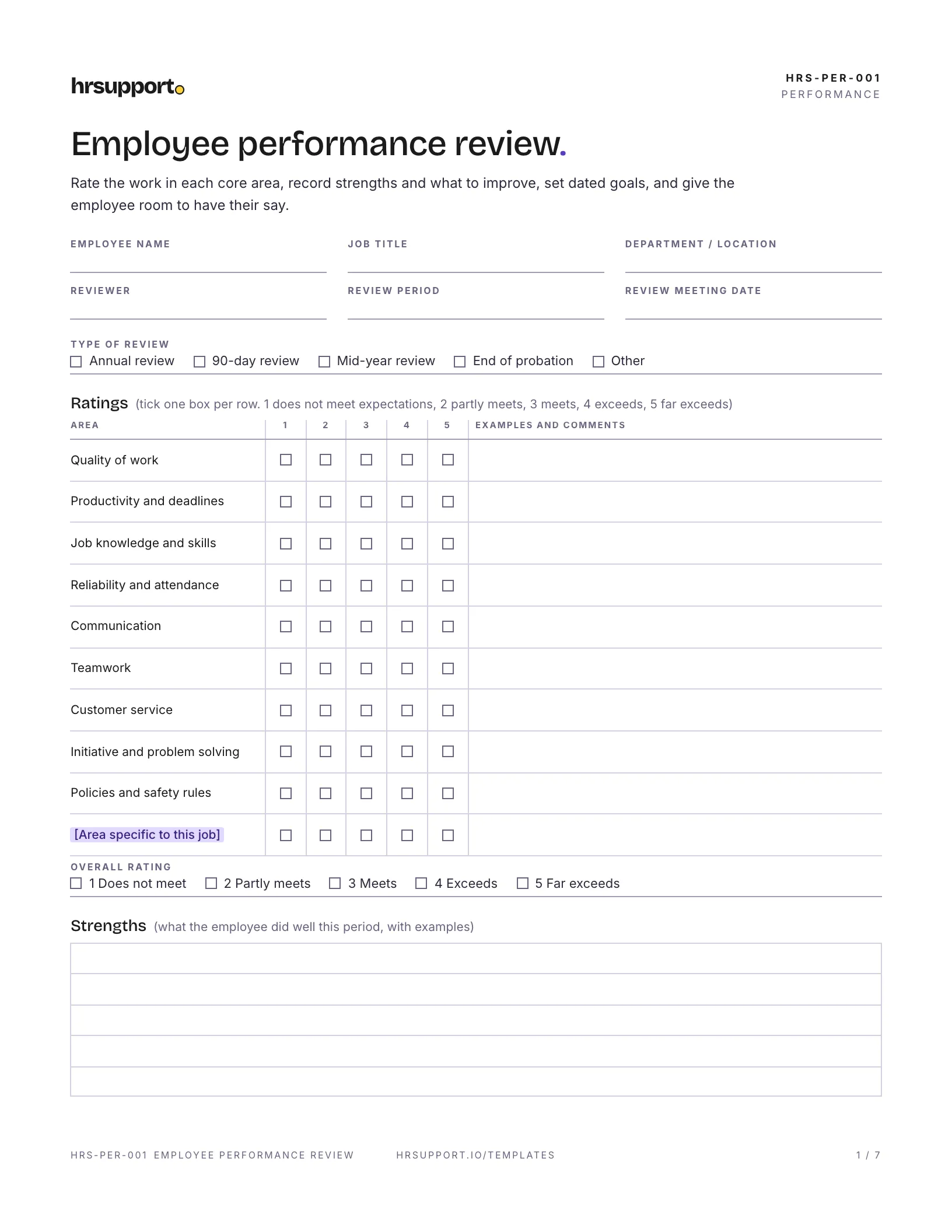
 Performance Review TemplateAnnual or 90-day review with 1–5 ratings, goals, self-assessment and signatures.Free
 Word
Word PDF
PDFA two-page form employees fill in before their performance review, with a completed example and good example answers for every section.
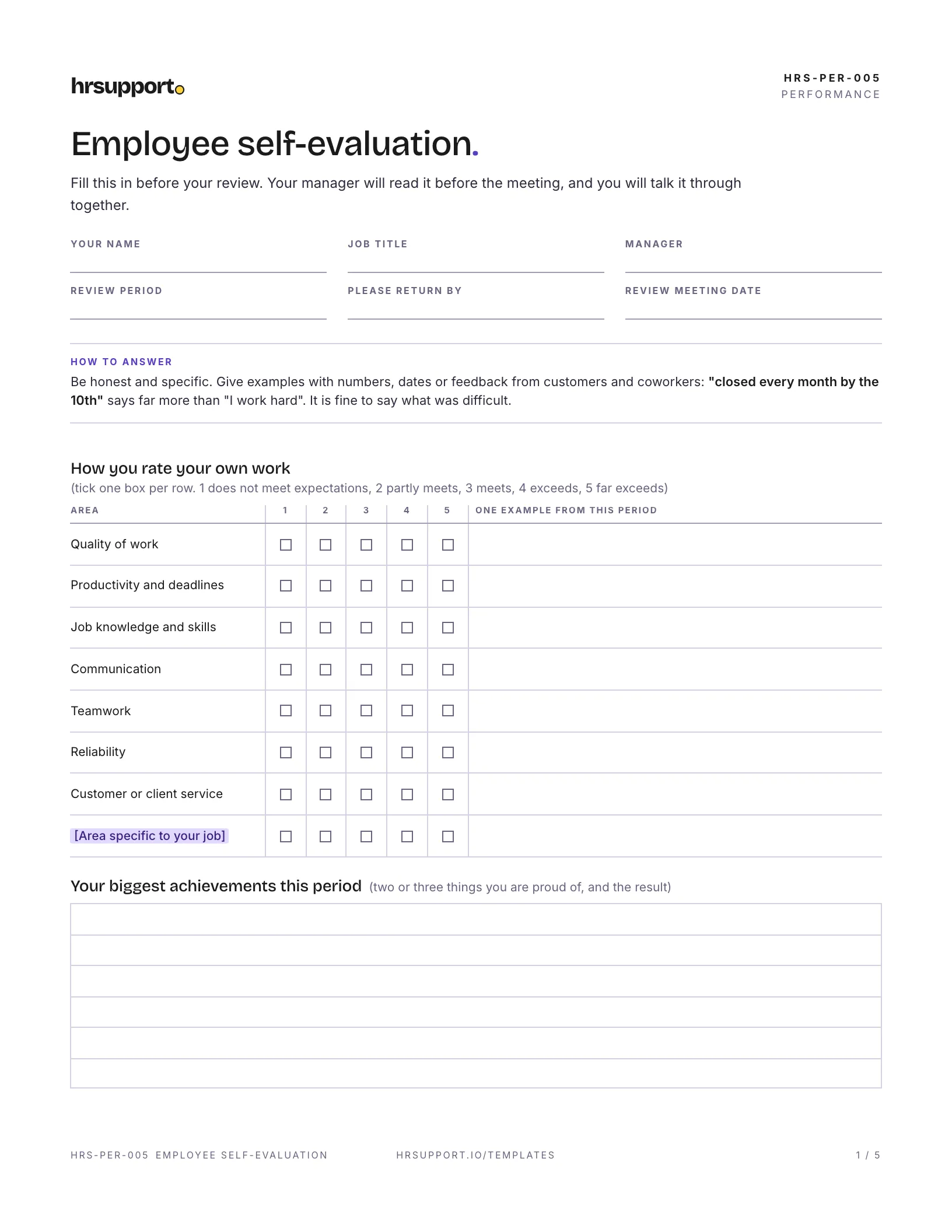
This free employee self-evaluation form is for managers to hand out before a performance review. The employee rates their own work, lists their biggest achievements, names what was difficult, and proposes goals for the next period. It uses the same areas and 1–5 scale as our performance review template, so you can read the two side by side. Below the download there are self evaluation examples for every section, for employees writing their own.
A five-page PDF and an editable Word file, sized for US Letter paper:
Page one has the employee, manager and dates, a short “how to answer” box, and the self-ratings table. The table covers eight areas on a 1–5 scale, with a column for one example per area. It ends with the employee’s biggest achievements. Page two covers what was difficult and what they learned, what would help, a goals table, space for anything else, and signatures. In the Word version you can rename the rating areas to fit the job.
The example is filled in by a bookkeeper at a fictional bookkeeping firm. She rates herself a 4 in most areas, a 3 for job knowledge and communication, and a 5 for month-end close, with a short example on every row. Her achievements: 6 new clients, every month closed by the 10th, and a checklist that cut her close from three days to two. Under “what was difficult” she owns a sales tax return filed a day late, and says what she changed. Her three goals each have a measure, the support she needs and a date.
Short, specific answers work best. Adapt these to your own job:
For more wording, our performance review phrases list 120 short phrases by skill and rating level. Many work just as well in the first person.
Start with a list of what you did this period: projects, numbers, thank-you messages, problems you solved. Pick the two or three that mattered most and write one sentence on each, with the result. Rate each area honestly and back each rating with one example. Name one thing that was hard and what you did about it. Finish with what would help you and where you want to go next. Keep it to the facts; your manager will ask about the rest in the meeting.
Sometimes an employee uses the form to raise discrimination or harassment, or to ask for an accommodation. Treat it like any other complaint or request and act on it. The EEOC lists raising these as protected activity, so nothing that follows should look like punishment (EEOC: Retaliation). With 15 or more employees, keep the form with the review for at least a year (29 CFR 1602.14).
Not sure how to handle something an employee wrote? That’s what hrsupport.io is for: HR answers for your state, with the law behind every answer.
Ready to use it? It’s free, and comes with a filled-in example.
Template questions
Your two or three biggest achievements, each with a result; an honest rating for each part of the job with one example; one thing that was difficult and what you learned; what would help you do better; and two or three goals with a measure and a date. Use numbers, dates and feedback from customers or coworkers wherever you can.
Rate yourself honestly against what the job requires. Straight 5s look unrealistic, and underrating yourself can anchor your manager low. A mix of 3s and 4s, each backed by a real example, is more believable. If you rate yourself higher than you expect your manager to, give your strongest example on that row.
Be honest and focus on what you did about it. Name the problem in one or two sentences, say what you learned and what you changed, and point to any progress since. Then ask for the help you need, such as training or more time with your manager. Owning a problem early usually goes down better than avoiding it.
Strong examples name the skill and prove it. "I trained two new hires this spring, and both now work the register alone" is better than "I'm a great team player". Others: "Every payroll run went out on time" or "Customers mentioned me by name in 9 online reviews." One sentence, one skill, one piece of proof.
About two weeks before the review meeting, with a return date a few days before it. That gives the employee time to think and gather examples, and gives you time to read it before you finish your own ratings. For a 90-day review, a week is usually enough.
Read it before you finish your ratings, and compare the two. Where you differ by two or more points, start there in the meeting; that gap is the most useful thing to discuss. Use the employee's goals and the support they ask for as the starting point for the review goals. File the form with the review.
Free HR templates
Performance Review TemplateAnnual or 90-day review with 1–5 ratings, goals, self-assessment and signatures.FreeWordPDF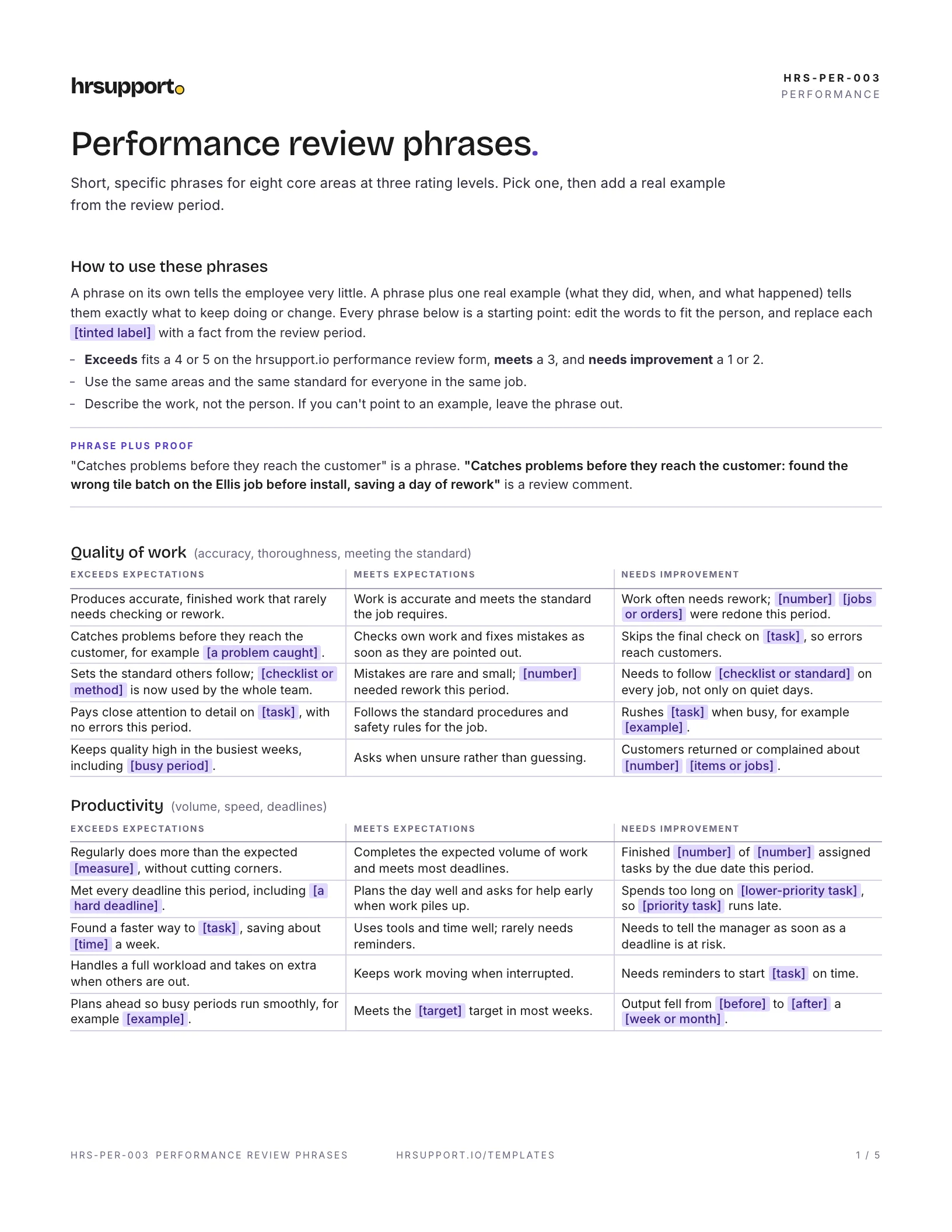 Performance Review Phrases120 review phrases across 8 skills and 3 rating levels, plus phrases to avoid.FreeWordPDF
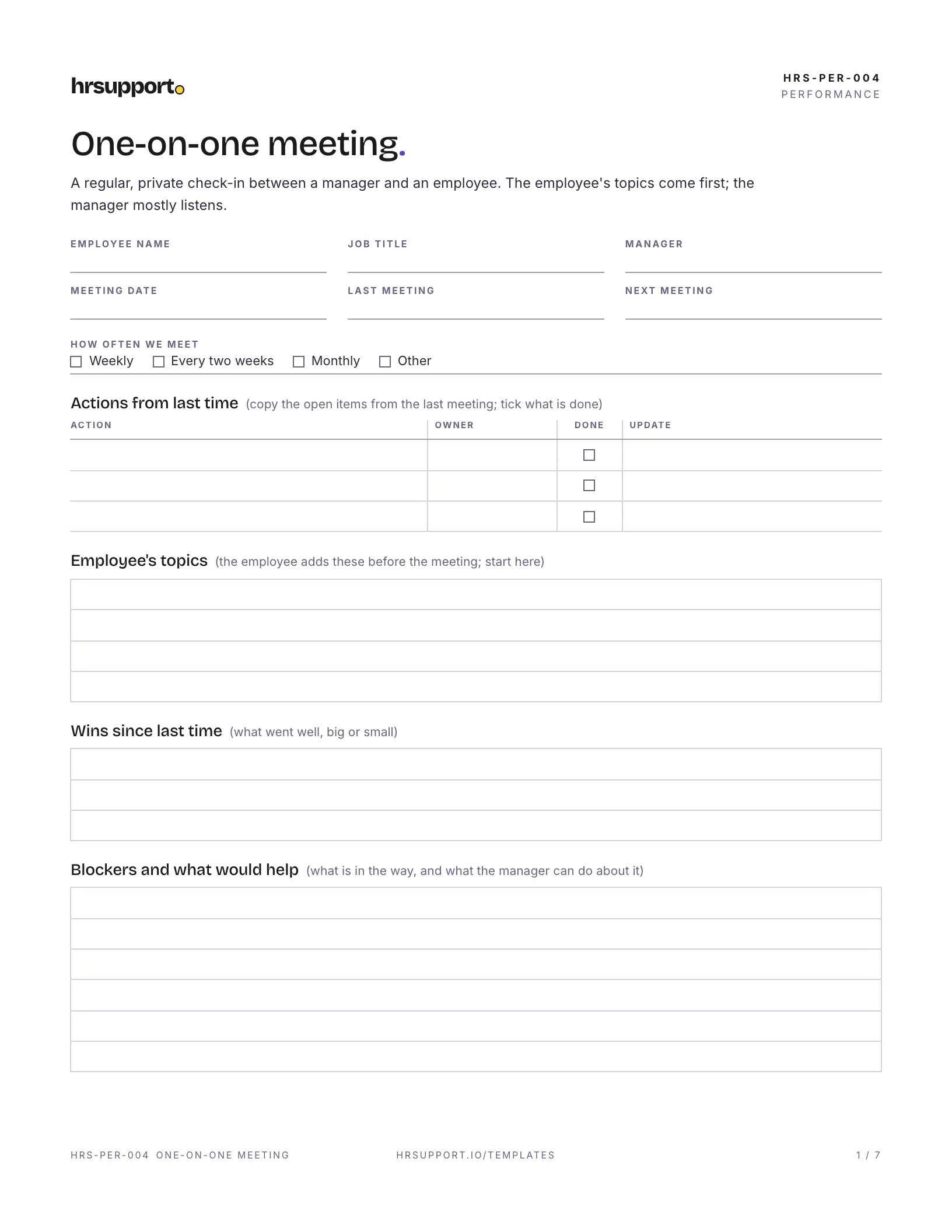 One-on-One Meeting TemplateAgenda, notes, action items and 15 questions for regular manager check-ins.FreeWordPDF
Join the waitlist for early access and early-access pricing. It takes ten seconds.