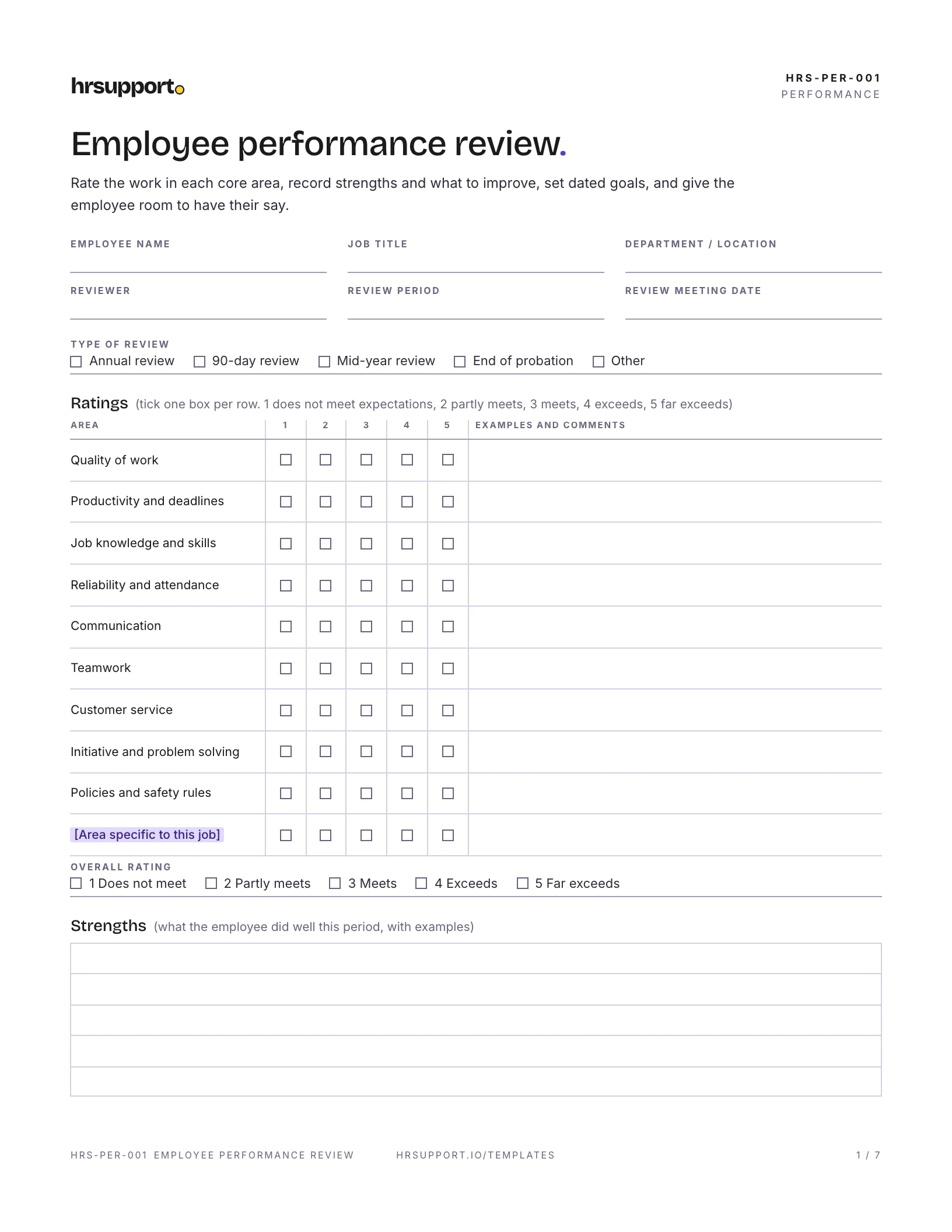
 Performance Review TemplateAnnual or 90-day review with 1–5 ratings, goals, self-assessment and signatures.Free
 Word
 PDF
A two-page individual development plan for small teams with little or no training budget. Agree a few SMART goals together, start with on-the-job actions, and check progress every quarter.
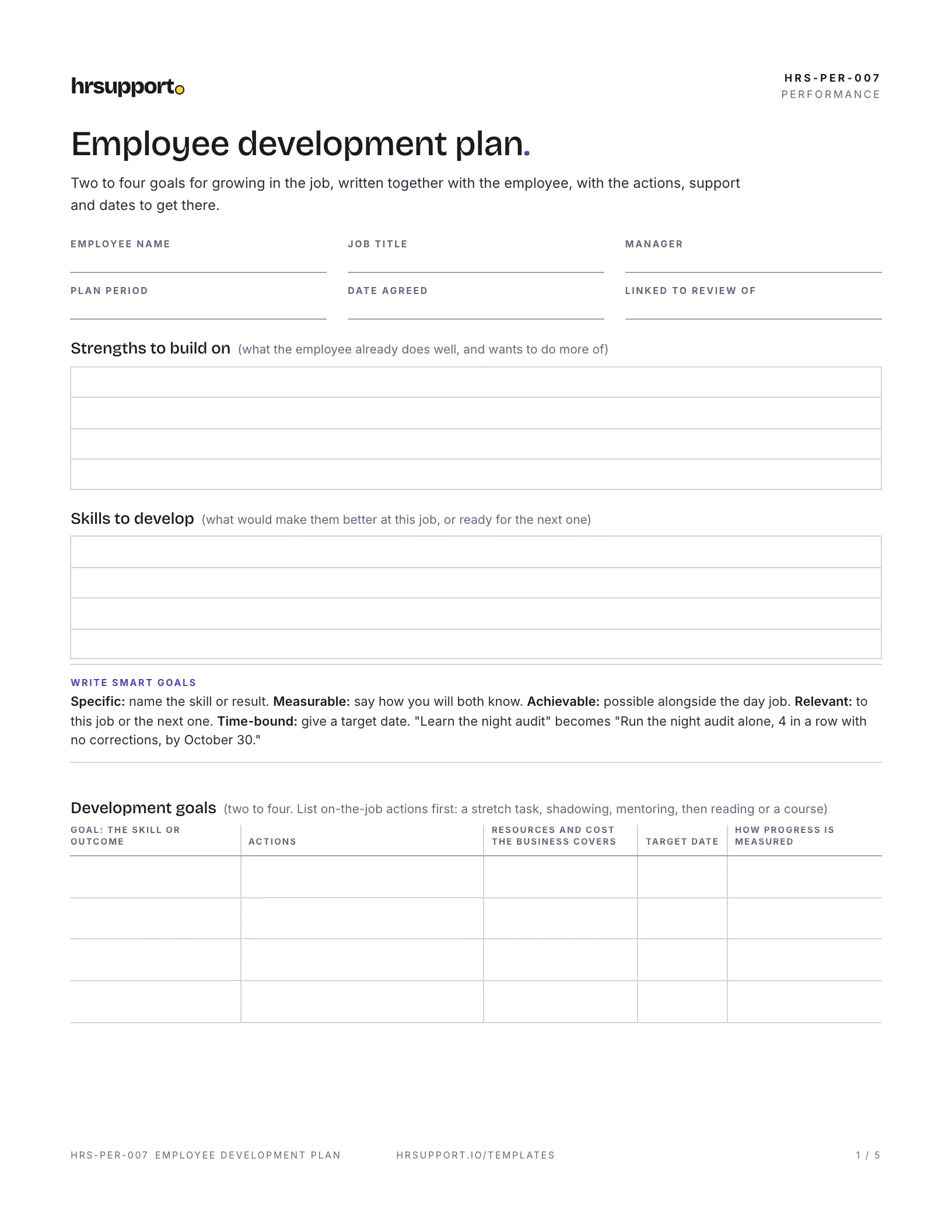
An employee development plan template helps you and an employee agree, in writing, how they will grow over the next six to twelve months. This free individual development plan (IDP) is built for small businesses with little or no training budget. It records the employee’s strengths and the skills to develop, two to four SMART goals with on-the-job actions first, the support you’ll give, and a quarterly check-in log, all on two pages.
A five-page PDF and an editable Word file, sized for US Letter paper:
Page one records the employee, job, manager, plan period and the review it comes from. It has space for strengths to build on and skills to develop, and a short guide to writing SMART goals. Below that is the goals table, with columns for each goal’s actions, the resources and cost the business covers, a target date and how progress is measured. Page two covers career interests (the next role and a rough timeline), the support the employee needs from you, a quarterly check-in log, comments and signatures.
SMART stands for Specific, Measurable, Achievable, Relevant and Time-bound. The guide on page one of the template turns a vague aim into a goal you can check:
If you can’t say how you’d know the goal was met, it isn’t measurable yet. If it can’t be done alongside the normal job, cut it down or move the date.
Most small businesses can’t send people on expensive courses, and they don’t need to. The template puts on-the-job actions first:
Spend money only on the one or two skills you can’t teach in-house, and write the amount on the plan.
The example is a plan for a front desk agent at a fictional 14-person country inn, agreed after her mid-year review. Her four goals are to run the night audit without help, handle group and wedding bookings, write a check-in checklist and use it to train new staff, and learn the basics of room pricing. Three of the four cost nothing but the owner’s and assistant manager’s time. The fourth uses an online course with a fee cap and set paid hours. Her career interest is assistant manager in about two years, written as an interest, not a promise. The check-in log shows the first quarterly check-in, with honest progress and one change agreed.
An individual development plan, a professional development plan and a career development plan are all names for the same thing: a short, agreed plan for one person’s growth. Some put more weight on the current job, others on the next role. This template covers both, with goals for the job on page one and career interests on page two. If you’re planning who could step into key roles in the business, use the plans as the “development needed” part of a succession plan.
Under the federal Fair Labor Standards Act, time a nonexempt employee spends at training, lectures or meetings counts as hours worked unless all four of these are true. It is outside regular working hours. It is truly voluntary. It is not directly related to the job. And the employee does no productive work during it (29 CFR 785.27). Training meant to make someone better at their current job is directly related to it (29 CFR 785.29). So most of what goes in a development plan is paid time. The Department of Labor sums up the rule in Fact Sheet #22. Your state may add its own rules.
Want answers to the HR questions that come up as your team grows? That’s what hrsupport.io is for: HR answers for your state, with the law behind every answer.
Ready to use it? It’s free, and comes with a filled-in example.
Template questions
A written plan, agreed between a manager and an employee, for building the skills the employee needs in their job or for the next one. It lists a few goals, the actions to reach each one, the support the business gives, target dates and how progress is measured. It is also called an individual development plan, or IDP, a professional development plan or a career development plan.
The employee's strengths and the skills they need to develop, two to four goals with actions, resources and a target date, and how each goal is measured. Add the employee's career interests, the support they need from their manager, a log of check-ins and both signatures. Keep it to two pages; a longer plan rarely gets read again.
Make each goal Specific (the skill or result), Measurable (how you will both know), Achievable alongside the day job, Relevant to this job or the next one, and Time-bound with a date. "Get better at scheduling" becomes "Build the weekly schedule alone, with no gaps in cover, by March 31." Two to four SMART goals a year is plenty for most people.
Use the work itself. Give a stretch task from a more senior job, with support. Pair people for shadowing and cross-training, which also gives you cover. Have the owner or an experienced employee mentor someone in a set weekly slot. Use free training from suppliers, software vendors and trade groups. Save paid courses for the one or two skills you can't teach in-house.
For nonexempt employees, usually yes. Under the federal Fair Labor Standards Act, training time is hours worked unless all four are true. It is outside regular hours. It is truly voluntary. It is not directly related to the job. And the employee does no productive work during it. Training that makes someone better at their current job is directly related to it, so it counts.
A development plan is for growth. The employee is doing the job, and the plan builds skills for this job or the next one. A performance improvement plan is for a problem. It sets out what must improve, by when, and what happens if it doesn't. Don't call a PIP a development plan, and don't use a development plan to fix serious performance problems.
Free HR templates
Performance Review TemplateAnnual or 90-day review with 1–5 ratings, goals, self-assessment and signatures.FreeWordPDF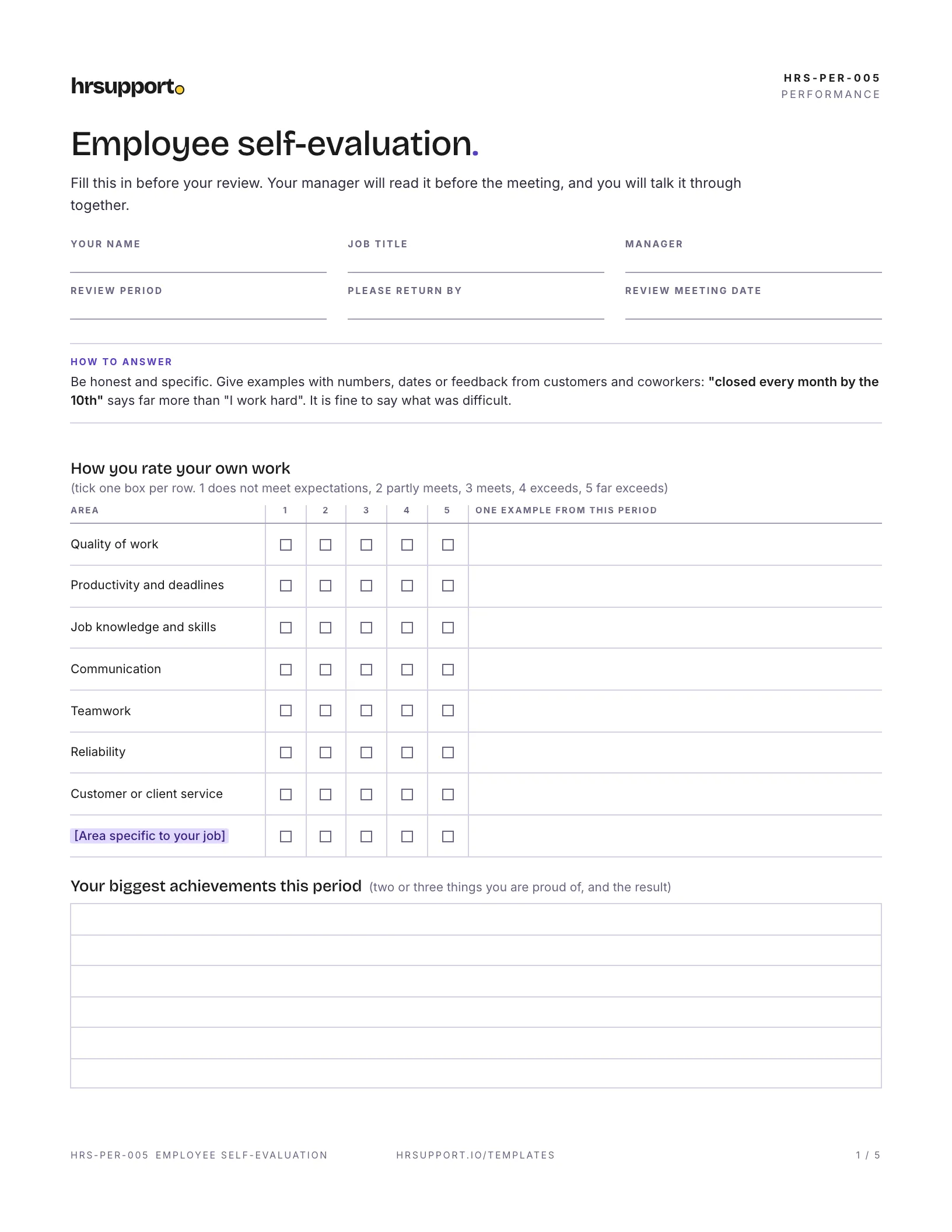 Employee Self-Evaluation FormTwo-page self-evaluation to hand out before a review, with example answers.FreeWordPDF
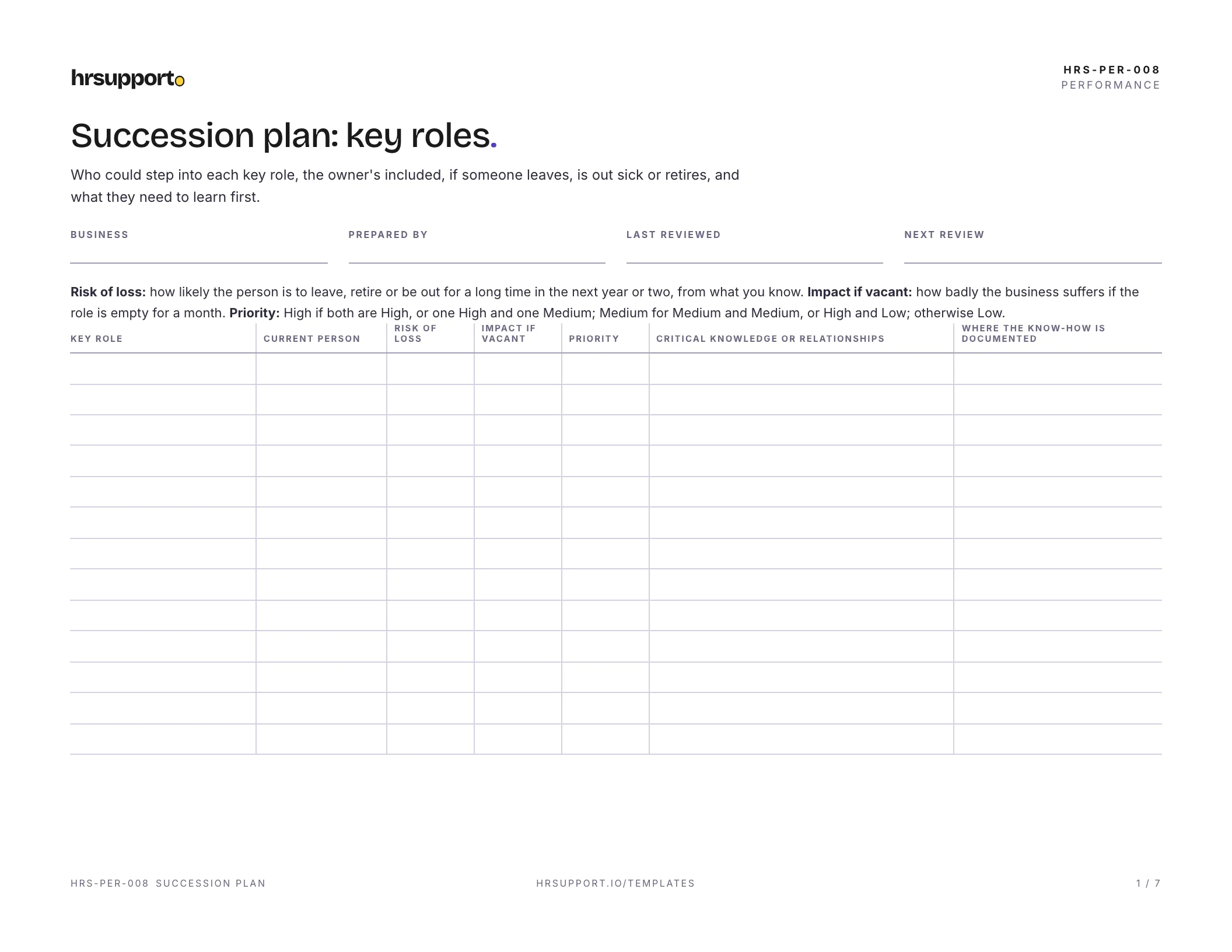 Succession Planning TemplateKey roles by risk, successors and readiness, gap summary and an emergency cover plan.Free
 ExcelPDF
Join the waitlist for early access and early-access pricing. It takes ten seconds.