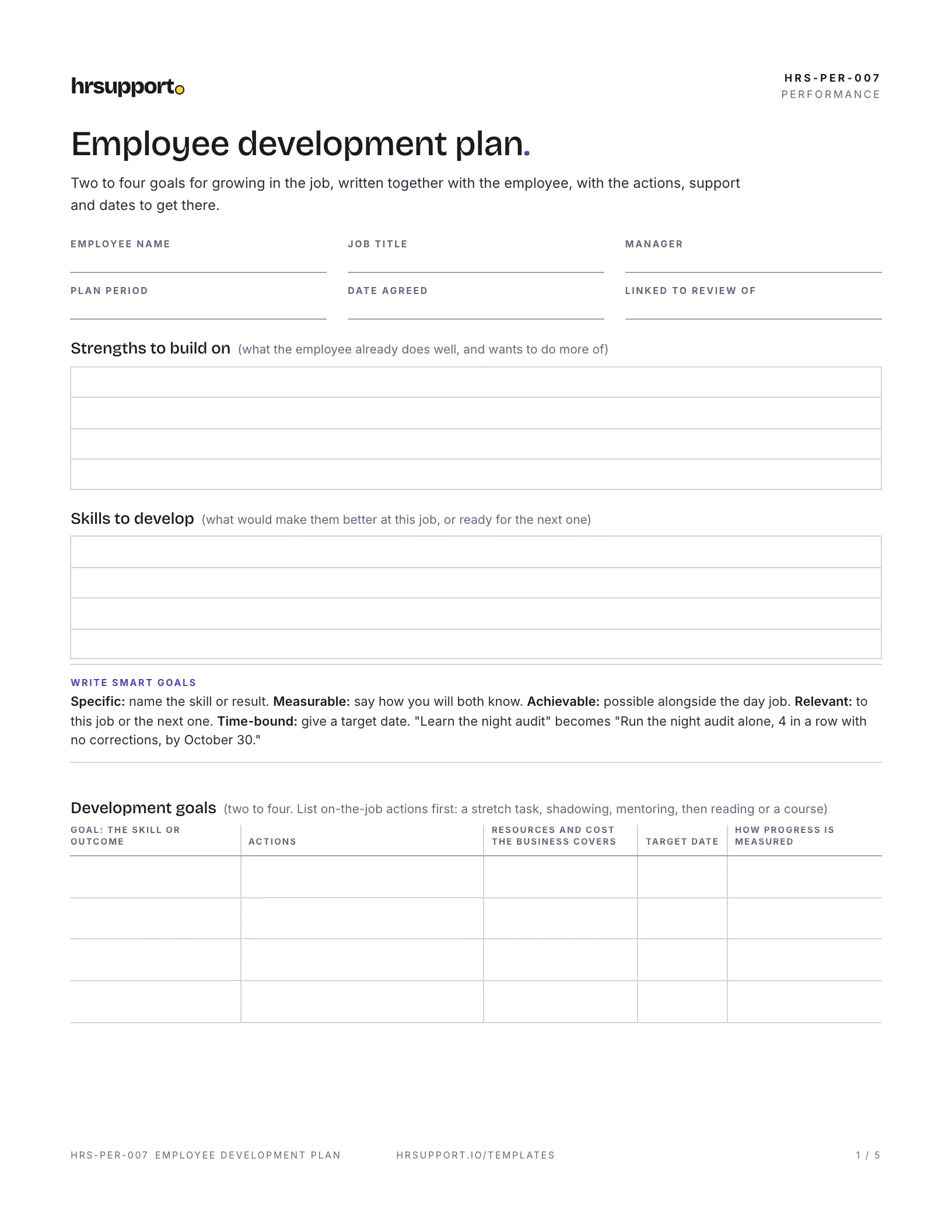
 Employee Development Plan TemplateTwo-page IDP with SMART goals, on-the-job actions, support and a check-in log.Free
 Word
 PDF
An Excel succession plan for a small team, plus a printable version. List your key roles, your own included, name who could step in and how ready they are, and see at a glance where the business is exposed.
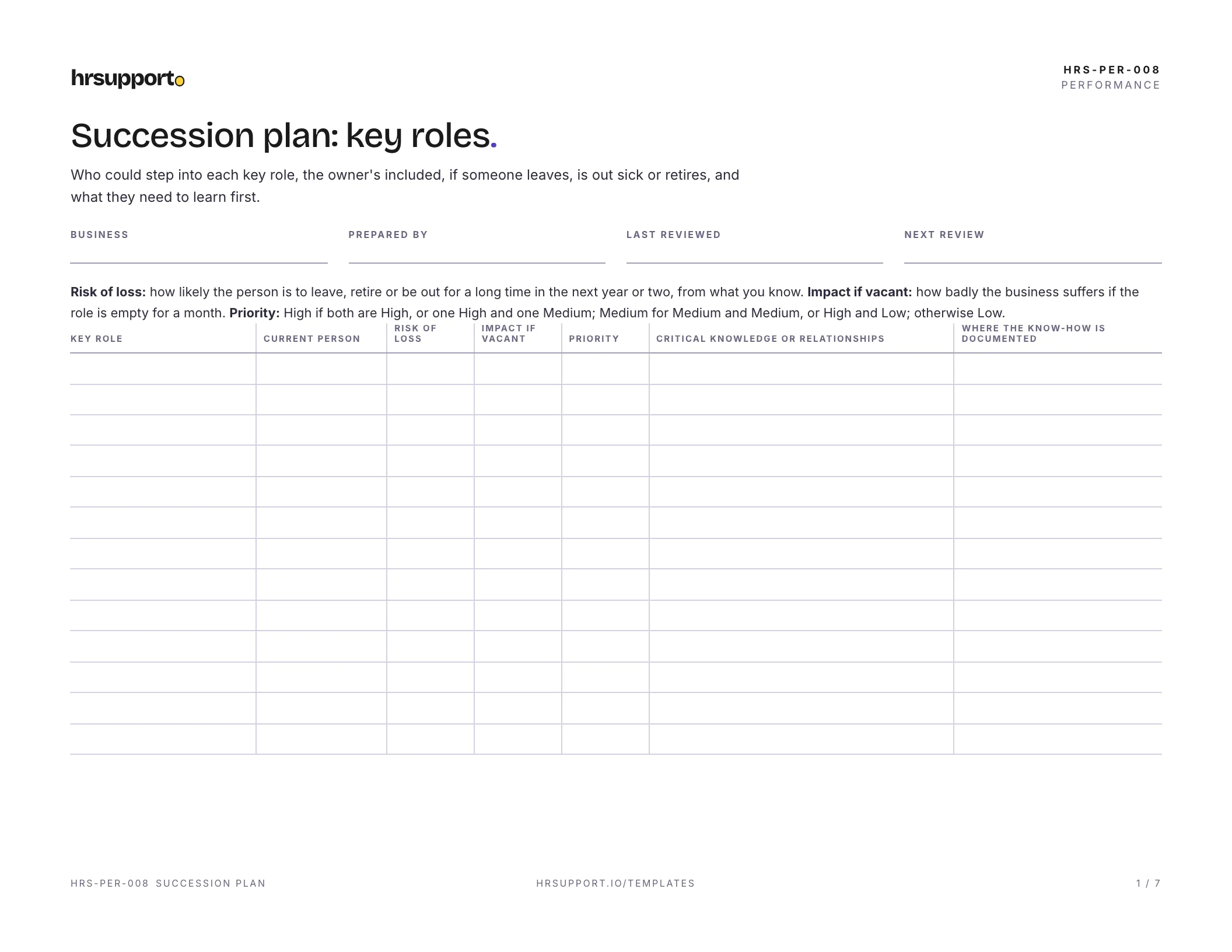
A succession planning template helps you answer one question before you need to: if a key person left, retired or was out sick for months, who would step in? This free succession planning template is an Excel workbook for small businesses, with a printable PDF. You list your key roles, the owner’s included, rate the risk of losing each person and the impact if the role were empty, and name who could take over and how ready they are. The workbook works out a priority for each role and flags the gaps.
An Excel workbook and a seven-page PDF, sized for US Letter landscape:
The workbook opens with sample rows for a fictional machine shop already typed in, so you can see the formulas work. Select the lavender cells and press Delete to start your own.
The example is a fictional machine shop with 25 employees. Eight key roles are listed, from the owner and general manager to the shipping lead. Four come out High priority: the owner, the shop foreman, the part-time bookkeeper and the estimator. The estimator has a successor ready now, since the owner used to do the quoting, but the other three don’t, so the Summary lists them as the gaps to work on first. Each successor has a short development note, such as “schedule the shop two days a week with Luis”. The estimator’s pricing know-how isn’t written down anywhere, which the Summary counts too. The emergency cover plan shows who signs checks, runs payroll and talks to the bank if the owner is suddenly out.
In a business of 5 to 50 people, the most important key role is usually the owner’s. Ask what would happen if you were out for a month starting tomorrow. Who could approve payments? Who knows the passwords, the banker and the biggest customers? The Emergency cover sheet lists the common owner duties so you can name who covers each one and where the information is. Write down where passwords are kept, never the passwords themselves.
Risk of loss and impact use drop-down lists, so the priority formula always gets a value it understands. The Successors sheet reads its roles from Key roles row for row, so you type each role once. The Summary uses COUNTIF and COUNTIFS to count the gaps. A numbered list then pulls in the high priority roles with no one ready now, so it updates as soon as someone becomes ready. Colors follow the ratings: coral for a gap, yellow for Medium or for know-how that isn’t written down, violet for ready now.
Some people searching for a succession plan want to sell the business or pass it to family or employees. That is a legal and tax matter, so talk to an attorney and an accountant before you make plans. The SBA’s guide to closing or selling a business is a starting point. Whatever you decide, a buyer or successor will still need to know who does the work, which is what this template records.
Want answers to the HR questions that come up as your team grows? That’s what hrsupport.io is for: HR answers for your state, with the law behind every answer.
Ready to use it? It’s free, and comes with a filled-in example.
Template questions
A written plan for who could step into each key role if the person in it leaves, retires or is out for a long time, and what they need to learn first. In a small business it usually covers a handful of roles, the owner's included. Some people use "succession plan" to mean handing over or selling the business itself; that is a separate legal and tax matter.
List the roles you couldn't do without for a week, starting with your own. Rate how likely you are to lose each person and how badly the business would suffer. For the highest priority roles, name who could step in and how ready they are, what they need to learn, and who covers in an emergency. Then write down the know-how and review the plan every year.
Each key role and the person in it, a rating for risk of loss and impact if vacant, the critical knowledge and relationships, and where they are written down. Then possible successors with their readiness, the development they need, an emergency backup, and a summary of the gaps. This template also has an emergency cover plan for the owner's duties.
Usually not in those words. Plans change, and someone told they are "the successor" may expect a job that never comes, or leave when it goes to someone else. Talk to the employee about their development instead: the skills you want them to build and the bigger work you'd like them to take on. Keep the plan itself confidential.
Review it once a year, for example alongside your performance reviews. Update it straight away when someone gives notice, is promoted, takes on a new key duty or is out for a long time. Each review, check whether successors have moved closer to ready, and whether the know-how for each role is written down yet.
Not quite. A business succession plan is about ownership, such as selling the company, passing it to family or to employees. That involves valuation, contracts and tax, so talk to an attorney and an accountant. This template is about people. It covers who can do the work, including the owner's day-to-day duties, which any ownership plan will also need.
Free HR templates
Employee Development Plan TemplateTwo-page IDP with SMART goals, on-the-job actions, support and a check-in log.FreeWordPDF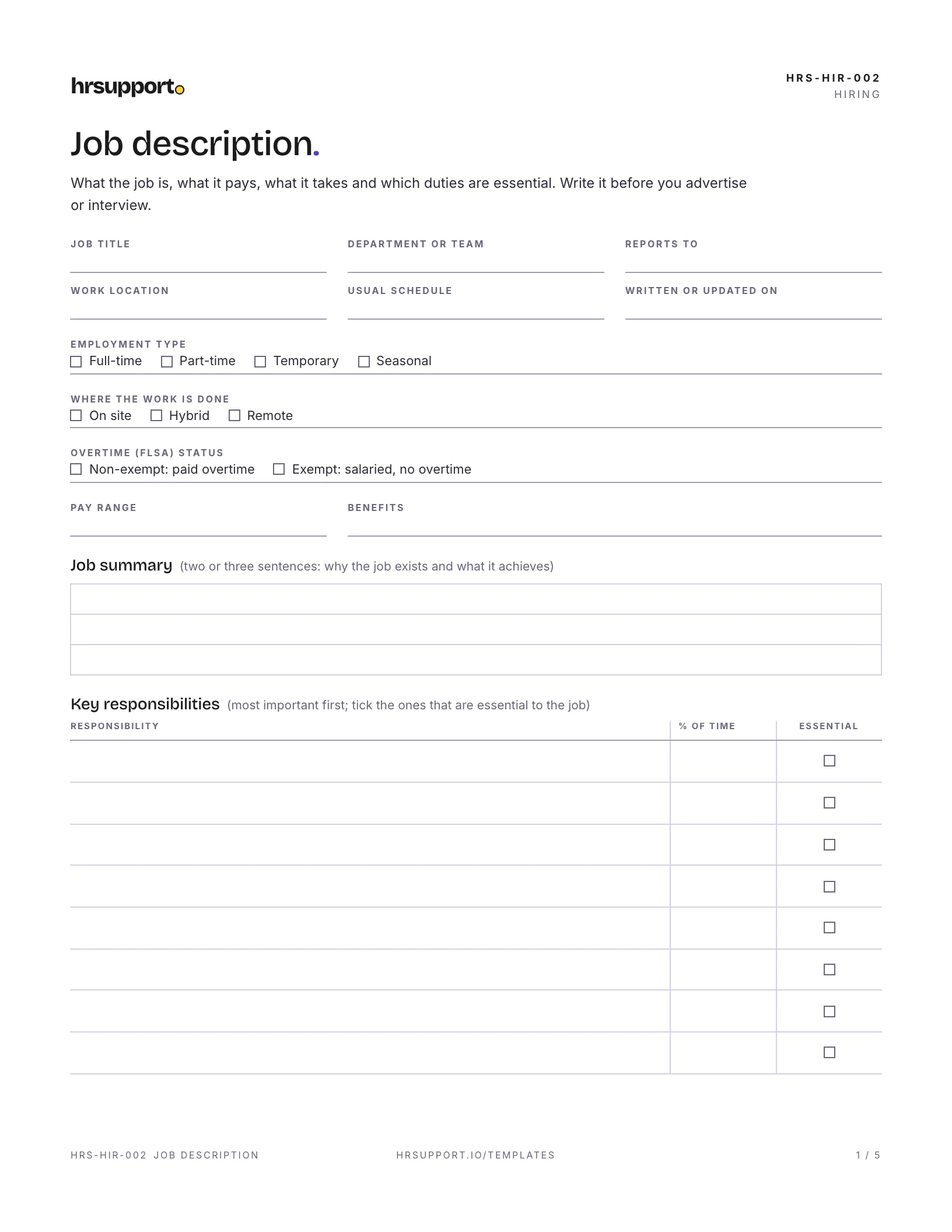 Job Description TemplateDuties, essential functions, FLSA status, pay range, qualifications and an EEO statement.FreeWordPDF
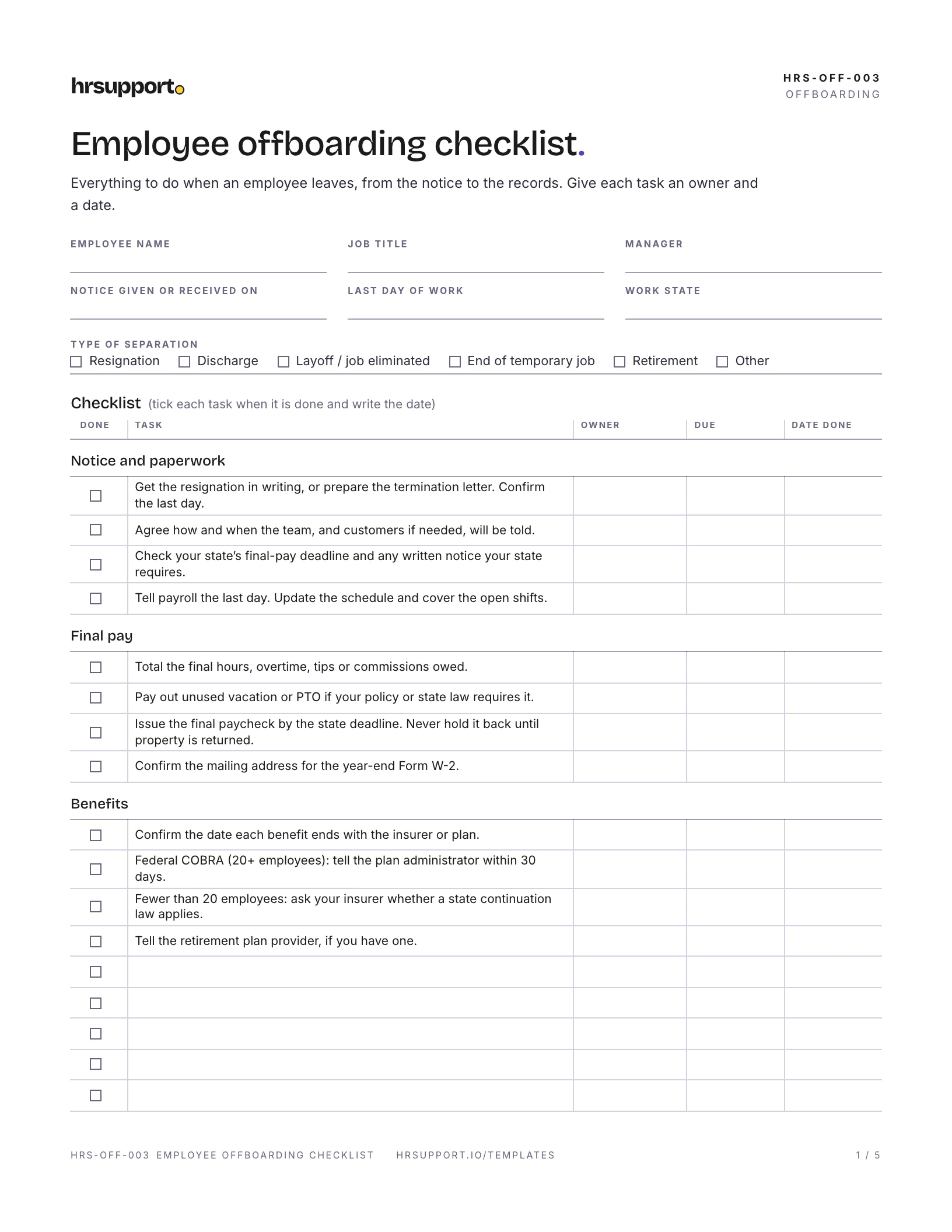 Offboarding ChecklistNotice to records, with final pay, COBRA, access removal and I-9 retention.FreeWordPDF
Join the waitlist for early access and early-access pricing. It takes ten seconds.