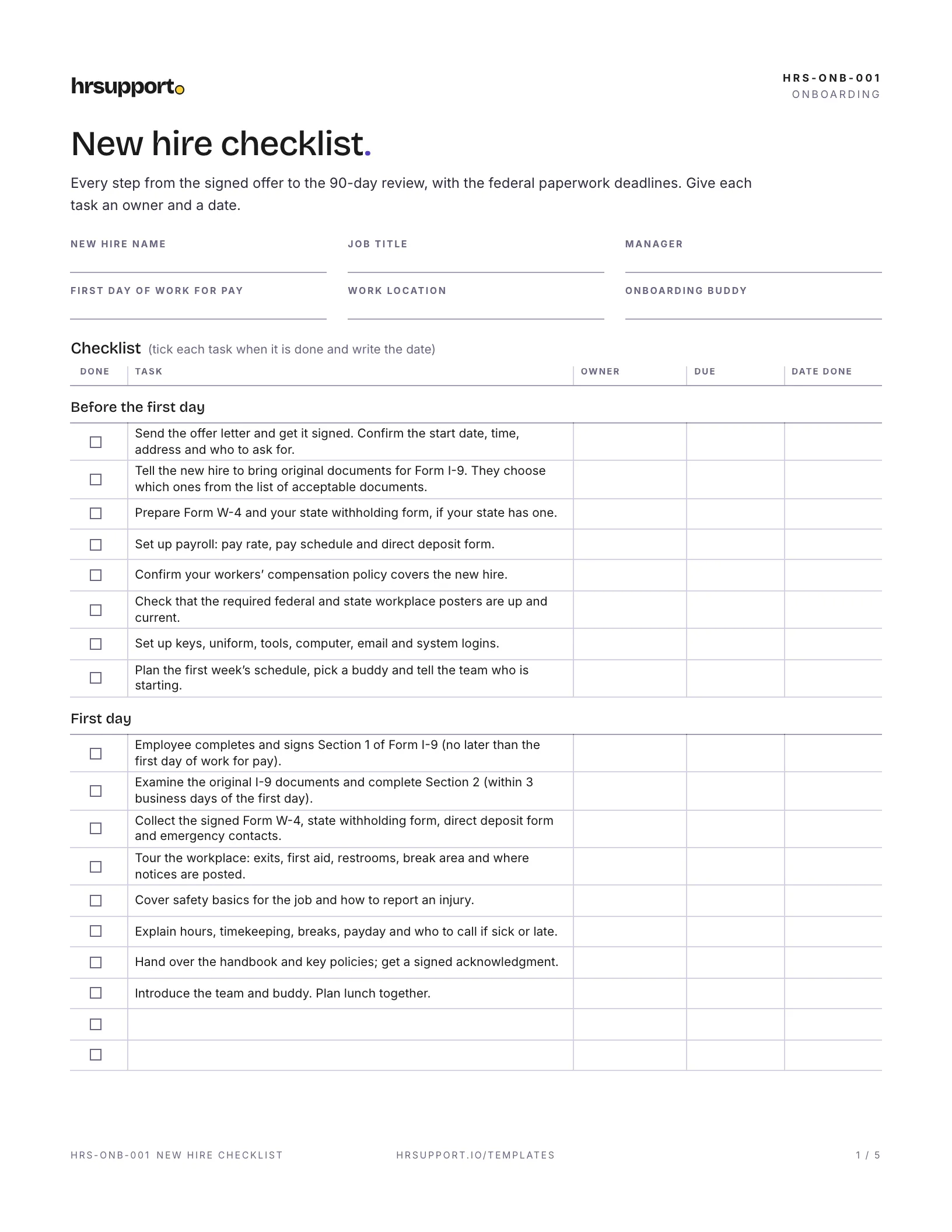
 New Hire ChecklistBefore day one to the 90-day review, with the I-9, W-4 and state reporting deadlines.Free
 Word
 PDF
Plan a new hire's first three months with them, phase by phase, with goals you can measure and check-ins at day 30, 60 and 90.
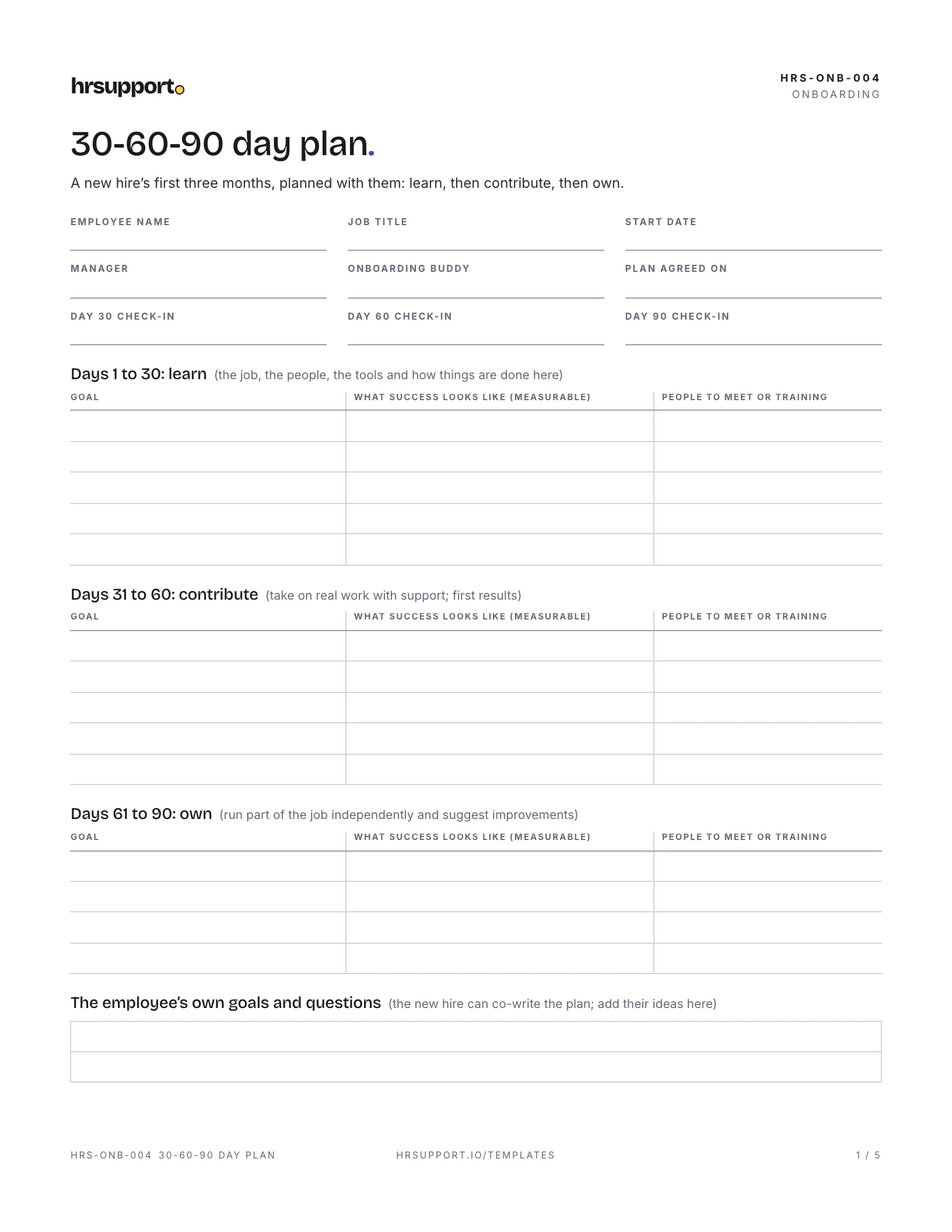
This free 30-60-90 day plan template helps a manager plan a new hire’s first three months with them. A 30 60 90 day plan splits those months into three phases: learn, contribute, own. Each phase has a few goals, a measurable result for each, the people to meet or training needed, and a check-in at the end. It’s written for US small businesses onboarding a new employee without an HR department, and the employee can co-write it.
A five-page PDF, sized for US Letter paper, and an editable Word file:
The plan works best alongside the paperwork side of onboarding. Use the new hire checklist for forms, equipment and the first day, and this plan for the work itself.
The example is for a dispatcher and customer service lead starting on a Monday at a fictional plumbing company, with the owner as manager and the office manager as onboarding buddy. In the first 30 days she learns the dispatch software, rides along with two technicians, learns the price book and calls the five biggest commercial customers. From day 31 she runs the morning dispatch alone, works on missed calls and books service plan renewals. From day 61 she owns the weekly schedule, handles complaints first and trains a backup. She adds her own goal: learning enough about heat pump installs to answer first-call questions.
The day 30 check-in is on track. At day 60 she needs support: missed calls are at 8% against a goal of under 5%, so calls now roll over to the office manager and they recheck in two weeks. By day 90 missed calls are down to 4%. The plan ends complete with one goal carried forward, and they move to one-on-ones every two weeks.
The phases stay the same; the goals change with the job:
Many people searching for a 30-60-90 day plan are writing their own, for an interview or a new job. The template works for that too. Fill in the three phases with what you’d learn, contribute and own, and keep every goal measurable. If you’re already hired, bring your draft to your manager in the first week and ask them to fill in what success looks like. Their changes tell you what the job really needs.
A 30-60-90 day plan is about goals and feedback. If your handbook also has an introductory or probationary period, keep it separate from the plan. Avoid calling anyone “permanent” after day 90, and have the policy wording checked so it doesn’t read as a promise about how long the job lasts. The template says that finishing the plan doesn’t change the terms of employment.
Training in the plan is usually paid time. For non-exempt employees, the Department of Labor counts training as work time unless it’s outside regular hours, really voluntary, not directly related to the job, and no productive work is done (DOL Fact Sheet #22, 29 CFR 785.27). Ride-alongs, courses and reading for the job almost never meet all four.
When the plan ends, keep the momentum. Carry unfinished goals forward with new dates, keep the one-on-ones going and set goals for the rest of the year. The check-in notes make the first performance review much easier to write, and nothing in it should come as a surprise.
Want help with something that came up in a new hire’s first 90 days? That’s what hrsupport.io is for: HR answers for your state, with the law behind every answer.
Ready to use it? It’s free, and comes with a filled-in example.
Template questions
A 30-60-90 day plan sets out what a new employee should learn and achieve in their first three months, in three phases. The first 30 days are for learning the job and meeting people, days 31 to 60 for contributing with support, and days 61 to 90 for owning part of the work. Each phase has a few goals, a way to measure them and a check-in at the end.
Both. The manager knows what the job needs and drafts the goals; the new hire adds their own goals and questions, and agrees what success looks like. Plans the employee helped write are easier to own. Many candidates also bring their own 30-60-90 day plan to an interview. If yours does, use it as a starting point.
Three to five per phase, each with a result you can check. Days 1 to 30: learn the tools, meet the key people and customers, shadow the work. Days 31 to 60: take on real tasks with support, such as running a process alone. Days 61 to 90: own part of the job, improve something and train someone else. "Gets up to speed" is not a goal; "books 20 calls a day with no errors" is.
No. A 30-60-90 day plan is a tool for setting goals and giving feedback. Some employers also have an introductory or probationary period in their handbook. If you do, keep the two separate, avoid calling anyone "permanent" afterwards, and have the policy wording checked so it doesn't read as a promise about how long the job lasts.
Use the same three phases, but weight the first month toward listening. A new manager should meet each team member one to one, learn the numbers that matter and understand current problems before changing anything. In days 31 to 60, they pick one or two improvements. By day 90 they run the team's routines, such as one-on-ones and the weekly schedule, on their own.
Talk about it at the check-in, not at day 90. Tick needs support, write what's behind and agree what will help, such as more training, a clearer process or more time with the buddy. Then set a date to look again. Sometimes the goal was unrealistic, so change it and note why. If problems continue after that, treat it as a performance conversation.
Free HR templates
New Hire ChecklistBefore day one to the 90-day review, with the I-9, W-4 and state reporting deadlines.FreeWordPDF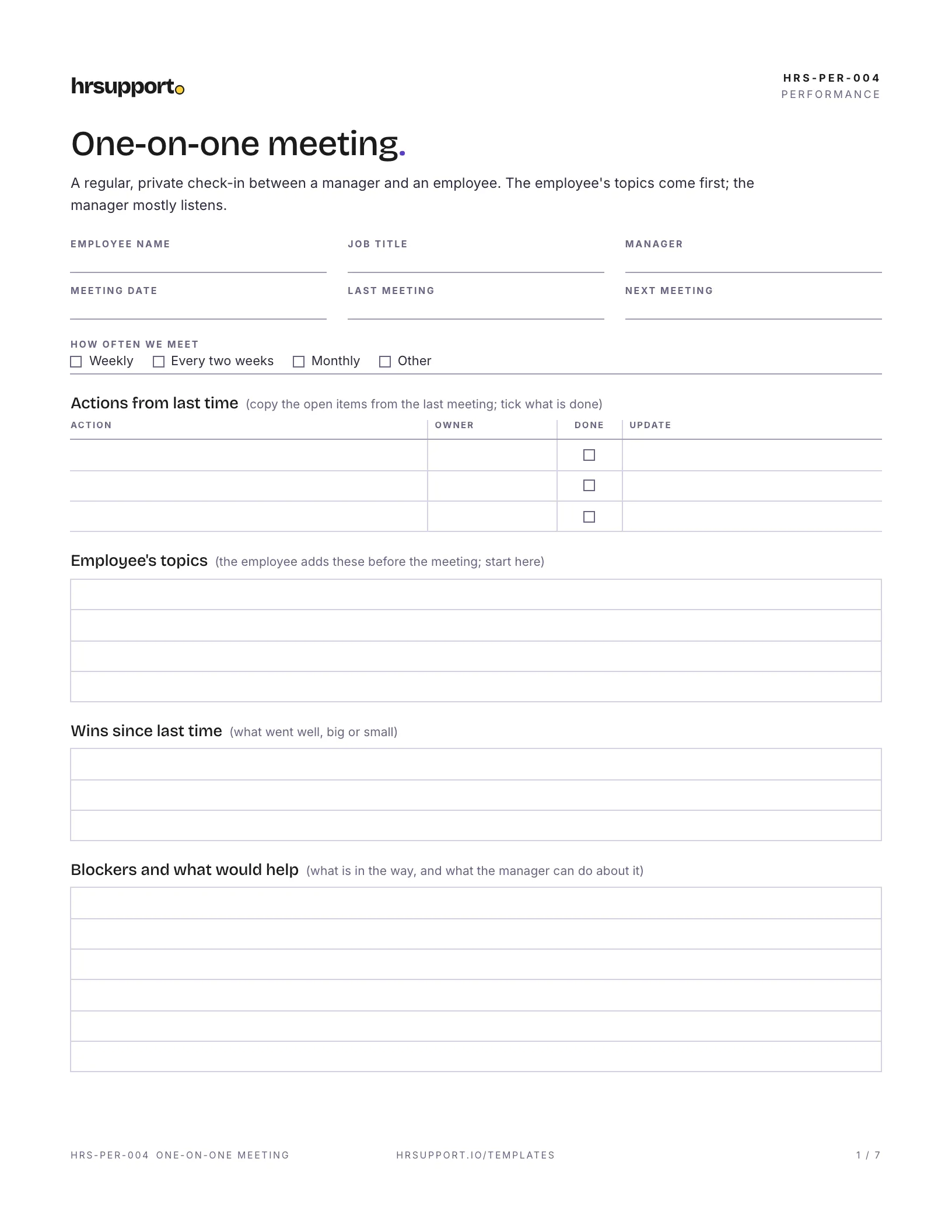 One-on-One Meeting TemplateAgenda, notes, action items and 15 questions for regular manager check-ins.FreeWordPDF
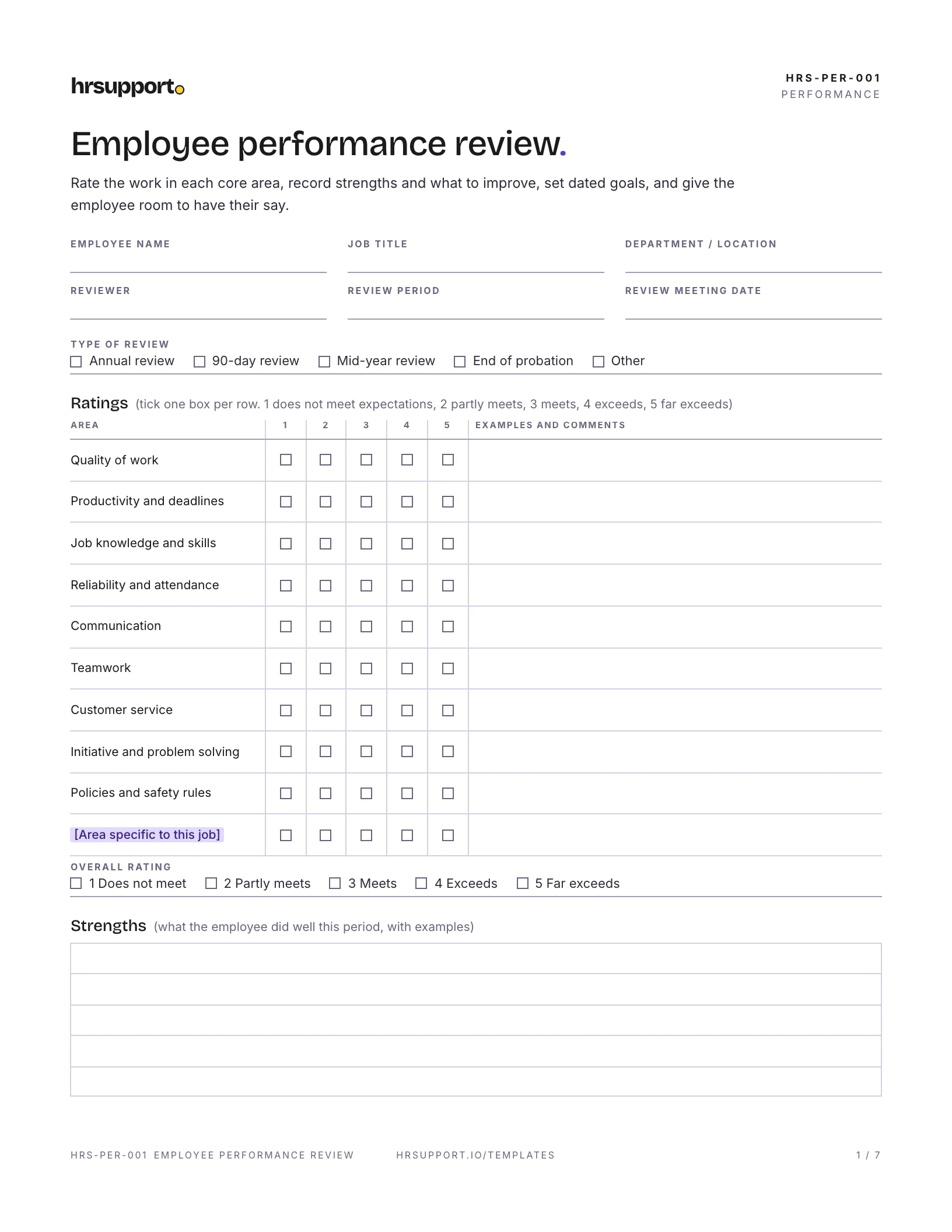 Performance Review TemplateAnnual or 90-day review with 1–5 ratings, goals, self-assessment and signatures.FreeWordPDF
Join the waitlist for early access and early-access pricing. It takes ten seconds.